

In laboratories at Auburn University, scientists have designed a new class of materials that could change both how computers calculate and how factories make chemicals. The research, published in ACS Materials Letters, describes a controllable form of electride that lets electrons move freely across a solid surface. These free electrons could serve as the foundation for faster computation and more efficient catalysis.
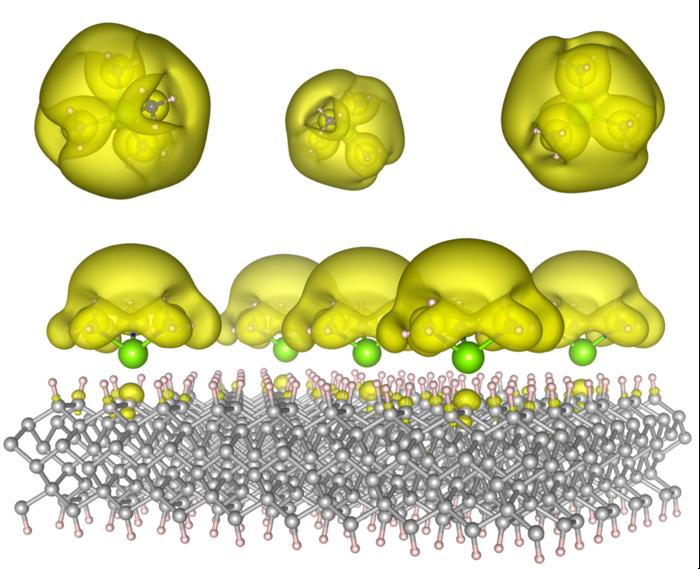
Electrides are unusual solids where electrons occupy spaces between atoms instead of being bound to them. The Auburn team created a stable version by anchoring special molecules called solvated electron precursors onto durable surfaces such as diamond and silicon carbide. The result is a structure known as a Surface Immobilized Solvated Electron Precursor Electride, or SISEPE, where electrons can be arranged like islands or extended into wide metallic seas.
Designing Free Electrons for Useful Work
In most materials, electrons are confined to orbit specific nuclei. That confinement limits how the material conducts electricity, interacts with light, or drives chemical reactions. The Auburn group set out to free the electrons and then control their movement through precision design. Using advanced computational models, they predicted how to adjust the molecules, surfaces, and electron densities to create tailored properties.
“By learning how to control these free electrons, we can design materials that do things nature never intended,” said Dr. Evangelos Miliordos, Associate Professor of Chemistry at Auburn University and senior author of the study.
Low-density arrangements of the molecules lead to localized electron clusters that could serve as quantum bits for computation. Higher-density coverage turns the surface into a metallic sheet that can transfer charge efficiently, ideal for catalysis or energy conversion. The same material platform can shift between these states depending on how it is fabricated, offering rare flexibility for both scientists and engineers.
In quantum computing, such control could provide the stability needed for processing information through electron states instead of physical transistors. In chemical industries, it could allow the design of catalysts that speed up reactions while reducing energy input. The findings merge concepts from chemistry, physics, and materials science into one integrated framework for electronic design.
Stable Platforms for the Quantum Age
Previous generations of electrides were unstable, degrading quickly when exposed to air or heat. By immobilizing solvated electron precursors on solid surfaces, the Auburn researchers demonstrated a design that is both robust and tunable. The approach transforms electrides from fragile curiosities into realistic materials that can be manufactured and integrated into future devices.
“Our work shows a new path to materials that offer both opportunities for fundamental investigations on interactions in matter as well as practical applications,” said Dr. Marcelo Kuroda, Associate Professor of Physics at Auburn University.
Coauthor Dr. Konstantin Klyukin, Assistant Professor of Materials Engineering, emphasized the broader impact of this approach. Anchoring molecular complexes to well-defined surfaces allows researchers to study how free electrons behave under different conditions. It also opens doors for innovations in redox chemistry and nanodevice fabrication. “This is fundamental science, but it has very real implications,” Klyukin noted in the university release.
The project included graduate students Andrei Evdokimov and Valentina Nesterova and was supported by the U.S. National Science Foundation. All authors are part of Auburn’s Center for Multiscale Modeling of Materials and Molecules (CM4), which links computational modeling with experimental materials research. Within CM4, teams develop new algorithms and simulations that bridge atomic behavior and macroscopic function.
The potential applications are striking. Imagine computing devices that store and manipulate data using the natural quantum properties of electrons, or catalytic systems that produce cleaner fuels by minimizing waste reactions. Each depends on mastering how electrons move, interact, and couple with matter. Auburn’s discovery provides a framework for doing exactly that.
“This is just the beginning,” Miliordos said. “By learning how to tame free electrons, we can imagine a future with faster computers, smarter machines, and new technologies we haven’t even dreamed of yet.”