

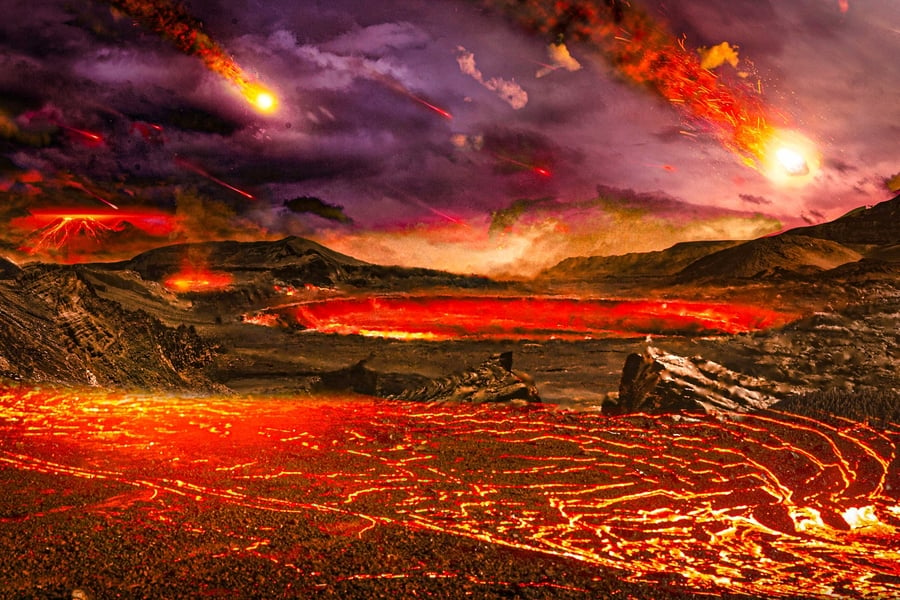
A tiny wobble in potassium is rewriting Earth’s origin story. In new work published today in Nature Geosciences, an MIT-led team reports a subtle deficit of potassium-40 in some of the planet’s oldest and deepest rocks, a chemical quirk that points to preserved fragments of the 4.5-billion-year-old proto Earth.
Why this matters: for decades, scientists assumed the Moon-forming giant impact melted and mixed Earth so thoroughly that any primordial signature vanished. The new potassium data argue that at least a few ancient mantle domains survived the chaos and still leak to the surface through modern hotspot volcanism. The finding helps pin down the starting ingredients that built our planet and, by extension, the inner solar system.
The team, led by MIT geochemist Nicole Nie with collaborators from Chengdu University of Technology, Carnegie Science, ETH Zürich, and Scripps, targeted rocks that sample deep time and deep Earth. That meant Archean basalts from Greenland and Canada, plus fresh lavas from Hawaii and La Réunion that tap mantle plumes. After dissolving powdered samples, the researchers isolated potassium and measured all three stable isotopes with thermal ionization mass spectrometry, chasing a signal so faint that even a few stray calcium atoms could ruin a run.
They found an average 40K deficit of about 65 parts per million in specific Archean mafic rocks and select modern ocean-island basalts. Most other terrestrial materials clustered near zero. Picture a bucket of yellow sand with a single brown grain missing. That missing grain, in isotope-speak, is the 40K the team expected but did not see. The pattern is inconsistent with later geological processing, crustal contamination, or analytical artifacts, the authors report. It also fails to match any known meteorite group.
“This is maybe the first direct evidence that we’ve preserved the proto Earth materials.”
To test origins, the group modeled how proto Earth with a negative 40K signature would evolve after the Moon-forming collision and later meteoritic drizzle. Late accretion alone, typically less than 0.5 percent of Earth’s mass, could not move potassium isotopes enough. But mixing roughly 9 to 12 percent impactor material during the giant impact brings the modeled mantle toward today’s average, while leaving isolated pockets with the ancient deficit intact. Those pockets, the study argues, likely reside in deep mantle structures that plume volcanism sometimes taps.
The work dovetails with earlier anomalies seen in ruthenium-100 and other mass-independent isotopes that hinted at pre-impact reservoirs, but potassium provides a crucial lithophile counterpoint. Because potassium rides with silicate rocks rather than metal, its isotopes track the accreting Earth through stages that siderophile elements like ruthenium cannot cleanly see. If potassium in proto Earth was more volatile-depleted than today’s mantle, then a sizable fraction of Earth’s present potassium inventory arrived with the impactor.
There is a broader implication. The meteorite record, rich as it is, may be incomplete with respect to the stuff that built Earth. The 40K-deficient endmember implied by these samples does not appear among cataloged meteorites. Either those parent bodies are missing from collections, or they no longer survive as free-floating rocks. For planetary scientists, that is a nudge to reexamine assumptions about how the inner solar system mixed and how volatile elements were partitioned during planet formation.
“We see a piece of the very ancient Earth, even before the giant impact.”
In practical terms, the study offers a new tracer for identifying undisturbed mantle domains and for quantifying the mass balance of the Moon-forming event. It also suggests a fresh way to think about hotspot chemistry. If some plume sources are flavored by proto Earth remnants, then their subtle isotopic quirks are time capsules from a planet that no longer exists.
Visualize it: a cut face of basalt glints under lab lights, as if flecked with midnight. Inside, potassium atoms carry the memory of a world that once bubbled with lava oceans. Most were stirred and reset by a Mars-sized blow. A few were not.
Two caveats stand out. First, the anomaly is small, so meticulous measurement and replication remain essential. Second, potassium is mobile during alteration and metamorphism; the cleanest signals will continue to come from well-preserved mafic rocks and pristine plume glasses. Even so, the convergence between ancient Archean basalts and select modern OIB strengthens the case that proto Earth never fully disappeared.
If confirmed by additional labs, potassium-40’s whisper could become a loud new constraint on giant-impact models: how violent the collision was, how thoroughly the mantle mixed, and how much of the impactor’s mass became part of us. Earth, it seems, still carries fingerprints from before it was Earth.
What The Potassium Signal Means
A negative 40K anomaly points to building blocks unlike any known meteorite group. Mixing models show late accretion is insufficient, but a giant-impact addition of about 9 to 12 percent mass can reconcile proto Earth and modern mantle. The anomaly’s survival implies long-lived deep reservoirs that avoid full mantle homogenization, consistent with plume source regions.
Where To Look Next
Targets include other Archean cratons with minimally altered mafic units, additional hotspot chains with high 3He/4He, and deep-drilled Hawaiian glasses. Cross-checks with Ru, Mo, Nd, and Zr mass-independent systems could map how many primordial domains linger and how they relate to large low-shear-velocity provinces.