

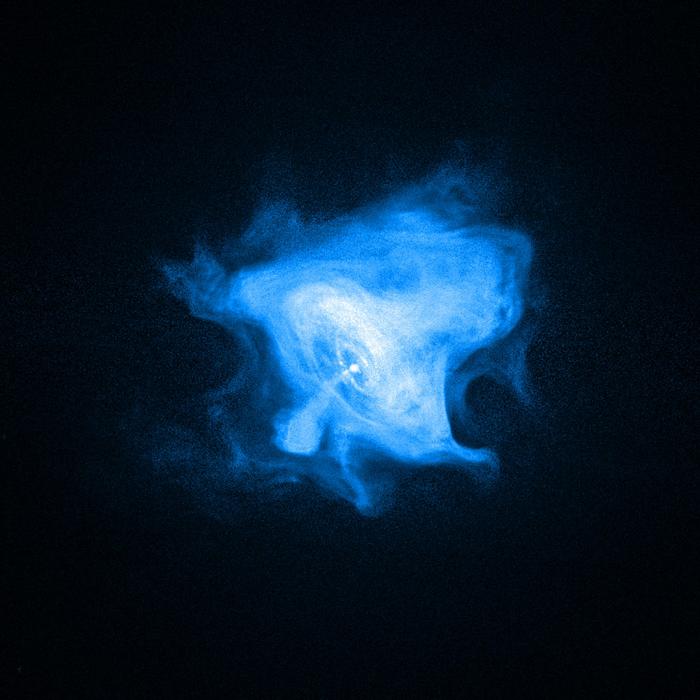
Picture a galactic metronome clicking in the dark, then faintly swelling and fading like two nearby notes on a piano. That slow rise and fall, researchers argue, may be the telltale beat of nanohertz gravitational waves tucked inside pulsars’ remarkably regular ticking. In a new analysis, Shun Yamamoto and Hideki Asada outline how to detect that modulation and, crucially, use it to tell diffuse cosmic hum from specific nearby supermassive black hole binaries.
Pulsar timing arrays act like a galaxy sized detector. Millisecond pulsars fire radio pulses with clocklike precision. Passing gravitational waves subtly stretch spacetime along the paths from pulsars to Earth, shifting pulse arrival times in correlated ways across the sky. In 2023, multiple collaborations reported strong evidence of such ultra low frequency waves, though the signal fell short of the classic 5 sigma threshold. The next question is source: a stochastic background made by many distant systems, or one or more relatively nearby binaries dominating a frequency bin?
Yamamoto and Asada explore a simple but high leverage idea from acoustics. If two gravitational wave sources have nearly the same frequency, their superposition produces a beat. That beat modulates the standard Hellings and Downs angular correlation pattern used in pulsar timing analysis. Detecting this modulation would strongly favor the binary scenario over a smooth, inflation era background.
“Beats between the two GWs can modify angular correlation patterns. The beat-induced correlation patterns are not stationary but modulated with a beat frequency $f_{beat} \equiv |f_1 – f_2|$.”
The method is intentionally spare. Treat the dominant contributors as two monochromatic waves with close frequencies and different sky positions. Compute the cross correlations of timing residuals among pulsar pairs, not over the whole observing time at once, but split into four equal time windows. The stationary pieces, which include the usual diagonal terms and any isotropic background, cancel when you compare windows. What remains is the cross term that carries the beat. From two simple ratios of those windowed correlations, the authors derive an analytic expression for the beat phase per window and thus the beat frequency itself.
A New Handle On Nanohertz Waves
The appeal is practical. You do not need to localize individual binaries first. You do not need to fit a large catalog of sources. You only need to test whether the correlation pattern breathes in time with a single slow frequency, consistent with interference between two close tones. If the amplitude ratio of the two contributors is not too lopsided, the modulation should rise above noise once correlation measurements reach roughly tens of percent precision. The authors also spell out where the trick fails: if the beat cycles many times within a window, it averages away; if the beat is much slower than the total observing span, too little of the envelope is sampled to pin down its period.
They check assumptions that could blur the tone. Frequency chirps from inspiraling binaries change the notes over time. For typical chirp masses and decade long baselines, the change is small enough that the two tone picture holds, except for the heaviest systems. Eccentric orbits also spread power into harmonics; for modest eccentricity the monochromatic approximation remains adequate. As a guardrail, they note that even with a real stochastic background present, its stationary contribution cancels in the window differencing, leaving the beat test intact.
“We obtain an analytic formula to present a proof-of-principle that $f_{beat}$ can be measured from the modulated angular correlations.”
From Math To Measurement
In practice, the highest leverage step is architectural, not exotic math. Break the observation into four quarters, compute sky angle dependent correlations in each, then take two ratios that eliminate fixed terms and isolate the beat factor. Solve a single trigonometric equation for the per window phase and hence the beat frequency. That one number answers a big question: are we hearing a smooth cosmic chorus or the overlapping notes of specific nearby black hole pairs?
It is also a narrative shift for PTA science. Instead of treating the early detections as only population level statistics, this approach teases out structure in time. If upcoming datasets reach firm detection at 5 sigma, a clean beat would quickly tilt the interpretation toward binaries. If no beat appears where expected, that absence becomes evidence for a more diffuse origin. Either way, the test is falsifiable, lightweight, and compatible with current array strategies.
I will admit a soft spot for its imagery. Two immense black holes, unseen, tapping out notes so slow that a single bar spans months, yet still shaping the rhythm of distant stellar clocks. In the data, the pattern would look like a breathing curve, a quiet swell across the sky map of correlations. Simple, and if nature cooperates, decisive.
DOIs and sources: arXiv: 10.48550/arXiv.2501.13450; Physical Review Letters: 10.1103/PhysRevLett.132.171002; Physical Review Research: 10.1103/PhysRevResearch.7.013196