

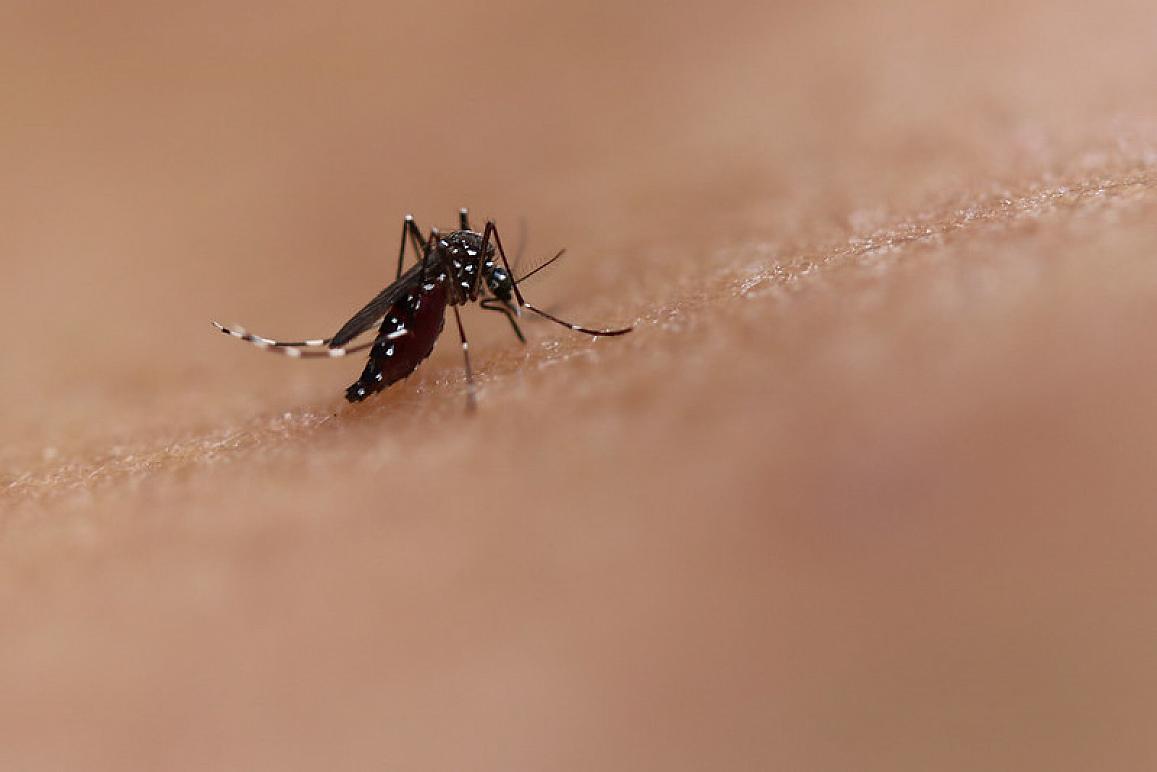
The bite you swat at in the pink light of morning may be written into the mosquito’s daily rhythm. In new experiments from Columbia University, researchers show that Aedes aegypti females become more persistent hunters at dawn and dusk, and that a neuropeptide linked to the insect circadian clock helps set this schedule. The study, published November 11 in Proceedings of the National Academy of Sciences, maps a biological timing system that could be exploited to reduce bites and disease transmission.
In a dark, camera-tracked arena, tiny pulses of carbon dioxide, the scent of human breath, rolled like invisible puffs across the mosquitoes’ enclosure. The insects snapped to attention. Using automated video and machine learning, the team measured how long that alert state lasted. They found a striking U-shaped pattern: activation was strong across daylight, yet the most persistent, predatory responses clustered at daybreak and nightfall, the very windows when people report the most bites.
“The more we can understand about how these behaviors that are so important for pathogen transmission are regulated, the more we can broaden our arsenal of tools that we can use against these mosquitoes,”
said study lead Laura Duvall, assistant professor of Biological Sciences at Columbia. Her group then asked a sharper question: is this timing hardwired by the mosquito’s own clock, or simply a reflection of when humans are outside?
How The Clock Controls The Bite
The team focused on Pigment-Dispersing Factor, or PDF, a neuropeptide that synchronizes clock neurons in many insects. Using CRISPR-Cas9 to disrupt the pdf gene, they observed that mutants lost the normal morning persistence in CO2-driven host seeking. In controlled feeding trials with heat and human odor, pdf mutants were significantly less successful at taking a blood meal in the morning, and in some cases at midday, compared with wild type. Importantly, the acute ability to sense CO2 remained largely intact; what changed was the stick-with-it drive that turns a brief whiff of breath into a committed search.
That separation matters. The work suggests at least two layers of regulation: peripheral sensory sensitivity, which lets mosquitoes detect us at almost any hour, and a central timing circuit that amplifies or dampens that drive depending on the time of day. The discovery provides one of the clearest examples yet that mosquito biting behavior is tied to internal circadian control, not just external cues like light or temperature.
“This is the first time we’ve found that there’s an internal rhythm in the mosquito’s behavior that could be driving these bites at dawn and dusk. Their internal clocks make them more persistent and predatory in their response to humans at these times of day.”
Disrupting The Mosquito’s Rhythm
When the researchers kept mosquitoes in constant darkness, the rhythm persisted for several days, confirming that it was driven by a true internal clock rather than environmental triggers. But when the pdf gene was removed, that rhythm flattened out and the insects’ feeding success fell sharply in the morning. Without their normal clock signaling, mosquitoes became less effective hunters.
At the molecular level, Duvall’s team showed that PDF loss disrupted the expression pattern of other clock genes, including period, in brain regions that control behavior. The changes were visible under the microscope: some clock neurons lost their usual connectivity, as if their internal timing network had fallen out of sync. Yet the mosquitoes could still detect CO2, supporting the idea that the sensory system and the behavioral persistence circuit are separable.
The findings open a provocative possibility: instead of targeting mosquito survival or reproduction, future vector control strategies might aim to “jet lag” them. If scientists could pharmacologically or genetically desynchronize their internal clocks, they might suppress the daily peaks of host-seeking activity, lowering the risk of human bites and disease transmission.
“We could, in theory, find ways to lock mosquitoes in a state that prevents them from effectively seeking out humans,” Duvall said. For now, the work provides a detailed map of how time-of-day biology underlies one of the world’s most persistent public health threats.
Proceedings of the National Academy of Sciences: 10.1073/pnas.2520826122