

Timekeeping at the smallest scales turns out to have a secret cost, one that rises not from quantum machinery but from the simple act of watching it tick.
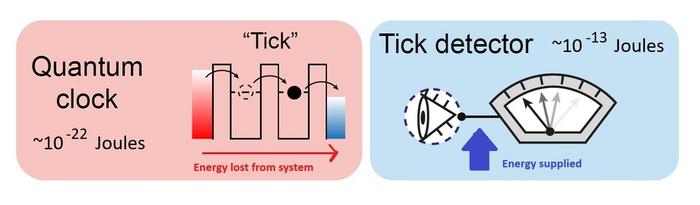
In a new study from the University of Oxford and collaborators across Europe, researchers built a microscopic quantum clock and discovered that reading its ticks consumes up to a billion times more energy than running the clockwork itself. Published in Physical Review Letters, the work reframes what limits precision in future quantum devices and reveals that measurement, not mechanics, defines the true thermodynamic cost of time.
The team constructed a quantum clock from a double quantum dot, a pair of nanoscale charge islands whose electrons hop back and forth. Each hop serves as a tick. By comparing the minuscule entropy produced by the hopping electron to the much larger entropy generated by the sensors used to detect those hops, the researchers show that the transition from quantum signal to classical information is the dominant, and perhaps unavoidable, price of keeping time at the quantum scale.
Measuring Quantum Ticks Creates the Cost
In their experiment, researchers used two sensing methods to read the clock. One measured tiny changes in electric current. The other used radio frequency reflectometry to detect shifts in how an incoming signal bounced off the device. Both approaches revealed the same principle. Converting an electron jump into a classical record requires orders of magnitude more energy than the jump itself. The observation drives the arrow of time, even when the underlying quantum process is nearly reversible.
“Quantum clocks running at the smallest scales were expected to lower the energy cost of timekeeping, but our new experiment reveals a surprising twist. Instead, in quantum clocks the quantum ticks far exceed that of the clockwork itself.”
A Surprising Thermodynamic Asymmetry
The experiment also showed that the measurement energy is not simply waste. It produces a richer record of the clock’s behavior than the bare electron transfers alone. When researchers used the full history of detected transitions to estimate time rather than counting only forward ticks, the clock’s precision improved by an order of magnitude. Precision, in other words, comes from information, and information comes from energy spent turning quantum motion into classical data.
“Our results suggest that the entropy produced by the amplification and measurement of a clock’s ticks, which has often been ignored in the literature, is the most important and fundamental thermodynamic cost of timekeeping at the quantum scale. The next step is to understand the principles governing efficiency in nanoscale devices so that we can design autonomous devices that compute and keep time far more efficiently, as nature does.”
The implications reach beyond nanoscopic clocks. Modern quantum sensors, navigation systems, and processors all require precise timing. If measurement rather than mechanism sets the energetic floor, then future designs may need to optimize the readout step rather than the quantum components themselves. The work also adds weight to the idea that irreversibility in physics arises from the act of observation. When a detector records a tick, it leaves an indelible trace that distinguishes past from future, even if the quantum system underneath tries to run time backward.