

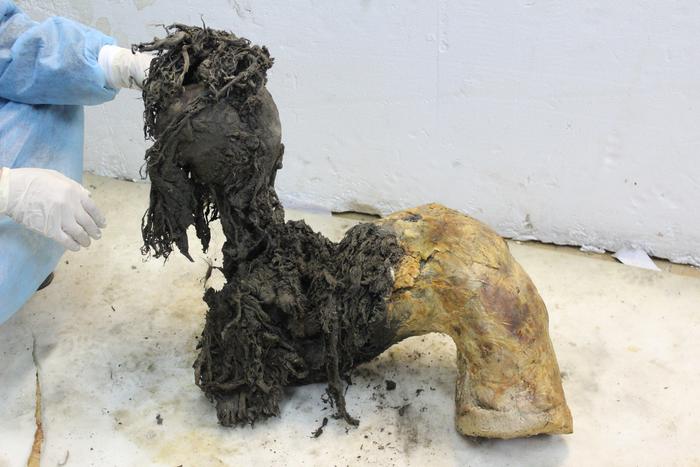
A 39,000 year old mammoth just whispered its final cellular secrets through strands of frozen RNA.
In a new study from Stockholm University and collaborators, researchers isolated and sequenced RNA from woolly mammoth tissues preserved in Siberian permafrost and showed that the molecules remained readable after tens of thousands of years. Published in Cell, the work delivers the oldest RNA sequences ever recovered and opens an entirely new window into the biology of extinct species.
For decades, ancient DNA has transformed paleogenomics by revealing evolutionary relationships and reconstructing genomes. But DNA has always been a static record, a blueprint that says little about which genes were active in specific tissues at the end of an animal’s life. RNA, in contrast, captures gene expression in motion. The long standing assumption that RNA is too fragile to survive beyond hours or days after death kept most researchers away from it, especially in Ice Age megafauna.
The team challenged that assumption by turning to a remarkably preserved juvenile mammoth known as Yuka, recovered from the coastal permafrost of northeastern Siberia. Yuka’s tissues, including skeletal muscle, had already yielded high quality ancient DNA in previous work. In the new study, scientists extracted both ancient DNA and ancient RNA from multiple mammoths, then pushed their sequencing and bioinformatics tools to detect tiny, damaged fragments of RNA still embedded in the frozen tissue.
They found that Yuka’s muscle sample was a standout. Among tens of thousands of reads, the researchers recovered transcriptional profiles that were clearly tissue specific. Genes involved in muscle contraction, calcium handling, mitochondrial energy production, and stress responses surfaced as some of the most abundant transcripts. Regulatory microRNAs that modern biologists know as hallmarks of muscle biology also appeared, suggesting that the molecular wiring of mammoth skeletal muscle resembled that of living mammals in key ways.
Just as important as the gene lists was the ability to show that these sequences truly came from mammoth cells and not from modern contamination. The group used damage patterns typical of ancient nucleic acids, mammoth specific genetic variants, and careful mapping against elephant and mammoth reference genomes to authenticate the RNA. They even detected rare mutations in microRNAs that act as a genetic fingerprint of mammoth origin, and proposed previously unknown microRNA loci based entirely on these ancient expression signals.
RNA Brings Mammoth Cells Back Into Focus
With authentic RNA in hand, the researchers could do something that ancient DNA alone cannot achieve. They could see which mammoth genes were switched on in a specific tissue shortly before death. That allowed them to infer that Yuka’s muscle sample was enriched in slow twitch fibers, based on the abundance of particular myosin, troponin, and tropomyosin transcripts. The findings also highlight subtle stress signals in the tissue, echoing earlier work suggesting that Yuka may have been attacked by predators shortly before dying.
“With RNA, we can obtain direct evidence of which genes are ‘turned on’, offering a glimpse into the final moments of life of a mammoth that walked the Earth during the last Ice Age. This is information that cannot be obtained from DNA alone.”
The study goes further, outlining a practical roadmap for future ancient RNA work. The authors compare different alignment tools, define minimum fragment lengths that balance sensitivity and false positives, and propose standards for distinguishing RNA derived reads from residual DNA contamination. They also examine how RNA damage accumulates with age and show that mammoths of different ages display predictable shifts in fragment length and mapping patterns, mirroring what has been seen in ancient DNA studies.
In one striking twist, the combined RNA and DNA evidence reveals that Yuka, long described as a female based on external anatomy, in fact carried an XY chromosome complement. That mismatch between physical description and genetic sex hints at either earlier misclassification or more complex developmental biology, and illustrates how molecular data can still revise basic facts about iconic museum specimens.
Ancient Transcriptomes And The Future Of Ice Age Biology
The implications of rescuing RNA from Ice Age carcasses extend beyond mammoths. If messenger RNAs and microRNAs can persist in permafrost preserved tissues for nearly 40,000 years, then other biomolecules that ride along with RNA might also be recoverable. That includes RNA viruses, as well as subtle regulatory signals that never leave a trace in the genome sequence itself. The authors argue that ancient RNA will complement ancient DNA and proteins, filling in missing layers of functional information about extinct animals and their environments.
“Our results demonstrate that RNA molecules can survive much longer than previously thought. This means that we will not only be able to study which genes are ‘turned on’ in different extinct animals, but it will also be possible to sequence RNA viruses, such as influenza and coronaviruses, preserved in Ice Age remains.”
Looking ahead, the team envisions integrated paleo studies that combine genomics, transcriptomics, proteomics, and three dimensional chromatin reconstructions from the same specimens. They also note that their protocols are not yet optimized and that improvements in tissue processing, end repair chemistry, and library preparation could reveal even richer RNA archives in both soft and hard tissues. For now, Yuka’s frozen muscle has delivered a proof of principle that RNA can bridge the gap between static genomes and living physiology, allowing scientists to read fragments of cellular activity from animals that vanished millennia ago.