

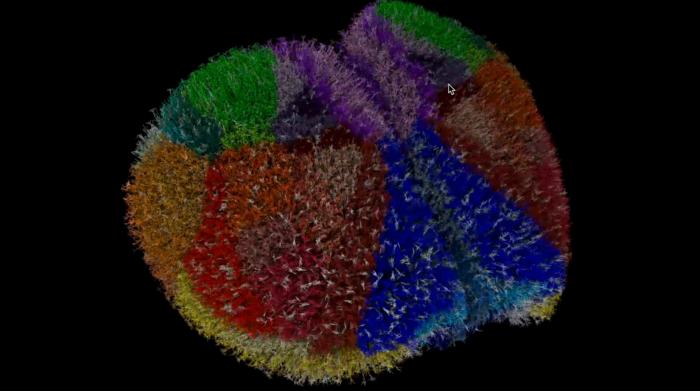
Powered by a supercomputer that can perform quadrillions of calculations each second, scientists have built one of the most detailed virtual brains ever created.
In a meeting announcement from the Allen Institute presented at SC25, researchers describe a biophysically realistic simulation of the entire mouse cortex built using Japan’s Fugaku supercomputer along with data from the Allen Cell Types Database and Allen Connectivity Atlas. The international team, led by scientists at the Allen Institute and the University of Electro-Communications, constructed a model with almost ten million neurons and twenty six billion synapses that captures the structure and electrical behavior of eighty six interconnected brain regions.
They call it a tool for virtual experimentation, a way to ask biological questions inside a living model that exists only in silicon. Instead of probing thin slices of tissue one experiment at a time, researchers can now watch waves of activity spread across the cortex, test how seizures evolve, or simulate Alzheimer related damage as it ripples from one circuit to another. What emerges is a shift in how neuroscience can be done at scale and at speed, without waiting for each new in vivo experiment to run its course.
The Scale of Simulation
The heart of this achievement is Fugaku, a national supercomputing flagship designed by RIKEN and Fujitsu. It is built from 158,976 interconnected nodes arranged in units, shelves, and racks that together manage hundreds of quadrillions of operations per second. That infrastructure is what allowed the team to transform massive biological datasets into a working cortex using the Allen Institute’s Brain Modeling ToolKit and a new neuron simulator called Neulite. The result is not an animation but a functioning digital cortex that sparks, quiets, and reorganizes itself much like a biological one.
“Fugaku is used for research in a wide range of computational science fields, such as astronomy, meteorology, and drug discovery, contributing to the resolution of many societal problems,” said Yamazaki. “On this occasion, we utilized Fugaku for a neural circuit simulation.”
That simulation includes structural features down to the branching of dendrites and electrical details such as ion flows and membrane voltage fluctuations across compartments. Researchers describe watching spontaneous cortical activity unfold in a resting state as if looking directly into the living brain. With this level of detail, even minor perturbations, like a small shift in synaptic strength, can ripple across networks and hint at how disorders begin long before symptoms surface.
A New Way to Ask Biological Questions
The model represents both a technical milestone and a research platform. It allows teams to test hypotheses that previously required invasive recordings or genetically engineered animal lines. It also offers the possibility of rehearsing therapeutic strategies, tweaking circuit properties to see whether an intervention could stabilize runaway activity or restore balanced communication between regions.
“This shows the door is open. We can run these kinds of brain simulations effectively with enough computing power,” said Anton Arkhipov. “It is a technical milestone giving us confidence that much larger models are not only possible, but achievable with precision and scale.”
The team views this as an early but decisive step toward full brain simulations and ultimately human scale models. That ambition will require even more data, more refined biophysical measurements, and next generation supercomputers. Yet the principle is now demonstrated. Realistic whole brain modeling is no longer theoretical. It is running on a machine in Japan, neuron by neuron and synapse by synapse, building a digital cortex that behaves like the real thing and opening a new chapter in how we explore the mind.
