

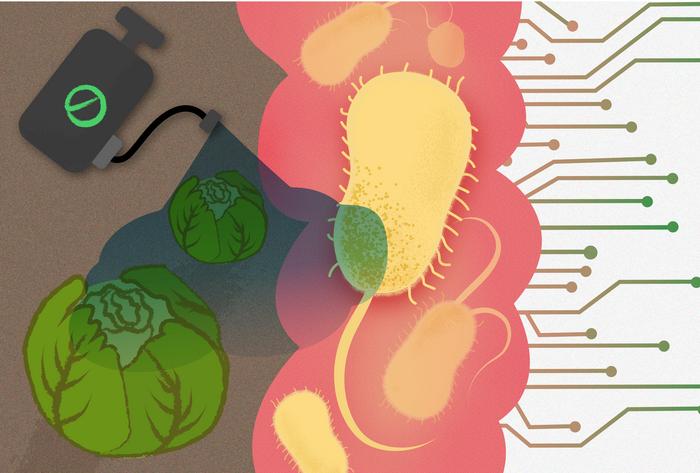
You don’t expect a pesticide or a flame retardant to bother the bacteria that line the human gut, but that is exactly what a large new screen suggests. Researchers at the University of Cambridge tested 1,076 industrial and agricultural chemicals against twenty two common gut species and found that 168 of them slowed or stopped bacterial growth. The work, published in Nature Microbiology, lands with a thud because most of these chemicals were never supposed to interact with bacteria at all.
It is not a neat story. Fungicides showed up where no one expected them. Plastics additives did, too. Some industrial chemicals, designed with supposedly inert profiles, turned out to block the growth of multiple gut species. The researchers ran the same assays across three independent days to make sure they weren’t seeing noise or plate effects. The patterns kept reappearing.
“We’ve found that many chemicals designed to act only on one type of target, say insects or fungi, also affect gut bacteria. We were surprised that some of these chemicals had such strong effects. For example, many industrial chemicals like flame retardants and plasticisers that we are regularly in contact with weren’t thought to affect living organisms at all, but they do.”
Some of the results are easy to grasp, others less so. Closantel, a livestock antiparasitic, knocked down nineteen of the twenty two species. A flame retardant, TBBPA, hit nineteen as well. A plastic component called bisphenol AF took out twelve. And the pattern didn’t fall along clean lines. The Bacteroidales group, which is abundant in many healthy guts, was especially sensitive. Escherichia coli barely flinched. Akkermansia held its ground.
A synthetic twenty member gut community gave the team a different angle. In that setting, some vulnerable species were rescued by their neighbors. Others collapsed even more quickly. A couple species, oddly enough, only became resistant when surrounded by the rest of the community, almost as if the group was soaking up the chemical before it reached them. None of this looked like a single rule or a tidy gradient of toxicity. It looked like biology reacting to stress with whatever tools it had.
The genetic screens made the picture even more uneven. In Parabacteroides merdae, several pollutants selected for mutants in a regulator called acrR, which normally controls an efflux pump. Those mutants tolerated closantel and TBBPA far better than the wild type strain. They also became resistant to the antibiotic ciprofloxacin. That little twist, the antibiotic angle, is the piece that gives the study a sting. Resistance that arises from non medical pollutants is not usually in the frame for safety assessments, but here it was, sitting in the data.
“Safety assessments of new chemicals for human use must ensure they are also safe for our gut bacteria, which could be exposed to the chemicals through our food and water.”
Some of the mutations that flourished under chemical pressure were even stranger. Loss of enzymes involved in branched short chain fatty acid pathways helped cells survive TBBPA. Those same pathways contribute molecules that are thought to modulate immune function. So a pollutant that selects for a mutation might not just change which bacteria survive, but what chemical signals they can still make once they do.
The machine learning model, which probably would not have worked without this much data, tried to tackle the prediction problem. The researchers gave it structural fingerprints of each chemical and asked it to classify toxicity for specific species. It worked better than expected for pesticides, less well when mixing pesticides and pharmaceutical drugs together. The tool got stronger when the team added features from a deep learning model trained on more than a billion molecules. That fact alone hints at how wide the chemical landscape is, and how little of it belongs to any one category.
None of this answers the question people actually care about, which is whether typical human exposures reach the concentrations tested in the lab. Some do, based on blood and urine measurements cited in the paper. Many probably do not. A lot of exposures come in short bursts or complicated mixtures that the screen cannot mimic. The authors don’t try to smooth over any of that. They just note that real world concentrations are poorly measured, especially in the gut, and that collecting exposure data alongside microbiome data would help.
The paper leaves you with a feeling that the microbiome is absorbing hits from directions no one has been watching. It also feels like an early map, not a final one, and a reminder that chemical categories tend to hide more than they reveal. The next steps sound simple enough, like washing produce or limiting home pesticide use, but the broader questions will need better monitoring and a clearer idea of what a “safe” chemical looks like for microbes that never see the outside world.
Journal: Nature Microbiology
DOI: 10.1038/s41564-025-02182-6