

Astronomers expected the James Webb Space Telescope to find small, simple galaxies at the edge of observable time. What they got instead were “Blue Monsters” shining far too bright and “Little Red Dots” that refuse easy classification. The early universe, it turns out, was not cooperating with predictions.
A team led by Cosmin Ilie at Colgate University now argues these anomalies might share a common origin: they could be dark stars, hypothetical behemoths fueled not by nuclear fusion but by the annihilation of dark matter particles. The proposal, published in the journal Universe, suggests that dark stars could resolve three distinct puzzles from the cosmic dawn simultaneously.
Enormous, Cool, and Hungry
Picture a celestial object so vast its radius spans ten times the distance from Earth to the Sun. Its surface would not glow with the blinding white of a standard massive star but would instead appear as a deep, simmering crimson or soft, hazy violet, shrouded in hydrogen gas. While ordinary stars race frantically against their own gravity, burning through fuel, these dark stars would sit quietly at the centers of dark matter halos, growing fat on invisible particles.
The physics works differently than in conventional stellar models. Normal massive stars heat up and blow away the surrounding gas that feeds them, limiting their growth. Dark stars remain relatively cool because their energy comes from dark matter annihilation rather than nuclear fusion. This lets them vacuum up nearly all the gas in their vicinity, ballooning to millions of solar masses.
The Blue Monsters that JWST keeps finding are extremely luminous, ultra-compact, and nearly dust-free. Before launch, no simulations predicted such objects should exist so early in cosmic history. Ilie’s team argues these might be single supermassive dark stars rather than clusters of billions of ordinary stars. The Little Red Dots, meanwhile, appear to be active black holes surrounded by dense gas envelopes. Exactly what you would expect if a supermassive dark star finally collapsed under its own weight.
What’s striking is how the spectroscopic evidence is starting to line up. The researchers found helium absorption features in the light signatures of objects called JADES-GS-z13-0 and JADES-GS-z14-0, patterns predicted by dark star models but difficult to explain otherwise. Whether this constitutes a smoking gun remains debated, but the alignment is hard to dismiss.
The Black Hole Problem Gets a Solution
Beyond the visual puzzles, dark stars offer something cosmologists have been desperate for: a mechanism to explain overmassive black holes. Scientists have struggled to account for how black holes weighing ten million suns could exist only a few hundred million years after the Big Bang. Standard models require black holes to grow from stellar remnants, a process far too slow to produce what JWST is observing.
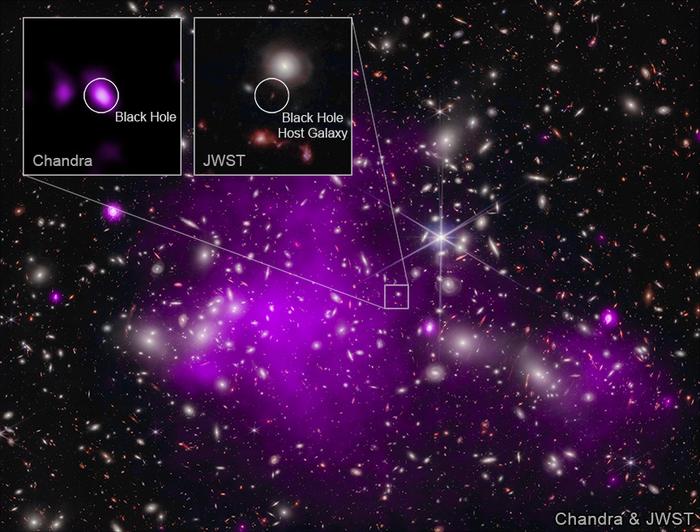
Because dark stars can grow so large before they die, their collapse provides a heavy seed. Instead of starting from a black hole a few dozen times the Sun’s mass and slowly accumulating material over billions of years, these early black holes would begin massive. A galaxy like UHZ1, observed when the universe was just three percent of its current age, harbors a black hole that had almost no time to grow conventionally. Dark star collapse offers a pathway that actually fits the timeline.
“Some of the most significant mysteries posed by the JWST’s cosmic dawn data are in fact features of the dark star theory,” Cosmin Ilie explains.
If dark stars are ultimately confirmed, the implications extend well beyond explaining weird JWST images. Because their energy source depends on the nature of dark matter itself, studying them could help constrain the properties of particles that make up most of the universe’s mass. For decades, physicists have tried to detect dark matter directly without success. Dark stars might offer an indirect approach, one visible across billions of light-years.
None of this is proven yet, for now at least. But the cosmic dawn is proving stranger than anyone anticipated, and dark stars fit the strangeness remarkably well.