

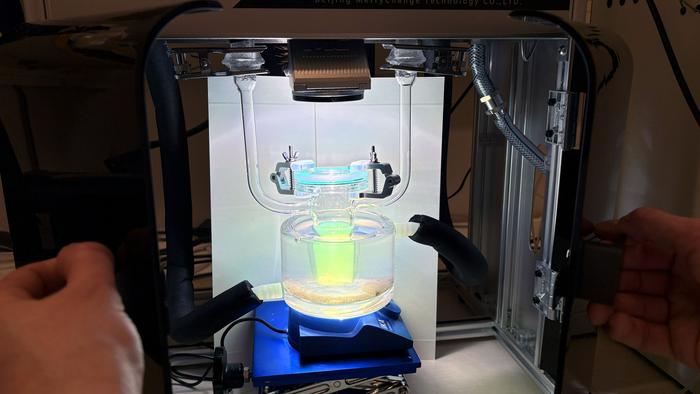
In a chemistry lab at Chalmers University of Technology in Sweden, a beaker of water sits under a lamp. Within seconds, tiny bubbles start rising to the surface. It looks unremarkable, like someone poured a glass of sparkling water. But those bubbles are high-purity hydrogen gas, produced without the precious metal that solar hydrogen systems have depended on for decades.
The researchers have eliminated platinum from the equation entirely. Instead of the rare metal, they use nanoparticles made from electrically conductive plastic, and the results are unexpectedly competitive. In tests published in Advanced Materials, the organic catalyst produced hydrogen at 209 millimoles per gram per hour. One gram of the material generated roughly 30 liters of hydrogen in a single hour under simulated sunlight.
Platinum has been the persistent bottleneck for solar hydrogen. Global supplies are limited, mining carries environmental and health risks, and production is concentrated in just a handful of countries, which raises uncomfortable questions about energy independence. Removing it from photocatalysis has been a goal for years, but performance typically collapsed when the metal was taken away.
Teaching Plastic to Love Water
The Chalmers team, led by Professor Ergang Wang, tackled the problem by redesigning the catalyst at the molecular level. They used conjugated polymers, plastics that absorb light and conduct electrical charge, built around a structural unit called BTSO. The challenge was that these materials naturally repel water, which limits their ability to drive the chemical reactions needed to split water molecules.
By adding polar side chains to the polymer backbone, the researchers made the material hydrophilic. The resulting nanoparticles have a loosely packed, open structure that acts something like a sponge. Water molecules and protons can penetrate deep into the particle and reach the active sites where hydrogen is actually produced.
“Developing efficient photocatalysts without platinum has been a long-standing dream in this field. By applying advanced materials design to our conducting-plastic particles, we can produce hydrogen efficiently and sustainably without platinum, at radically lower cost,” Alexandre Holmes, a postdoctoral researcher at Chalmers and joint first author of the study, explains.
When light hits these particles, it excites electrons that then drive the splitting of water molecules. The reaction starts almost immediately. Bubbles of hydrogen rise visibly through the water, a straightforward sign that photocatalysis is working.
What Comes After the Proof of Concept
The current system still relies on vitamin C as a helper chemical. It donates electrons and prevents the reaction from stalling, functioning as a temporary crutch that lets researchers demonstrate the catalyst’s efficiency without other variables interfering. The long-term goal is more ambitious.
The team wants to achieve what’s called overall water splitting: producing both hydrogen and oxygen using only sunlight and water, no additives required. That would represent true sustainability for solar hydrogen. Ergang Wang has said removing platinum was the most difficult hurdle, and the group is already exploring strategies to make the system fully self-sustaining.
Related work from Chalmers suggests the conductive plastic itself can be manufactured without harmful chemicals and at considerably lower cost than platinum-based alternatives. Whether that holds up at industrial scale remains an open question.
The study reframes a familiar problem in energy research. Rather than hunting for new rare materials, it demonstrates how careful molecular design can coax unexpected performance from common ones. If hydrogen plays the role in future energy systems that advocates predict, part of that progress may trace back to a humble, highly engineered piece of plastic sitting in a beaker of water.