

If you’ve ever closed the blinds against afternoon glare and then sat in the dimness wondering why you bothered, you understand the basic problem with windows. They let in light you want and light you don’t, heat that’s welcome in January and unbearable in July, and ultraviolet radiation that slowly destroys your furniture whether you notice or not. For most of us, managing windows means managing trade-offs.
A team of materials scientists in South Korea thinks they’ve found a way out. They have developed a transparent wood that shifts from frosted to clear as it warms, blocks nearly all UV radiation even when transparent, and insulates almost five times better than glass. No electricity. No sensors. No apps. The material just responds to temperature on its own, like a plant turning toward the sun.
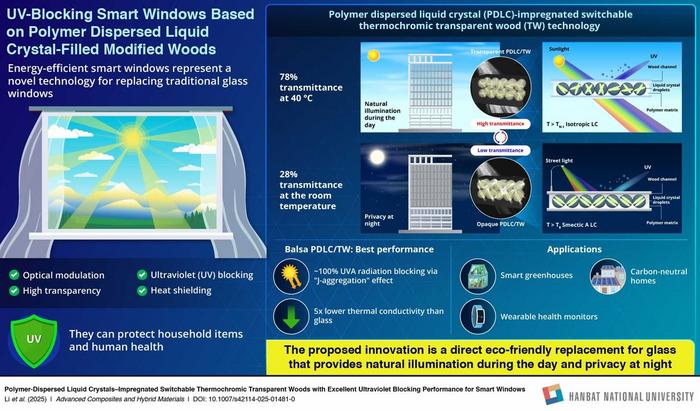
The work, published in Advanced Composites and Hybrid Materials, came from researchers at Hanbat National University and Kongju National University. They started with balsa wood, stripped out the lignin that gives wood its color and stiffness, and filled the remaining cellulose scaffold with liquid crystals suspended in polymer. At room temperature, the crystals scatter light and the window stays cloudy. Warm it past about 40 degrees Celsius, and the molecules line up, letting light pass through. The window clears.
What Happens When Your Window Does the Work
The practical appeal is obvious. Privacy at night without curtains. Daylight during warm hours without the usual penalty of heat gain. In laboratory tests, the material went from 28 percent light transmission to 78 percent as it warmed, then back again as it cooled. The switching happened reliably, cycle after cycle.
But here’s the part worth noticing. Even fully transparent, the wood blocked almost all UVA radiation — the kind that ages skin and fades fabrics over years of quiet exposure. Most of us don’t think much about UV coming through windows, but dermatologists do. Glass blocks UVB, the burning rays, but lets UVA pass freely. If you’ve ever noticed that the left side of your face has more sun damage than the right, your car window is probably why. This material stops both.
The insulation is substantial too. “With a thermal conductivity of 0.197 W m-1 K-1, our novel bio-composite is nearly five times more insulating than conventional glass, significantly slowing heat loss or gain in buildings,” explains Jin Kim, an assistant professor of materials science involved in the research. In model house experiments, structures with the transparent wood warmed and cooled more gradually than those with glass. That kind of thermal buffering could matter for heating and cooling bills, though nobody has tested it in a real building yet.
Not There Yet
Before you call your contractor, some caveats. The material switches to its clear state only when warm, which works well in hot climates but raises questions about cold ones. What happens in Minnesota in February, when you want every bit of daylight you can get but the window stays stubbornly frosted? The researchers say future versions could be tuned for different transition temperatures, but that work hasn’t been done yet.
Balsa wood is light and workable, but it’s not what builders typically reach for. And while laboratory tests showed the material held up under a week of continuous UV exposure, a week is not a decade. Windows need to last.
The researchers also tested thin sheets as wearable fever indicators — a patch that turns transparent when skin temperature exceeds 38 degrees Celsius. Clever, though it’s a long way from a prototype patch to something a nurse would trust.
Still, the core idea has real charm. Traditional smart windows require wiring, software, maintenance. They solve one problem by adding others. This approach uses wood and physics and nothing else. For anyone who has ever wished their house would just figure out what to do with the sun — let it in when welcome, keep it out when not, and stop the slow fade of everything near the glass — that simplicity is the whole point.
Advanced Composites and Hybrid Materials: 10.1007/s42114-025-01481-0