

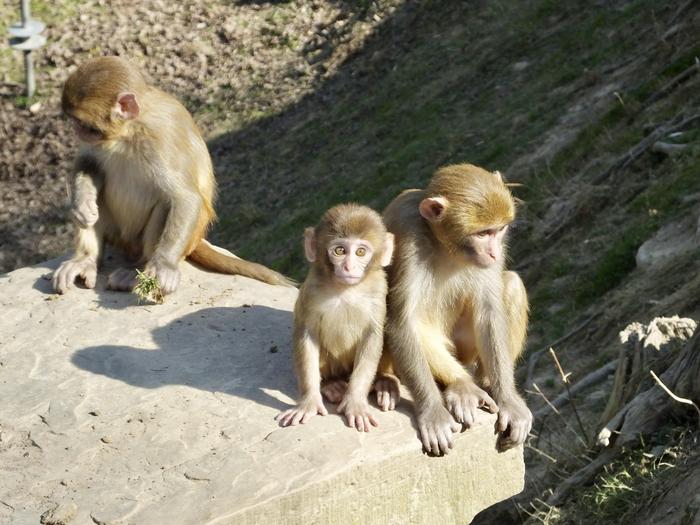
The rhesus macaque does not share. Its society runs on steep hierarchies, ritual submission, and the constant threat of aggression from those above. The Tonkean macaque, a lesser-known cousin from Sulawesi, plays differently: loose coalitions, frequent reconciliation after conflict, affiliative bonds that cross kin lines. Primatologists have long catalogued this contrast in behaviour. What Sarah Silvère and her colleagues at the University of Strasbourg wanted to know was whether you could see it in the brain.
The answer, published this week in eLife, is yes. But not in the way anyone expected.
The team assembled 42 post-mortem MRI scans from 12 macaque species, spanning the full range of what primatologists call social tolerance grades. Grade 1 covers the rigid, despotic societies of rhesus and long-tailed macaques. Grade 4 covers the loose, cooperative societies of Tonkean and crested black macaques. The researchers measured the volumes of two subcortical brain regions — the amygdala and hippocampus — and tested how well they predicted where a species landed on that social spectrum. The amygdala won. Convincingly. High-tolerance species had substantially larger amygdalae than their intolerant counterparts, a finding that held up across a Bayesian model accounting for age, sex, and overall brain size.
This was not what intuition suggested.
The amygdala carries a reputation as the brain’s threat-detector, the region implicated in fear responses, stress reactivity, and, in macaques in particular, aggressive behaviour. Ablation studies have shown that damaging it changes how animals respond to social cues, and the assumption has generally been that species with more fighting would have more amygdala. “Larger amygdala in socially tolerant species may reflect an enhanced capacity to process complex social information, facilitate better social interactions and manage conflicts,” says Silvère. Not a hair-trigger. A hub.
That reframing matters. Tolerant macaques live in larger, denser social networks where nepotism counts for less, reconciliation is more common, and the outcomes of any given social interaction are harder to predict. A rhesus monkey operates within a rigid dominance hierarchy where the rules are clear. A Tonkean macaque has to track a more complex, fluid social landscape, calibrate its responses to individuals it may not be closely related to, and navigate conflicts without falling back on simple dominance cues. Under the social brain hypothesis, that kind of environment should select for expanded social-cognitive capacity. The amygdala, it seems, is where some of that capacity lives.
Where the results became genuinely strange was in the developmental data. Plotting amygdala volume against age across the four social grades, the team found that intolerant species follow the pattern familiar from humans and other primates: a relatively small amygdala at birth that grows across the lifespan. Tolerant species do the opposite. They start life with a larger amygdala and show a significant decrease in relative volume as they age. This trajectory — a shrinking amygdala in socially complex animals — has not been reported in primates before. In very old individuals, past around 19 years, the lines begin to converge, the intolerant species having grown their amygdalae substantially over decades. But in the critical developmental window, tolerant macaques begin life neurologically primed for social complexity, while their intolerant cousins catch up only slowly through experience.
The hippocampus told a more equivocal story. Its volume did not differ strongly across social grades in most age ranges, though between roughly 13 and 18 years — a period associated with social maturation in macaques — tolerant species showed credibly larger hippocampal volume. One intriguing detail: tolerant Tonkean macaques have higher basal cortisol levels than intolerant species, which might seem to contradict the idea that living in a tolerant group is less stressful. It is less stressful in the sense of avoiding physical aggression. But navigating a less predictable, less nepotistic social world requires sustained social attention, and that sustained attention has a measurable physiological cost.
None of this data was gathered from living animals. Silvère and her colleagues built the dataset from opportunistically collected post-mortem specimens — animals from zoos, from the Simian Laboratory Europe at the University of Strasbourg, and from open-access neuroimaging archives. Two species, the Tonkean and the Tibetan macaque, had never been scanned at all before this study. All had died of natural or accidental causes. Across 42 brains and 12 species, the sample is limited enough that the researchers are careful about how much they claim. “To our knowledge, our study is the first to report neuroanatomical links to social tolerance grades based on MRI data,” says senior author Sébastien Ballesta. But its breadth within those limits — nearly half the 25 species in the macaque genus — gives it a weight that previous work comparing only one or two species could not achieve.
The nature-versus-nurture question sits at the edge of what the data can resolve. Cross-fostering experiments by Frans de Waal and colleagues in the 1990s showed that rearing a rhesus macaque in the company of Tonkean macaques shifted its social behaviour toward greater tolerance. The new findings suggest the brain comes partially preset — tolerant species begin life with larger amygdalae — but that social experience then shapes the trajectory. The developmental divergence the team observed likely reflects both biological predisposition and cumulative social shaping across the lifespan.
What this means for understanding human brain evolution is a question the paper opens rather than closes. Correlations between amygdala size and social network complexity exist in humans too; the region’s functions extend well beyond the threat-detection story that dominated earlier decades of neuroscience. The macaque genus, with its 25 species spanning an unusually wide range of social systems in a relatively short evolutionary time frame, offers a kind of natural experiment that single-species research cannot match. Future work comparing cortical regions, white matter connectivity, and the full range of living primate species could sharpen the picture considerably. Identifying which neural circuits are conserved across the primate order and which are highly variable might, Ballesta suggests, eventually illuminate the biological roots of neurodivergence in humans. The amygdala, long cast as the seat of fear, may have been fronting for something rather more sophisticated all along.
Study link: https://elifesciences.org/articles/106424