

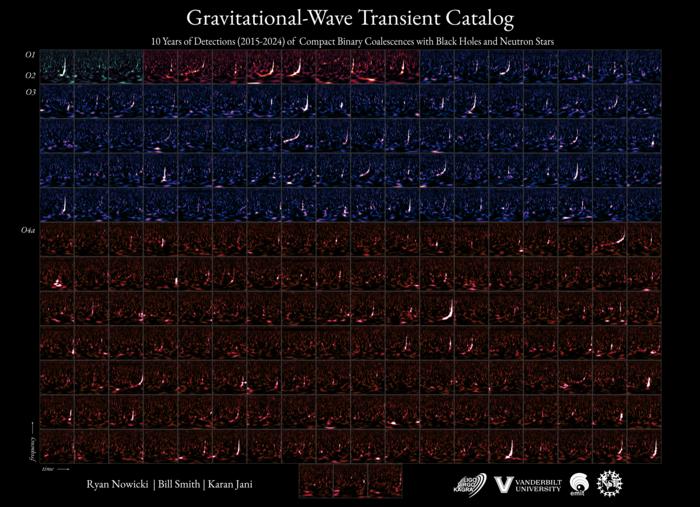
In November 2023, a faint shudder passed through a pair of L-shaped tunnels in Washington state and Louisiana. It had been travelling for a very long time. The signal, once the collaboration’s software had picked it apart, told an improbable story: two black holes, each roughly 130 times the mass of the sun, had spiralled into one another and merged. Most colliding black holes that LIGO picks up weigh in at about 30 solar masses. These were something else entirely. So heavy, in fact, that astrophysicists reckon each one was itself the product of an earlier collision, a sort of second-generation black hole born from the wreckage of a prior smash-up in some unimaginably crowded pocket of the cosmos.
That signal is just one entry in a haul of 128 new gravitational wave detections published today by the LIGO-Virgo-KAGRA collaboration in a special issue of Astrophysical Journal Letters. The updated Gravitational-Wave Transient Catalog 4.0 covers nine months of observations between May 2023 and January 2024, and it more than doubles the previous tally of 90 detections amassed across all three earlier observing runs combined. “We are really pushing the edges, and are seeing things that are more massive, spinning faster, and are more astrophysically interesting and unusual,” says Daniel Williams, a research fellow at the University of Glasgow.
The sheer volume is striking, but what really catches the eye is the variety. Alongside bread-and-butter mergers of similar-sized black holes, this batch includes the heaviest black hole binary ever detected (the 130-solar-mass pair above), a binary where both black holes spin at about 40% of the speed of light, and an oddly lopsided couple with one partner twice the mass of the other. Two black hole-neutron star collisions round things out.
Take the spinning pair, GW231028. Both black holes were rotating far faster than you’d typically expect; scientists suspect they might be remnants of prior mergers that spun them up as smaller black holes spiralled together. Or GW231118, a genuinely asymmetric system where one black hole outweighed its companion two to one. That sort of imbalance is uncommon. It could point to formation channels that theorists are still working to explain, or it could just be a quirk of the particular stellar nursery these objects came from. Hard to say.
“You can’t ever predict when a gravitational wave is going to come into your detector,” says Amanda Baylor, a graduate student at the University of Wisconsin at Milwaukee who helped sift through the data. “We could have five detections in one day, or one detection every 20 days. The universe is just so random.”
All the detections in this phase came from LIGO’s two interferometers alone (the Virgo detector in Italy was still being upgraded and did not rejoin until later in the run). Each instrument fires laser beams down kilometre-scale tunnels arranged in an L-shape and measures, with absurd precision, whether the beams return at slightly different times. A passing gravitational wave stretches space by a fraction smaller than the width of a proton, creating a tiny timing mismatch. Recent upgrades pushed LIGO’s sensitivity so it can now pick up neutron star collisions roughly a billion light-years away. For heavier black hole mergers, the reach extends tens of times further.
With perhaps 200 confirmed mergers now in the full catalogue, the collaboration has started treating black holes not as isolated curiosities but as a population. Patterns are creeping in. Salvatore Vitale, an associate professor of physics at MIT, notes that the data suggest black holes which collided earlier in the universe’s history tended to have larger spins than those merging more recently. If that holds up it raises a genuinely interesting puzzle: what conditions in the younger universe could have wound these objects up so fast?
The growing catalog has also given researchers a sharper tool for stress-testing Einstein’s general theory of relativity. When black holes collide they warp spacetime more violently than perhaps any other process in nature, which makes these events (in a way) the ultimate laboratory. The team used one of the strongest signals in the new batch, GW230814 from August 2023, to probe whether any features of the waveform strayed from what general relativity predicts. “So far, the theory is passing all our tests,” says Aaron Zimmerman, an associate professor of physics at the University of Texas at Austin. “But we’re also learning that we have to make even more accurate predictions to keep up with all the data the universe is giving us.”
Then there is the question cosmologists perhaps care about most: how fast is the universe expanding? The answer sits in a number called the Hubble constant, and it has been the subject of a long-running spat between different measurement methods. Gravitational waves offer a way in that sidesteps some of the complications. “Merging black holes have a really unique property: We can tell how far away they are from Earth just from analyzing their signals,” says Rachel Gray, a lecturer at the University of Glasgow. Every collision acts as a sort of cosmic distance marker. By pooling every detection in the full LVK catalogue the team produced a new independent estimate: about 76 kilometres per second per megaparsec. Still rough. “It’s still early days for this method, and we expect to significantly improve our precision as we detect more gravitational wave sources,” Gray says.
What makes GWTC-4 feel like a turning point is not any single detection but the sense of a field shifting from stamp collecting to cartography. A decade ago the first gravitational wave was a solitary triumph, now there are hundreds of confirmed mergers spanning two orders of magnitude in mass; from neutron stars barely heavier than the sun to remnant black holes exceeding 100 solar masses. “We still don’t completely understand how black holes form in the universe, but our observations offer a crucial insight into these questions,” says Jack Heinzel, a graduate student at MIT.
The fourth observing run is not finished. About 300 mergers were picked up in total during this phase, with many still being analysed. The detectors keep getting more sensitive. And when the next catalogue arrives the map of the gravitational-wave sky will be denser, stranger, and (if the pattern holds) replete with objects nobody quite predicted.
Study link: https://iopscience.iop.org/article/10.3847/2041-8213/ae0c06