

Anders Hagen Jarmund does not remember whether it was a signpost or a lamppost. What he remembers is the licking, and then the sticking, and the panic that followed. He was a boy in Hattfjelldal, a small town in northern Norway where winters bite hard and frozen metal is everywhere. “I don’t remember if it was a signpost or a lamppost behind the school, but I remember licking it and my tongue got stuck,” he says.
If you grew up somewhere cold, you probably know the drill. Maybe you did it yourself, or watched a friend do it, or at least had a parent warn you not to. The phenomenon even has a clinical name: tundra tongue. Yet until very recently, nobody had bothered to study it properly. No epidemiology, no biomechanics, no systematic accounting of just how badly things can go when a child’s wet tongue meets metal at minus 15.
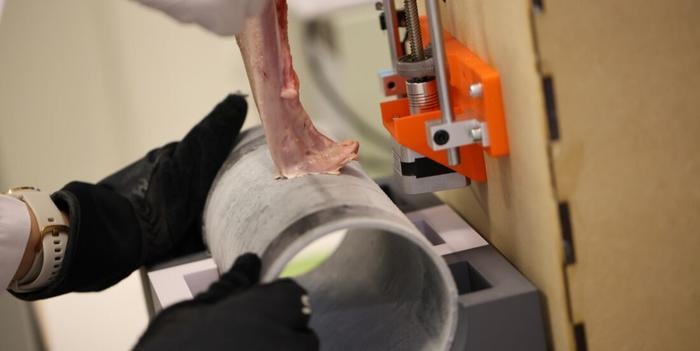
Jarmund, who has just finished his medical degree at the Norwegian University of Science and Technology and is completing a PhD on preeclampsia, decided to fix that. Along with his brother Ståle, and fellow researchers Sofie Eline Tollefsen and Cristoffer Sakshaug, he launched what might be the most thorough investigation of frozen tongues ever attempted: a historical newspaper review spanning nearly two centuries, and an experimental study involving 84 pig tongues, a force sensor, an infrared camera, and a fair amount of donated saliva.
The results, published in two peer-reviewed papers this year, are funnier than you’d expect from medical literature. They are also, in places, genuinely grim.
For the newspaper review, the team combed through the digitised archives of Norway, Sweden, and Denmark’s national libraries, searching for reports of people freezing their tongues to cold metal. They started with records going back to 1748 and found the earliest documented case in 1845: a French schoolboy who froze his tongue to a metal bridge and tore off skin from both tongue and lips pulling himself free. Across more than 17,000 search hits, they identified 856 newspaper reports describing 113 individual cases. One particularly newsworthy incident turned up in 76 different newspapers.
The demographics tell a story that will surprise roughly nobody who has spent time around small children. The median age for tundra tongue is 5.25 years. Boys account for 63 percent of cases. Railings are the most common culprit, responsible for 40 percent of incidents, followed by fences and lamp posts. “I’m not surprised the majority were boys,” Jarmund says, with the self-awareness of someone who has been there.
Most cases ended with nothing worse than a sore tongue and a frightened child. But 18 percent involved a trip to the doctor or hospital, and the injuries documented in the newspapers could be severe: deep ulceration, avulsion (the clinical term for having a chunk of tongue torn clean off), potential need for suturing, and in one case what appeared to be systemic infection. A child in the United States got his tongue frozen to a railway line; he was discovered in time and the approaching train was rerouted. Someone else remained stuck for 90 minutes, long enough that hypothermia becomes a real concern. Six children once got their tongues frozen after reading about it in the newspaper, which tells you something about how five-year-olds process cautionary tales.
The remedies people reached for were almost as varied as the cases themselves. Warm water was most common, used in about 30 percent of incidents. Others tried glycerol, coffee, whiskey, a car cigarette lighter, a penknife, and, in one case, heating with denatured alcohol. Norway, for its part, took the problem seriously enough to pass regulations in 1998 requiring insulation on playground equipment, though the data suggest that railings and lamp posts (which aren’t playground equipment) are the real offenders.
Having mapped the scale of the problem, Jarmund and his team wanted to understand the mechanics. How much force does it take to yank a tongue off frozen metal? What actually happens to the tissue? They needed tongues, but “we doubted any ethical committee would approve human volunteers for this,” Jarmund says. After some debate about which animal tongue best approximates a human one, they settled on pigs. Eighty-four tongues, sourced from a licensed slaughterhouse north of Trondheim. “And they were quite cheap,” Jarmund notes. “But I’m not sure there’s a huge market for pig tongues.”
Ståle Jarmund used the experiments as his master’s project in engineering, and the team pulled together an interdisciplinary group including an associate professor of mechanical engineering and professors of pathology and biophysics. Days in the lab followed: warming tongues, cooling metal, pressing the two together, then measuring what happened when they were pulled apart. In 54 percent of tests, pieces of the pig tongue tore away. The harder they pulled, the worse the damage, which is intuitive enough. But the temperature relationship held a surprise. The greatest risk of avulsion came between minus 5 and minus 15°C. At very low temperatures, perhaps counterintuitively, the tongue froze so solidly that it actually resisted tearing when yanked free. The ice, in a sense, was protecting the tissue by holding it together.
The practical upshot is straightforward, and Jarmund delivers it with the calm of someone who has both lived it and studied it. “Try not to panic,” he says. “I remember the panic, you’re standing there and your tongue is stuck to metal. But above all else: Don’t pull your tongue off too fast.” Breathe on the metal, or apply warm water if you have it. The ice bond will break. What you do not want is a five-year-old in full flight-or-fight pulling backwards with everything he’s got, because that is how you lose a piece of tongue.
It is, on one level, a silly topic for two academic papers. Jarmund knows this. “We were curious, of course, and no one has studied this,” he says. “It was also a little bit for us to learn how to do this type of research.” But the data are real, the injuries are real, and the fact that it took until 2026 for anyone to systematically document a phenomenon known since at least 1845 says something about the gaps that open up when a problem seems too minor, or too funny, to take seriously.
Study link: https://doi.org/10.1016/j.ijporl.2026.112740