

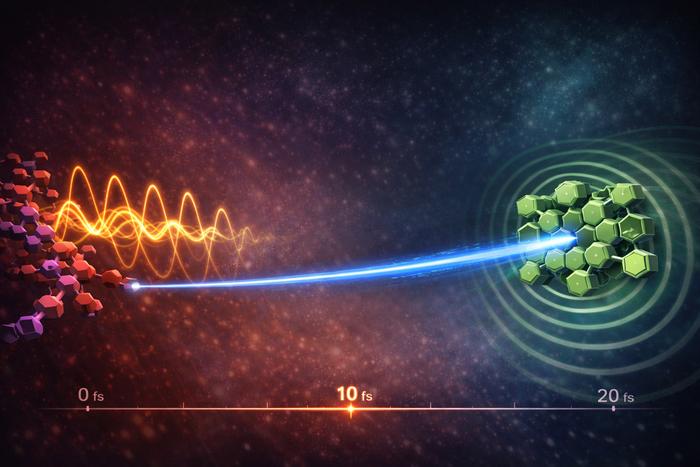
One quadrillionth of a second is not, by any normal reckoning, a useful unit of time. A femtosecond sits so far below everyday experience that the usual comparisons barely help: one second contains roughly eight times more femtoseconds than all the hours that have passed since the Big Bang. But at the scale where atoms inside molecules physically vibrate, shaking back and forth along their bonds, 18 femtoseconds turns out to be just enough time for something remarkable to happen. An electron can jump ship.
That’s what Pratyush Ghosh at St John’s College, Cambridge, and colleagues have now captured in a set of experiments designed, somewhat perversely, to make such a jump as difficult as possible. Rather than engineering a system optimised for fast electron transfer, the team built one that conventional theory said should have been sluggish. A polymer donor and a non-fullerene acceptor were placed side by side with almost no energy offset between their frontier orbitals (less than 100 millielectronvolts) and only weak electronic coupling. By every established design rule in solar energy research, this arrangement should have slowed charge transfer to a crawl.
It did not. The electron crossed the interface in about 18 femtoseconds, faster than many supposedly well-optimised organic systems and right at the natural timescale of molecular motion. “We deliberately designed a system that, according to conventional theory, should not have transferred charge this fast,” says Ghosh. “By conventional design rules, this system should have been slow and that’s what makes the result so striking.”
The finding, published in Nature Communications, matters because ultrafast charge separation is one of the critical bottlenecks in converting sunlight into electricity or driving chemical reactions with light. When a photon strikes an organic material, it creates what physicists call an exciton: a tightly bound pair consisting of an electron and the positively charged hole it leaves behind. For a solar cell or a photocatalytic system to work, that pair has to split apart, quickly, before it recombines and the energy dissipates as heat or light. The faster you can prise the two apart, the less you lose.
For decades, the accepted wisdom held that you needed two things for rapid charge separation: a large energy difference between the donor and acceptor materials and strong electronic coupling between them. Both come with costs. Large energy offsets limit the maximum voltage a solar cell can produce, while strong coupling can increase unwanted energy losses. Researchers had to accept a sort of trade-off; speed for efficiency.
Ghosh’s team bypassed that trade-off entirely. Using ultrafast laser pulses lasting less than 12 femtoseconds, they tracked what happened after the polymer absorbed light. The donor molecule did not simply shed its electron through some slow, diffusive process. Instead, specific high-frequency vibrations in the polymer backbone began mixing the electronic states at the donor-acceptor boundary, effectively catapulting the electron across in one coherent burst. “Instead of drifting randomly, the electron is launched in one coherent burst,” Ghosh says. “The vibrations don’t just accompany the process, they actively drive it.”
The mechanism is, in a sense, counterintuitive. Molecular vibrations have traditionally been treated as nuisances in solar cell design; thermal jitter that blurs electronic states and saps performance. What the Cambridge group found is that certain vibrations, specifically a high-frequency mode localised on the electron-poor segment of the polymer, do the opposite. They modulate the energy gap between the exciton state and the charge-transfer state so rapidly that the electron gets funnelled across the interface before it has time to settle into anything more leisurely.
To confirm this wasn’t a fluke of one particular molecular arrangement, the team tested two configurations. In one (TS-P3), the acceptor molecule sat directly above the segment of the polymer where the driving vibration was localised. In the other (TS-P2), the acceptor faced a different part of the backbone. The difference was dramatic: 18 femtoseconds versus roughly 376 femtoseconds. Same materials, same energy levels, but a twentyfold change in speed depending on where, precisely, the vibration met the electronic coupling region.
Perhaps the clearest fingerprint of just how fast and clean this process is came from an unusual observation. Once the electron arrived at the acceptor molecule (a perylene diimide derivative), it triggered a brand-new coherent vibration there, a sort of molecular ringing that has only rarely been observed in organic materials. “That coherent vibration is a clear fingerprint of how fast and how cleanly the transfer occurs,” says Ghosh. Quantum dynamics simulations using the multi-layer MCTDH method confirmed the picture: the acceptor’s vibrational mode only started oscillating after charge transfer populated the new electronic state, not from direct photoexcitation.
What all of this amounts to, if it holds up in broader material systems, is a new kind of design principle for organic solar cells, photodetectors and photocatalytic devices. Instead of engineering large energy offsets that sacrifice voltage, researchers might instead tune which vibrational modes sit at the donor-acceptor interface. “Our results show that the ultimate speed of charge separation isn’t determined only by static electronic structure,” Ghosh says. “It depends on how molecules vibrate. That gives us a new design principle.”
Akshay Rao at Cambridge’s Cavendish Laboratory, a co-author on the study, puts it more bluntly: “Instead of trying to suppress molecular motion, we can now design materials that use it, turning vibrations from a limitation into a tool.” The half-period of high-frequency molecular vibrations, it seems, sets the ultimate speed limit for charge separation in organic systems. And it can be reached without brute-forcing the electronic structure. Whether the same trick works in the disordered blends of real-world solar cells, rather than the tidy covalently tethered systems used here, is the obvious next question. But the rulebook, at least, has a new chapter.
Study link: https://www.nature.com/articles/s41467-026-70292-8