
Key Takeaways
- NASA’s OSIRIS-REx mission collected samples from asteroid Bennu, revealing unexpected boulder-covered surfaces instead of fine regolith.
- Thermal inertia measurements suggested a loose material cover, but analysis showed boulders with complex internal crack networks.
- These cracks significantly reduce thermal conductivity, explaining the low thermal inertia seen from telescopes and spacecraft.
- Lab analysis combined with simulations confirmed the cracks play a major role in thermal behavior, challenging previous assumptions about asteroid surfaces.
- The findings indicate that low thermal inertia in carbonaceous asteroids may result from dense internal cracking rather than just surface dust.
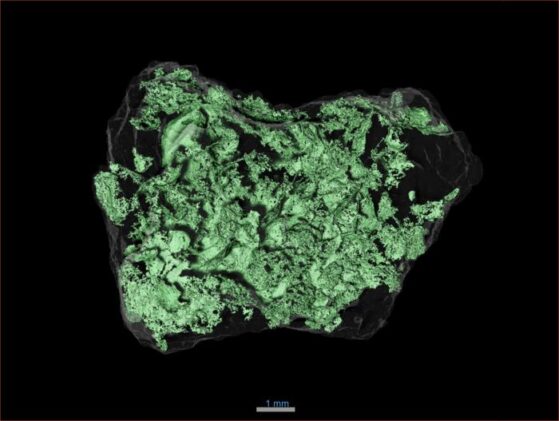
The rock sitting in a sealed nitrogen container at NASA’s Johnson Space Center is roughly the size of a pea. It came from a place roughly 300 million kilometers away, collected by a spacecraft that spent three years surveying one of the most boulder-strewn surfaces anyone had ever seen in the solar system. Under a microscope, it looks, in some respects, like a very old piece of charcoal: dark, granular, faintly nodular at the surface. Inside, though, is where it gets interesting. Riddled through its interior, visible only in X-ray scans, is a labyrinthine network of cracks, jagged and disjointed, threading around grain boundaries and mineral clasts in every direction.
That rock, and several dozen like it, may have finally resolved one of the more confounding puzzles to emerge from NASA’s OSIRIS-REx mission to asteroid Bennu. The puzzle began not at the asteroid but in 2007, eleven years before OSIRIS-REx arrived, when NASA’s Spitzer Space Telescope measured Bennu’s thermal inertia: a property that describes how quickly a surface heats up in sunlight and cools down in shadow.
Low thermal inertia suggests a surface covered in fine, loose powder, the kind of granular material that gains and loses heat rapidly, like dry sand on a beach. Bennu’s reading was anomalously low. Pre-mission models predicted a surface dusted with sub-centimeter particles, perhaps extensive stretches of fine regolith where the spacecraft could safely touch down and scoop up material. When OSIRIS-REx settled into orbit in late 2018 and began imaging the surface in detail, what it found instead was something closer to a rubble pile from a demolition site.
Boulders. Almost nothing but boulders.
“We expected some boulders, but we anticipated at least some large regions with smoother, finer regolith that would be easy to collect,” said Andrew Ryan, a planetary scientist at the University of Arizona who led the mission’s sample physical and thermal analysis team. “Instead, it looked like it was all boulders, and we were scratching our heads for a while.”
Boulders should behave thermally more like blocks of concrete than loose sand, retaining warmth well into the night side of the asteroid’s rotation. Spacecraft data suggested these particular boulders were somehow losing heat far faster than expected. The leading hypothesis was that the rocks were extraordinarily porous, full of microscopic voids that would insulate poorly and produce the low thermal inertia the telescopes had measured from Earth. Then the samples arrived.
OSIRIS-REx returned 121.6 grams of Bennu material to Earth in September 2023, and the task of understanding what those fragments could tell researchers about the boulders they came from fell partly to a team using a technique called lock-in thermography. Developed originally for industrial applications, the method involves heating a tiny spot on a sample with a laser and watching how the thermal wave spreads through the material, not unlike, in a rough sense, the way ripples propagate across still water from a point of disturbance. From the rate and pattern of diffusion, researchers can derive the material’s thermal inertia with high precision. When the team at Nagoya University in Japan applied this technique to the Bennu particles, the results didn’t match the spacecraft data. Not even close. The lab measurements came in far higher than what OSIRIS-REx had recorded at the asteroid. The same mismatch, Ryan noted, had been found with samples from Ryugu, Bennu’s near-twin: a carbonaceous asteroid visited by JAXA’s Hayabusa2 mission, which had also puzzled researchers with its anomalously low surface thermal inertia.
Before OSIRIS-REx arrived at Bennu, Earth-based telescopes measured the asteroid’s thermal inertia, a property reflecting how quickly its surface heats up and cools down. The low value they recorded is typically associated with loose, fine-grained material like sand or dust, which loses heat rapidly. Scientists assumed this meant Bennu’s surface would be covered in small, powdery particles. When the spacecraft arrived in 2018 and found a surface almost entirely covered in boulders, it fundamentally upended those predictions.
Thermal inertia describes a material’s resistance to temperature change. A surface with low thermal inertia heats up quickly in sunlight and cools quickly in shadow; high thermal inertia means slower, more gradual temperature swings. Scientists use thermal inertia measured from telescopes and spacecraft to infer what an asteroid’s surface is made of, whether it’s covered in loose dust, solid rock, or something in between. Understanding this property is also important for predicting how asteroids might respond to deflection attempts or how their orbits might shift over time due to the gentle pressure of solar radiation.
Cracks act as barriers to heat flow through a rock. Even a small network of internal fractures can significantly reduce how efficiently heat conducts from the sunlit surface into the rock’s interior and back out again. In Bennu’s case, the densely interlocking crack networks in the dark, hummocky boulders appear to reduce thermal conductivity by up to 40 percent compared to uncracked material, which brings the rocks’ thermal behavior much closer to what telescopes and the OSIRIS-REx spacecraft measured from orbit. The effect is disproportionate: the cracks occupy a small fraction of the rock’s total volume but constrict heat flow in a way that dominates the material’s thermal properties.
The crack networks in Bennu’s sample particles appear to be genuinely ancient features rather than damage from spacecraft collection or sample return. Some fractures contain mineral deposits, including magnetite and phosphate, that form only in the presence of liquid water, suggesting these cracks were open billions of years ago when Bennu’s larger parent body was undergoing aqueous alteration. Other cracks are likely younger, probably caused by thermal fatigue from repeated heating and cooling cycles on the asteroid’s surface, or by micrometeoroid impacts over millions of years. Together, the crack patterns record a complex, multi-stage geological history spanning much of the solar system’s lifetime.
The research strongly suggests that low thermal inertia on carbonaceous asteroids in general may reflect dense internal cracking in boulders rather than fine surface dust. The carbonaceous asteroid Ryugu, visited by Japan’s Hayabusa2 mission, shows a very similar thermal puzzle, and its returned samples contain crack networks that closely resemble those in Bennu’s hummocky particles. For stony asteroids, which have different mineralogy and are generally less porous, the situation is less clear. But the principle that boulder cracks can dominate surface thermal behavior is likely to change how planetary scientists interpret telescope data for a wide range of small bodies going forward.
The samples were telling them the rocks were not as thermally sluggish as the asteroids they came from. Something was missing from the picture, and it turned out to be the cracks.
To map those cracks without destroying the samples, the team at Johnson Space Center devised a workflow that Ryan’s collaborator Nicole Lunning, the lead sample curator at the Astromaterials Research and Exploration Science division, described with a certain satisfaction: “The sample goes into its own ‘spacesuit,’ gets a CT scan, and then comes back to its pristine environment, all without having any exposure to the terrestrial environment.” Sealed in airtight containers under protective nitrogen, the particles were carried to an X-ray computed tomography instrument, scanned in three dimensions, then returned to their clean-room conditions. The resulting datasets revealed internal fracture networks in remarkable detail. In the dark, rough-surfaced “hummocky” particles, the cracks were abundant, short, jagged, and disjointed, weaving around internal clasts and encapsulating whole regions of the particle in a dense tangle. In the comparatively smoother “angular” particles, cracks were fewer, longer, and straighter, running through the material like visible fault lines.
The distinction matters because of how cracks affect heat flow. Even a volumetrically small crack network can dramatically reduce a material’s thermal conductivity if those cracks are densely interlocking and oriented across the principal direction of heat flow. Ryan’s team used the XCT data as input for computer simulations and found that the hummocky particles’ crack networks could reduce thermal conductivity by as much as 40 percent relative to uncracked material. When those simulated values were scaled up to boulder size, the thermal inertia fell into the range the spacecraft had actually measured. The cracks, not just the porosity, were doing most of the work.
There are caveats worth noting. The analysis relies on scaling from millimeter-sized particles to meter-scale boulders, a substantial extrapolation, and the team acknowledges that not all crack features were resolvable in the XCT data. The Hayabusa2 samples from Ryugu present a slightly different picture: their crack networks look similar to Bennu’s hummocky particles, but their bulk densities suggest lower overall porosity, so the two asteroids, while evidently similar, may not be identical in their internal architecture.
What the cracks appear to record, though, is a genuinely ancient history. Some of the fractures in the hummocky particles are filled with magnetite and phosphate, minerals that precipitate from aqueous fluids, indicating the cracks were open during a period of water activity on Bennu’s parent body, billions of years ago. Others probably formed later, from thermal fatigue as the asteroid’s surface expanded and contracted through repeated cycles of sunlight and shadow, or from micrometeoroid impacts chipping away over millions of years. Angular particles, by contrast, seem to have undergone more extensive aqueous alteration that effectively cemented their matrix and produced fewer, more distinct fracture planes. They split cleanly when researchers applied a chisel, producing fragments that resemble the parent particle. Hummocky particles resist disaggregation despite their dense cracking: the jagged, interlocking nature of the network appears to hold the material together even as it compromises its thermal behavior.
That interlocking property may explain a feature of Bennu’s surface that has otherwise been difficult to account for. The largest boulders on the asteroid are almost exclusively hummocky. The brighter, angular boulder type seems to be progressively fragmented and lost over time, cleaving along its well-defined fractures in response to space weathering. Ron Ballouz, a planetary scientist at the Johns Hopkins University Applied Physics Laboratory and a co-author on the study, sees the broader significance clearly: “We can finally ground our understanding of telescope observations of the thermal properties of an asteroid through analyzing these samples from that very same asteroid.” For the first time, the chain of inference from telescope to spacecraft to laboratory to simulation runs all the way through, with each link confirmed. Any future asteroid observed to have anomalously low thermal inertia need not be assumed to be coated in dust. It might simply be broken, slowly, all the way down.
DOI / Source: https://doi.org/10.1038/s41467-026-68505-1
ScienceBlog.com has no paywalls, no sponsored content, and no agenda beyond getting the science right. Every story here is written to inform, not to impress an advertiser or push a point of view.
Good science journalism takes time — reading the papers, checking the claims, finding researchers who can put findings in context. We do that work because we think it matters.
If you find this site useful, consider supporting it with a donation. Even a few dollars a month helps keep the coverage independent and free for everyone.