

Key Takeaways
- Bottom trawling indiscriminately captures thousands of marine species, with researchers estimating the true number caught could reach as high as 5,700.
- Many caught species are unrecorded, as smaller or commercially insignificant fish get grouped into vague categories like ‘trash fish.’
- Approximately 95% of species caught by bottom trawling are unintended bycatch, and about 64% of these are retained rather than released.
- The impacts of bottom trawling are severe, especially on threatened species, and it occurs significantly within marine protected areas, where it shouldn’t.
- Governments need to regulate bottom trawling more effectively, given that 99% of this activity occurs in national waters.
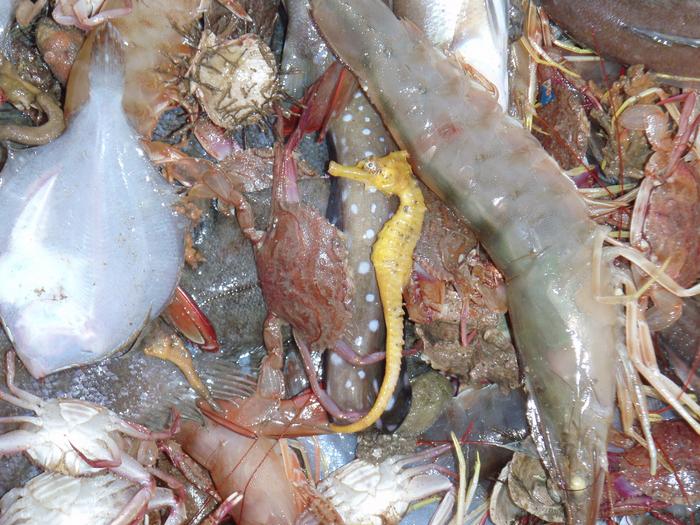
Somewhere on the Western Central Pacific seafloor, a net is moving. It weighs tonnes, it bristles with weights and roller gear, and it drags along the bottom at roughly four kilometres an hour, billowing sediment as it goes. Anything that cannot outswim it, or burrow deep enough to avoid it, ends up inside. Jacks. Croakers. Shrimps. Seahorses. A guitarfish with a wingspan wider than a dining table, critically endangered, listed on the IUCN Red List, almost certainly not what the vessel above was looking for. Almost certainly not counted when the catch comes up.
This is bottom trawling at scale, and for the first time researchers have attempted to quantify what it is actually catching. The answer, published this spring in Reviews in Fish Biology and Fisheries, is unsettling in both its breadth and its gaps.
Sarah Foster and her colleagues at the University of British Columbia’s Project Seahorse spent years assembling the world’s first global inventory of fish species recorded in bottom trawl catches, sifting through more than 9,000 records drawn from 236 sources spanning 1895 to 2021. What they found was nearly 3,000 distinct species, spread across 323 families and 75 orders. That figure, however, is probably an undercount by roughly half. Statistical extrapolations suggest the true number of species caught by bottom trawls lies somewhere between 3,700 and 5,700. The reason for the gap is not mysterious. Smaller fish, less commercially useful, are routinely lumped into catch categories labelled “trash fish” or “mixed fish” and never identified further. Entire taxonomic lineages are effectively invisible.
In some cases, yes. Marine protected areas vary widely in what activities they permit, and bottom trawling continues inside portions of some designated zones. The UBC study specifically calls for governments to exclude trawling from MPAs as a precautionary measure, since the biodiversity impact of current trawling activity cannot be fully assessed given the scale of under-reporting.
Smaller or commercially unimportant fish are routinely grouped into vague catch categories like “trash fish” or “mixed fish” without species-level identification. This means entire taxonomic groups go unrecorded. The UBC researchers estimate the true number of species caught by bottom trawls may be nearly double the roughly 3,000 documented so far, based on statistical extrapolation models.
No, but the distinction between intentional and incidental catch matters less than it might seem. The study found that around 95 per cent of documented species were unintended bycatch, yet about 64 per cent of those unintended catches were kept anyway. Whether a critically endangered guitarfish ends up in a net deliberately or by accident, the population-level effect is the same.
Bottom trawling supports large commercial fisheries and food supply chains, making outright global prohibition politically and logistically difficult. The researchers stop short of calling for a total ban, instead recommending a precautionary approach that excludes trawling from large ocean areas and, critically, from marine protected areas. Around 99 per cent of trawling occurs within national waters, giving individual governments direct authority to act.
One in seven of the assessed species carries a conservation status of threatened or near threatened on the IUCN Red List. One in four has either never been evaluated at all or lacks sufficient data for an assessment. That is not a footnote. That is the baseline.
“This is the clearest picture we’ve had of the breadth of bottom trawling,” said Dr. Foster, who led the research. “It reveals just how many species are being caught, and how much we have been missing.” The concern isn’t just about iconic or charismatic species, though the list certainly includes those: the critically endangered giant guitarfish, the endangered zebra shark, at least three seahorse species classified as vulnerable. The more pressing problem is structural. In roughly a third of all fish families, bottom trawls are catching at least half of all known species. For some families, they appear to be catching nearly all of them.
Syd Ascione, a research biologist at Project Seahorse and co-author of the study, put it in terms that are hard to argue with. “Bottom trawling sweeps up entire branches from the marine tree of life,” he said. “It does not discriminate between common species and those already on the brink of extinction. From critically endangered giant guitarfishes to vulnerable plough-nosed chimeras and seahorses, we put pressure on evolutionarily unique species, including many we still know too little about.”
The taxonomic picture that emerges from the inventory is, in a way, a portrait of indiscriminate industrial harvesting operating in near-total informational darkness. The study found that approximately 95 per cent of species documented in bottom trawl catches were not the intended targets of the fishery at all; they were bycatch, pulled up as collateral during operations aimed at shrimp or broad multi-species assemblages. Of those unintended catches, around 64 per cent were retained and kept rather than thrown back. So the fish arrive as accidents, and most of them stay. What happens to the populations they came from is, in most cases, unknown, and perhaps unknowable given the data deficit. Trawl-related pressures appear, across the literature, more frequently in the IUCN threat assessments of species already listed as threatened or near threatened, but the relationship is probably even stronger than the records suggest, given how much goes undocumented.
The geography of the problem adds another layer of complexity. The greatest species diversity in the inventory came from the Western Central Pacific, the Western and Eastern Indian Oceans, and the Eastern Central Atlantic. These are, broadly, the ocean regions with some of the highest overall marine biodiversity and also some of the weakest fisheries monitoring infrastructure. Species tend to be larger, on average, in the trawl records than in baseline surveys of demersal fish populations generally, which the researchers interpret as further evidence of systematic under-reporting at the small end of the size spectrum. Gear selectivity and commercial value might explain some of this, but not all of it.
“We can’t manage what we don’t know,” said Dr. Foster. “When we remove thousands of species without understanding the impacts on their wild populations, we risk destabilizing the very systems that fisheries depend on.”
The policy dimension is, in some respects, clarifying rather than complicated. Around 99 per cent of bottom trawling occurs within national waters, which means national governments hold both the legal authority and the practical responsibility to regulate it. Dr. Amanda Vincent, director of Project Seahorse and senior author of the study, was direct about what that implies. “We allow at least 100,000 trawlers to scrape the ocean floor, without even knowing what they are catching, and what damage they are doing to those species,” she said. “It is important that governments take a precautionary approach and exclude bottom trawling from large swathes of the ocean, and particularly from so-called marine protected areas.”
That last phrase carries some sting. Marine protected areas are, in principle, zones of conservation, not extraction. But bottom trawling continues inside some of them, catching species whose populations cannot be assessed because the data to do so does not exist. The inventory that Foster and her team have produced is the beginning of a reckoning with that situation, not the end of one. For hundreds of species, the first time their name appears in any formal record of human impact on the ocean may be in a catch log from a trawler that was looking for something else entirely.
How many of those species can sustain that kind of pressure, across how many trawls, across how many decades, is a question that marine biology has not yet answered. Increasingly, it looks like the answer was needed some time ago.
