

Key Takeaways
- Ethan Mooney discovered the oldest breathing apparatus in Captorhinus aguti, a 289-million-year-old reptile, during neutron scan analysis.
- The creature’s preserved costal breathing system offers insight into the evolutionary shift from amphibian respiration to more active terrestrial lifestyles.
- The unique preservation conditions in Oklahoma’s Richards Spur cave allowed for the survival of soft tissues and proteins, extending the known limits of preservation.
- Captorhinus serves as the ancestral example for rib-assisted respiration found in modern reptiles and mammals, influencing skull and locomotion evolution.
- Findings challenge assumptions about protein preservation, pushing back the timeline for soft tissue survival by nearly 110 million years.
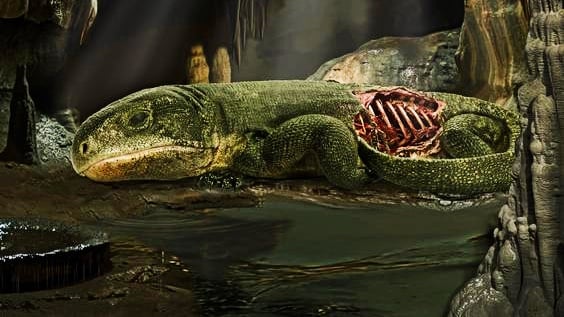
Ethan Mooney was processing neutron scan data from a tiny, palm-sized creature that had died in an Oklahoma cave some 289 million years ago when something stopped him cold. The scans kept revealing structures he hadn’t expected, thin and textured, wrapped around the bones. “I started to see all these structures wrapped around the bones,” he said later. “They were very thin and textured. And lo and behold, there was a nice wrapping of skin around the torso of this animal.” What he was looking at, it turned out, was the oldest breathing apparatus ever recorded in an amniote: the direct ancestor of the system that fills your lungs right now.
The creature is Captorhinus aguti, an early Permian reptile that scurried through cave systems near what is now Richards Spur, Oklahoma, roughly the size of a large lizard. Mooney, then a student at the University of Toronto working in professor Robert Reisz’s lab (and now a PhD candidate at Harvard), and his colleagues have published their analysis of three extraordinarily preserved specimens in Nature, describing the oldest-known complete costal breathing system in any amniote: the group that includes all reptiles, birds, mammals, and their common ancestor.
Costal aspiration breathing is the mechanism by which intercostal muscles rotate the ribs outward, expanding the chest cavity to draw air deep into the lungs. It’s what you’re doing right now, actually, whether you’re aware of it or not. Before amniotes evolved this system, the dominant respiratory strategy belonged to amphibians: pumping air using movements of the throat and mouth, or absorbing oxygen through permeable skin. Those methods work, sort of, for relatively sedentary creatures living near water. But they’re poorly suited to the dry, active, energy-intensive lifestyles that amniotes were beginning to pursue on land. A more powerful ventilation system was needed, and Captorhinus is the earliest fossil evidence we have that it had already arrived.
Costal aspiration breathing, in which intercostal muscles expand the chest cavity to draw air into the lungs, was a critical innovation for amniotes colonising the terrestrial environment. Before it evolved, the dominant approach involved pumping air with the throat or absorbing oxygen through the skin, methods that severely limit how active an animal can be. Finding the complete apparatus preserved in a 289-million-year-old reptile provides direct evidence of when and in what form this system first appeared, anchoring a major transition in vertebrate evolution to a specific anatomical blueprint.
The Richards Spur cave system in Oklahoma had unusually protective conditions: oil-seep hydrocarbons saturated the sediments, oxygen-poor mud encased the carcasses, and mineral-rich groundwater gradually replaced organic material with minerals. This combination appears to have inhibited the bacterial decay that normally destroys soft tissue, allowing skin, cartilage, and even protein remnants to survive. The hydrocarbons in particular may have interacted with the mineralization process in ways researchers are still working to understand.
The short answer is that it now seems to be, at least under the right conditions. Synchrotron infrared spectroscopy detected clear protein signatures in the Captorhinus specimens, consistent with preserved amide bonds in bone, cartilage, and skin. This pushes the known record for protein preservation back by roughly 110 million years, well beyond what most researchers thought plausible. Whether the molecules retain enough structure to yield sequence information is a separate question, but their presence at all is a significant revision to assumptions about deep-time preservation.
Captorhinus sits near the base of the amniote family tree, meaning it’s ancestral not just to reptiles and birds, but to the lineage that eventually produced mammals, including us. The costal breathing apparatus the team reconstructed in Captorhinus is, with modifications, the same system operating in your chest right now. Mammals evolved a diaphragm and altered the ribcage geometry considerably, but the underlying principle of using rib movements to ventilate the lungs traces back to the anatomical arrangement first documented here.
The reason this particular cave system yielded such astonishing preservation comes down to chemistry. The Richards Spur locality is saturated with oil-seep hydrocarbons; its pockets of oxygen-free mud and mineral-rich groundwater created conditions that, in a sense, mummified whatever died there. The three Captorhinus specimens emerged with bones, calcified cartilage, and three-dimensional skin intact.
Getting inside them without damaging them required a specialised facility in Australia. The team used neutron computed tomography at the Australian Nuclear Science and Technology Organisation’s OPAL research reactor, near Sydney, where neutrons rather than X-rays penetrate the surrounding rock matrix while leaving the fossil untouched. The scans revealed structures never before seen in a Paleozoic reptile: a segmented cartilaginous sternum, sternal ribs, intermediate ribs, and cartilaginous extensions off the cervical ribs connecting the ribcage to the shoulder girdle. Together, they form a complete thoracic skeleton that Reisz describes as the ancestral template. “We propose that the system found in Captorhinus represents the ancestral condition for the kind of rib-assisted respiration present in living reptiles, birds, and mammals,” he said.
The skin added another layer of surprise. It preserved in three dimensions, folded tightly against the torso, with a distinctive accordion-like texture formed by concentric corneous bands. The skin itself preserved in what Mooney described as a wonderful accordion-like texture, concentric bands running from the torso up to the neck. The pattern resembles that of modern worm lizards, small burrowing squamates still alive today, which may hint at something about how Captorhinus moved through the tight spaces of its cave environment.
Perhaps the most striking discovery was chemical rather than structural. Synchrotron infrared spectroscopy, conducted at a synchrotron facility in Taiwan, detected distinct protein signatures in the bone, cartilage, and skin: amide bands preserved within the mineral matrix, almost certainly remnants of the original organic molecules. Proteins degrade. The conventional assumption among paleontologists is that they can’t survive more than perhaps 100-150 million years in the fossil record; the previous oldest confirmed example came from a Jurassic sauropodomorph dinosaur, around 180 million years old. These Captorhinus specimens are roughly 289 million years old. The gap is nearly 110 million years. “The protein remnant finding is exceptional,” Mooney said. “It dramatically pushes our understanding of what is possible in terms of soft tissue preservation in the fossil record.” The hydrocarbons permeating the cave are probably responsible, interacting with the mineralization process in ways that aren’t yet fully understood.
The evolutionary implications run deep. Before costal aspiration breathing, early amniotes likely had skulls shaped in part by the demands of buccal ventilation, the throat-pumping method that requires a relatively broad snout. Once the ribcage took over respiratory duties, the head was, in a manner of speaking, liberated. Amniotes could begin experimenting with cranial architectures suited to new feeding and sensory strategies rather than breathing mechanics. The extraordinary diversity of skulls we see in modern reptiles, birds, and mammals, from the elongated beak of a toucan to the flattened face of a bulldog, is arguably downstream of what Captorhinus had already sorted out by 289 million years ago.
There’s also a locomotion angle that the team finds intriguing. In living lizards, the sternum can shift slightly relative to the shoulder girdle during walking, and the two coracoid plates can slide past each other. Captorhinus appears to have had the same arrangement. Mooney and Reisz suggest this makes it the earliest-known example of the coracosternal mobility seen in modern reptiles, and raises the possibility, floated by some researchers in recent years, that terrestrial locomotion may itself be an evolutionary adaptation to costal breathing, rather than the other way round.
Mooney, who has now moved to Harvard’s Museum of Comparative Zoology to continue working on early reptile evolution, puts it plainly: “It was a game changer that allowed these animals to adopt a much more active lifestyle.” The specimens themselves are housed at the Royal Ontario Museum in Toronto, where they’ll remain available for future study. Given what this one cave system has already yielded, there’s every reason to think more surprises are waiting inside the rock.
The oldest breath, it turns out, was a small lizard-shaped creature in an Oklahoma cave, its arm tucked beneath its body, its ribcage intact across nearly 300 million years. Every time you breathe in, the ribs flex outward in exactly the same way.