

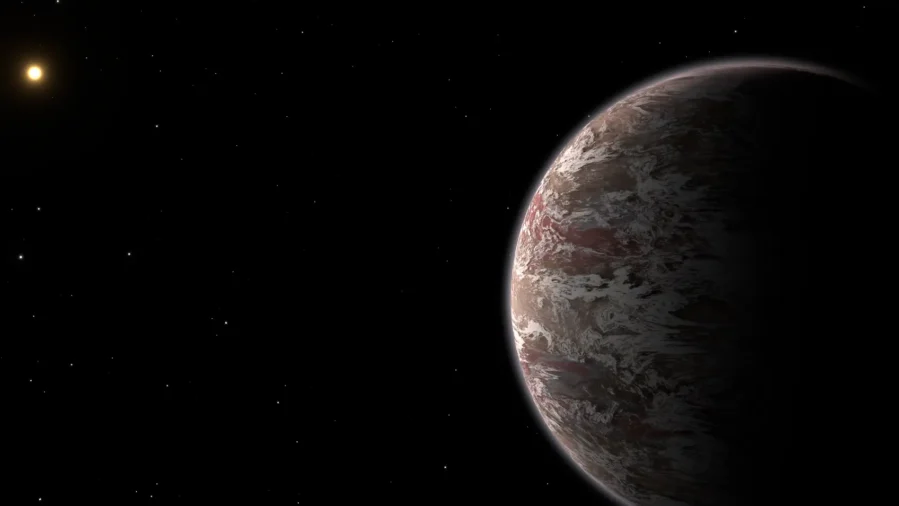
About 12 light years away, in the southern constellation Indus, a gas giant roughly the size of Jupiter drifts through a slow, wide orbit around a dim orange star. It is bitterly cold out there: around 275 kelvin, or just a few degrees above freezing. Cold enough, as it turns out, for water to freeze into high, wispy clouds in a planet’s upper atmosphere. That, at least, is what a team led by Elisabeth Matthews at the Max Planck Institute for Astronomy now suspects after studying the planet Epsilon Indi Ab with the James Webb Space Telescope for the second time. The result has wrong-footed most of the atmospheric models scientists rely on, and raises an interesting open question about what the coldest giant planets in the universe are actually made of.
For most of the history of exoplanet science, finding and characterising a genuine Jupiter analogue was essentially impossible. The technique that has revealed the atmospheres of hundreds of exoplanets since JWST began operating in earnest in 2022 requires the planet to pass in front of its host star from our perspective, and cold, wide-orbiting gas giants almost never oblige.
Matthews and her colleagues took a different approach. Using MIRI, the telescope’s mid-infrared camera, they blocked out the host star’s light with a coronagraph and imaged the planet directly. “JWST is finally allowing us to study solar-system analogue planets in detail,” Matthews says. “If we were aliens, several light years away, and looking back at the Sun, JWST is the first telescope that would allow us to study Jupiter in detail.” Studying an Earth, she’s quick to add, would need much more capable instruments than anything currently planned.
The trick that revealed clouds in Epsilon Indi Ab’s atmosphere is almost elegantly simple. Ammonia absorbs strongly at around 10.6 micrometres but is nearly transparent at 11.3 micrometres. Measure a cold planet through filters at both wavelengths and the brightness difference tells you how deep the ammonia feature is.
A Planet That Doesn’t Match Its Models
What Matthews’s team found was unambiguous evidence for ammonia, but less of it than the models had led them to expect. The planet shows a clear brightness difference between the two infrared filters, confirming the molecule’s presence, but the signal is shallower than solar-metallicity atmosphere models predict by a conspicuous margin. At first glance, this might suggest Epsilon Indi Ab is unusually poor in nitrogen, since ammonia (NH3) is the main nitrogen-bearing molecule in cold atmospheres. But that explanation runs into problems quickly. A nitrogen-depleted atmosphere would glow more brightly at near-infrared wavelengths between 3 and 5 micrometres, because fewer molecules would be there to absorb the outgoing light; and archival ground-based observations have already failed to detect Epsilon Indi Ab at those wavelengths, placing firm upper limits on how bright it can be. The planet isn’t just nitrogen-poor, then. Something else is going on.
Strikingly, the same oddity shows up in a cold brown dwarf called WISE 0855, a free-floating object about 285 kelvin that is perhaps the best studied ultracold substellar object known. It, too, shows a shallower ammonia feature than models predict. That two independent objects in the same temperature regime share this quirk is, the researchers reckon, probably not a coincidence.
The explanation Matthews and colleagues find most plausible is the presence of thick water-ice clouds. At temperatures around 275 kelvin, water vapour in a planetary atmosphere can condense into ice particles, forming clouds not entirely unlike high-altitude cirrus layers in Earth’s atmosphere. These clouds would do two things simultaneously: they would scatter and absorb outgoing radiation, making the planet fainter than expected at near-infrared wavelengths; and they would partly mask the ammonia absorption feature, because the clouds block some of the infrared light that would otherwise carry the ammonia signature outward. The best-fitting model includes a water-ice cloud so optically thick it reaches a column optical depth of 416. That is, to put it plainly, an awful lot of cloud. Bhavesh Rajpoot, a PhD student at MPIA who contributed to the orbit analysis, notes that despite its greater mass, the planet is physically about the same size as Jupiter, making it a genuine if more massive cousin of our solar system’s largest planet.
There’s a wrinkle in the cloud hypothesis, though. The same models that incorporate water-ice clouds still prefer a somewhat elevated metallicity and an elevated carbon-to-oxygen ratio for Epsilon Indi Ab; and those parameters are hard to explain with standard planet formation theory, which struggles to produce massive giant planets with large amounts of heavy elements.
A Universal Trend in Cold Atmospheres?
What makes the finding potentially more important than a single puzzling planet is what it might imply more broadly. In the past year or so, a small sample of cold, directly imaged exoplanets has emerged, and they are all, without exception, fainter than models predict at 3 to 5 micrometres. James Mang at the University of Texas at Austin, who provided the new atmosphere models used in the analysis, says the discovery illustrates something about where the field now sits: “What once seemed impossible to detect is now within reach, allowing us to probe the structure of these atmospheres, including the presence of clouds. This reveals new layers of complexity that our models are now beginning to capture.”
The practical upshot is that most published atmospheric models for cold giant planets simply leave clouds out, because clouds make the calculations considerably more demanding. That probably needs to change.
Future observations should help resolve some of the ambiguity. JWST programs are already approved to observe Epsilon Indi Ab at wavelengths spanning 3 to 20 micrometres, which should reveal whether water-ice clouds are genuinely present and provide better constraints on the planet’s composition. NASA’s Nancy Grace Roman Space Telescope, slated for launch in the next couple of years, might even be able to detect the clouds directly in reflected light; water ice is highly reflective, so if the clouds are there, Roman could see their glint. The growing catalogue of directly imaged cold giants is, in a way, a proving ground: learn to read the atmospheres of cold Jupiters now, and the techniques will be ready when, eventually, something more like an Earth comes into view.
For the moment, Epsilon Indi Ab remains obstinately complicated, its clouds partly obscuring the very signals scientists most want to study. Which is, perhaps, exactly what you’d expect from a planet that has been doing this for billions of years without anyone watching.
Source: E. C. Matthews et al., “A second visit to Eps Ind Ab with JWST: new photometry confirms ammonia and suggests thick clouds in the exoplanet atmosphere of the closest super-Jupiter,” The Astrophysical Journal Letters, 2026. DOI: 10.3847/2041-8213/ae5823
Frequently Asked Questions
Why do water-ice clouds make it harder to study an exoplanet’s atmosphere?
Clouds act as a kind of lid on the atmosphere, blocking the infrared light that would otherwise carry the chemical fingerprints of deeper layers outward. For Epsilon Indi Ab, the suspected water-ice clouds are thick enough to muffle the ammonia signal scientists were expecting and to make the planet much fainter than predicted at near-infrared wavelengths. That means the atmosphere below the cloud deck stays hidden, and distinguishing between competing explanations for the planet’s odd spectrum becomes considerably harder.
Could this mean most atmospheric models for cold exoplanets are wrong?
Probably not wrong so much as incomplete. Most published models for cold giant planet atmospheres deliberately omit clouds, because including them makes the calculations far more computationally demanding. Epsilon Indi Ab is one of several recently imaged cold planets that are all fainter than cloud-free models predict, which strongly suggests clouds are a real and common feature of these atmospheres. The models will need updating, but the underlying physics they capture is still broadly sound.
Is Epsilon Indi Ab the closest Jupiter-like exoplanet we can directly study?
Yes, at roughly 12 light years from Earth, it is the closest directly imaged giant exoplanet to our solar system. That proximity is part of why it’s so scientifically valuable: the star’s rapid motion across the sky makes confirming that the planet is a genuine companion rather than a background star straightforward, and the relatively short distance means the planet is bright enough for detailed photometric study. The next generation of cold directly imaged giants are considerably more distant.
Why does it matter that ammonia is present but shallower than expected?
Ammonia abundance is a tracer for several things at once: the overall nitrogen content of the atmosphere, the temperature and pressure structure, and the presence of cloud layers that can dissolve or mask the molecule. A shallower-than-predicted ammonia feature, seen in both Epsilon Indi Ab and the cold brown dwarf WISE 0855, hints at a physical process operating in very cold substellar atmospheres that current models aren’t capturing. Whether that process is cloud formation, chemical reactions dissolving nitrogen into water-ice particles, or something else is one of the key open questions the field is now investigating.