

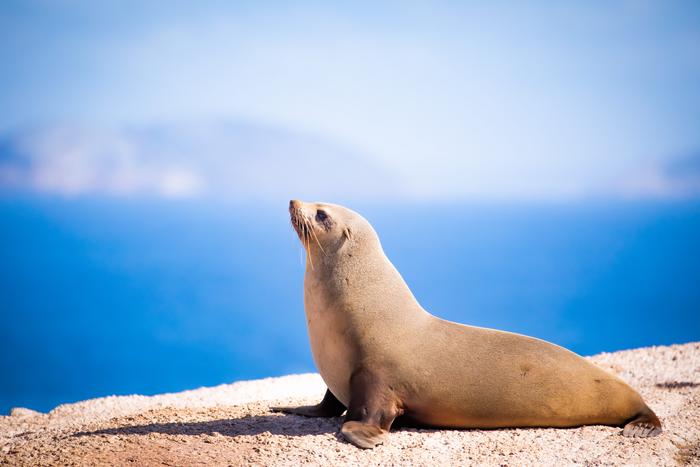
Six hours after a fur seal hauls herself onto a rocky beach, something unexpected happens inside her chest. Her heart rate, which you might reasonably expect to be winding down toward sleep after days of cold-water hunting, climbs instead. Sharply. For an animal sprawled apparently motionless on the shore, her cardiovascular system is doing anything but resting. It is, it seems, settling accounts.
That’s the upshot of a new study in Frontiers in Physiology, one that’s forcing marine biologists to rethink what “recovery” actually means for diving mammals, raising the more unsettling possibility that what we’ve been calling “rest” is something considerably more complicated.
Melissa Walker, an associate research fellow at Deakin University in Australia, and colleagues tracked the complete heart rate profiles of two subspecies of fur seal across entire foraging cycles: from the moment animals slipped into the ocean to the point where they finally hauled out and settled back into something approaching stillness. The dataset was originally collected between 2003 and 2008, instruments glued to twelve seals’ backs along the coasts of South Africa and southeastern Australia. Modern analytical methods, applied to that archived data decades later, revealed the pattern. “Here we show in Cape and Australian fur seals that there is a positive relationship between their heart rate at sea during foraging and their heart rate on land during rest,” Walker said. “This likely means that payback for some of the physiological costs of foraging at sea are delayed and recovered later when the seal is on land.”
The two species studied are close relatives but forage very differently. Cape fur seals, off South Africa, hunt mainly in open water, sometimes diving beyond 190 metres. Australian fur seals prefer the seafloor at shallower depths around 80 metres, holding a steadier heart rate for longer at depth. Both species, though, share a problem: they routinely exceed what physiologists call the aerobic dive limit, the threshold beyond which the body can no longer sustain diving on oxygen alone and begins running on anaerobic metabolism. The consequence is lactic acid accumulation, nitrogen dissolving into the blood, an oxygen debt that needs paying back.
A Debt That Compounds with Every Dive
At sea, seals manage this through frantic surface intervals between dives, heart rate spiking to over 160 beats per minute as they hyperventilate and replenish oxygen stores. But the study’s analysis suggests they can’t fully clear the bill at sea. Each successive bout of dives adds to a running total of physiological debt that the short surface rests only partially offset. By the time a seal swims back to the colony, she’s carrying a significant tab.
The instruments showed something that previous, shorter-term heart rate studies had completely missed. Rather than simply decelerating toward a resting state, heart rate in both species peaked, reaching around 80 to 84 beats per minute, roughly six to eight hours after the animals came ashore. Multiple peaks, often. It was only after these post-arrival surges that heart rate finally dropped toward what you’d see during REM sleep, sometimes not settling until more than 40 hours after haul-out. “Physiological recovery from oxygen debt is more protracted, complex, and occurs over much longer timescales than previously understood,” Walker said, “with the elevated heart rate on land likely helping to support a delayed recovery.”
Why the delay? Several overlapping explanations seem plausible, and probably all contribute. Lactic acid takes time to flush. Nitrogen absorbed during deep dives can only be safely offloaded once an animal is no longer submerging (the metabolic equivalent of slowly deflating a badly over-inflated tyre). Digestion, too, generates substantial heat and increases metabolic demand; prey caught near the end of a foraging trip might not begin processing until the seal reaches shore. There’s also the cost of swimming back to the colony (Australian fur seals studied here can travel up to 320 kilometres), an exertion that adds its own physiological burden on top of the diving debt already accrued.
The Numbers Behind the Payback
The study’s statistical backbone is a set of area-under-curve analyses comparing cumulative heart rate at sea with cumulative heart rate onshore. The relationship was strong and consistent across both species despite their different foraging styles: animals that worked harder at sea showed proportionally elevated heart rates during their subsequent haul-out. The that worked harder at sea showed proportionally elevated heart rates during their subsequent haul-out. The correlation coefficients ranged from 0.61 to 0.86, suggesting something systematic rather than coincidental. The more intense the foraging trip, the longer and more elevated the onshore cardiac response.
That link has practical implications for how we think about pinniped energetics more broadly. Most energy budget models for these animals treat the at-sea foraging period and the onshore rest period as relatively separate. This study suggests they’re more tightly coupled: the costs of one bleed directly into the other. “A key benefit of such high heart rates on land may be that seals can prioritize foraging while at sea, focusing on acquiring food and avoiding predators, and then allocate energy to processing and recovery once they return to land,” Walker said. It’s a kind of physiological deferred payment scheme, and apparently a fairly ancient one.
What Comes Next
There are caveats. The study followed only lactating females, adding further energetic demands (milk production, potentially foetal growth) that non-breeding animals wouldn’t face. Whether the same pattern holds across sexes, age classes, and other pinniped species remains to be tested. Walker acknowledges that “numerous factors” are likely driving the onshore heart rate elevation, and disentangling them (teasing apart digestion from lactic acid clearance from travel recovery) digestion from lactic acid clearance from will require studies that track foraging success and digestive state alongside cardiac data. “Future studies could track these variables alongside onshore heart rate patterns to clarify the mechanisms behind this apparent delayed recovery,” she said.
The broader lesson may be about the value of looking at the full picture rather than snapshots. Dozens of past studies had measured fur seal heart rate at sea, or onshore, in isolation. Often just a few hours of data. The connections between the two phases, the way physiological costs cascade across time and environment, only became visible when someone finally looked at both ends of the cycle together. Other archived datasets from wild mammals, the researchers suggest, could be reanalysed with modern methods to find similar carry-over effects that no one thought to look for the first time around.
Frequently Asked Questions
Why do fur seals’ hearts beat faster when they’re resting on land?
The elevated heart rate appears to reflect the body settling overdue physiological accounts from the foraging trip. Seals diving repeatedly at sea accumulate oxygen debt, lactic acid, and dissolved nitrogen that can’t be fully cleared during brief surface intervals between dives. Once ashore and safe from predators, the cardiovascular system ramps up to flush these metabolic byproducts and potentially process a final meal. The peak typically arrives six to eight hours after haul-out, suggesting it’s a delayed response rather than a direct reaction to swimming to shore.
Does this mean seals aren’t actually resting when they haul out?
It’s more accurate to say that rest and physiological recovery are happening simultaneously, and the recovery component is far more metabolically active than previously assumed. Seals do sleep during haul-out periods, but the heart rate data suggest that for the first half or more of their time ashore, significant internal work is underway. True resting heart rates, approaching levels seen during REM sleep, weren’t reached until 19 to 42 hours after animals came ashore.
How does this compare to recovery in other athletic animals?
Large terrestrial carnivores like lions also accumulate lactic acid during intense prey-capture sprints and require recovery time afterward. But fur seals face a compounding challenge: they’re doing this repeatedly, in an environment with no accessible oxygen, across foraging trips lasting several days. The debt builds through many successive dive bouts rather than a single effort, which may explain why full recovery takes so long and requires the relatively unusual strategy of deferring some physiological processing until the animal reaches land.
Could these findings affect how we assess seal health and population status?
Potentially, yes. If standard energetic models treat the at-sea and onshore phases as largely independent, they may be underestimating the true cost of foraging. For seal populations already under pressure from prey availability changes or climate-related shifts in their foraging range, the metabolic carry-over between phases could matter. An animal forced to forage harder or longer would arrive ashore with a larger debt to clear, leaving less energetic reserve for reproduction or immune function.
Why did it take until now to notice this pattern?
Previous studies typically measured heart rate at sea or onshore in isolation, and often only for a few hours. The foraging-to-haul-out cycle for these seals lasts on average three to five days, and the onshore peak arrives six to eight hours after arrival, meaning any study that didn’t monitor a complete cycle, and then continue monitoring for many hours afterward, would simply miss it. The data in this study were actually collected between 2003 and 2008, but applying modern area-under-curve analysis to the full continuous traces revealed the cross-phase relationship that earlier, more fragmented analyses couldn’t detect.