

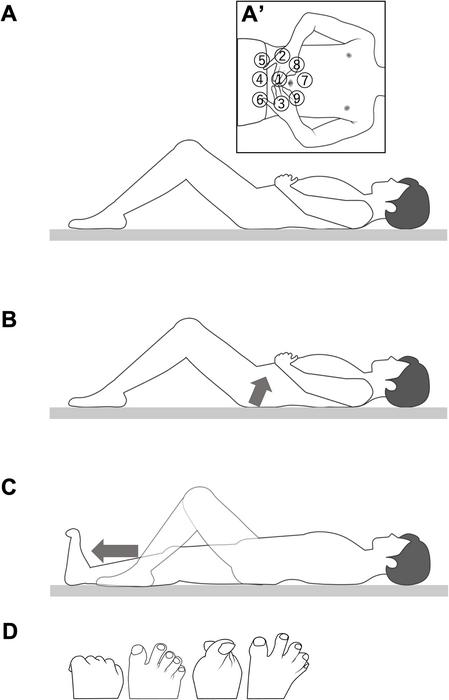
The least athletic thing you can do turns out to be surprisingly good training. Lie flat on the floor, flex your knees, press your fingertips lightly into your abdomen, and contract against the pressure. Then, in a slow and deliberate sequence, tilt your pelvis, lift your hips slightly, and extend one leg while dorsiflexing the ankle. Do this for ten minutes. Repeat for two weeks. Researchers at Tokyo University of Agriculture and Technology have now shown that something close to this routine, performed entirely on your back, measurably improves how steadily you stand and how quickly you can change direction on your feet.
The finding runs against the logic most of us apply to exercise: that balance is trained upright, in the positions that challenge it. But the study, published in PLOS ONE, suggests the body’s postural control system can be recalibrated from the floor up, in a position so biomechanically safe it barely qualifies as exertion.
The researchers recruited 39 healthy young adults across two linked experiments. In the first, 17 men were assigned to either an intervention or control group in a randomised crossover design, with physical fitness tests and a stabilometry assessment before and after two weeks. In the second, 22 men and women performed the same program, but this time sensors on their head, chest, pelvis, and ankles tracked how each body segment moved during a side-step agility task. The exercise itself consisted of three types of movement: abdominal muscle activation via tactile resistance, a bridge-like lift linking core engagement to hip extension, and a heel-slide manoeuvre designed to mirror the muscle-firing sequence of walking’s loading phase (the moment of weight transfer just after your heel contacts the ground).
The results were, in several respects, counterintuitive. Grip strength did not change. Standing long jump did not change. The 50-metre sprint time was unaffected. Whatever the program was doing, it was not building muscle.
The Brain, Not the Biceps
What changed instead were the subtler markers of movement coordination. Flexibility improved, measured by how far participants could reach in a seated forward-bend. Static balance in the most demanding test condition, standing with feet together, improved significantly, with both the area traced by body sway and the total path length of the center of pressure dropping after the intervention. And agility, measured by how many lateral side-steps participants could complete in 20 seconds, increased meaningfully, from an average of roughly 45 steps to around 49.
The kinematic data from the second experiment told a more precise story. After the program, participants were not just faster; they were moving more efficiently. The acceleration of the head and thorax per step during the side-step task fell significantly, while the legs were actually working harder in absolute terms. The researchers interpreted this as the trunk learning to behave like a stabilised pendulum, absorbing the force from the feet and damping it before it reached the upper body, rather than transmitting oscillations all the way to the head.
Why the Supine Position Might Be the Key
The logic behind training balance while horizontal rests on what the body does when it no longer has to fight gravity. In the standing position, anti-gravity muscles across the trunk and lower limbs are continuously active just to keep you upright; they are, in a sense, already committed. Lying down appears to quiet some of that background activity, possibly because pressure receptors in the skin detect the floor’s support and signal the central nervous system to reduce postural tone. The researchers suggest this suppression may have made their targeted exercises more effective, allowing participants to isolate and retrain the neuromuscular patterns governing trunk-to-leg coordination without the competing demands of an already-taxed postural system. It is a plausible interpretation, though not one the study could directly test.
The pattern of changes fits what exercise scientists call short-term neural adaptation, the well-documented phenomenon in which motor performance improves within days or weeks not because muscle fibres have grown but because the nervous system has got better at recruiting and coordinating them. Roughly 80 percent of strength gains in the first two weeks of isometric training have been attributed to neural factors in previous work, and the Atomi team’s results align with this: improvements in tasks requiring coordination and balance, silence in tasks requiring raw power.
Implications for Rehabilitation and Aging
The practical appeal is obvious, perhaps too neatly so. A ten-minute supine routine with no equipment, no loading, and no reported adverse events is about as accessible as exercise gets. The researchers note that the protocol resembles the floor-based elements of Pilates, which has its own evidence base for balance and low back pain, though the Atomi program is considerably shorter and more narrowly targeted. Falls in older adults are among the most costly and consequential injuries in any health system, and the dominant exercise approaches, resistance training, balance boards, single-leg standing, all require the participant to be upright and reasonably confident in their stability. An entry-level intervention that works from the floor could plausibly lower the barrier to training for people whose balance is already too compromised for standard programs.
There are real limits to what this study can claim. The participants were healthy young adults (average age around 21 or 22), and the team is explicit that extrapolating to older populations or people with existing balance impairments would require further study. The crossover design of the first experiment controls for individual variation reasonably well, but the sample is small, and the two-week window tells us nothing about whether gains persist.
The kinematic analysis is also restricted to the medial-lateral plane, the sideways axis most relevant to the side-step task. How the program affects anterior-posterior balance, or rotational control, or balance under perturbation, remains unknown.
What the study does establish is a proof of concept worth taking seriously: that the nervous system’s postural map can apparently be updated while lying still, and that the update shows up in dynamic movement tasks the program never directly practiced. How that transfer happens, through proprioceptive recalibration, through changes in motor unit recruitment, or through some reorganisation of the trunk-limb synergies involved in weight-loading, is probably a question for neuroimaging rather than accelerometers. But the researchers have at least shown which questions are worth asking next.
The study comes from a group with a long interest in the biomechanics of trunk-segment control, and follow-up work targeting older adults, or patients in early-phase rehabilitation, seems a reasonable next step. Whether a program this brief and this gentle can move the needle on fall prevention in the real world is a different kind of question entirely, and one that will need a much larger and longer trial to answer.
Source: Atomi et al., PLOS ONE (2026). https://doi.org/10.1371/journal.pone.0345749
Frequently Asked Questions
Could lying-down exercises actually help prevent falls in older people?
The early evidence is intriguing but limited. A study in healthy young adults found that ten minutes a day of floor-based exercises improved standing balance and movement efficiency after just two weeks, without requiring participants to stand or load their joints at all. The researchers suggest this could lower the barrier to balance training for people whose stability is already too poor for conventional upright programs, but a proper trial in older adults has not yet been done.
Why would training on your back improve how you move upright?
The nervous system appears to update its postural maps even in positions that don’t directly replicate the challenge. When lying down, the constant background activity of anti-gravity muscles quiets somewhat, which may allow the brain to retrain trunk-to-leg coordination patterns with less interference. The improvements seen in this study showed up in balance and agility tasks the exercises never directly practiced, suggesting a transfer of neural control rather than simple muscle strengthening.
Is this basically just Pilates?
There’s a family resemblance: both involve floor-based core work with an emphasis on controlled, low-intensity movement. But the program tested here is considerably shorter (ten minutes versus typical Pilates sessions of 45 to 60 minutes), more narrowly targeted at trunk-to-lower-limb coordination, and grounded in a specific biomechanical model of how the torso and legs interact during walking. Whether it would produce the same results as a full Pilates protocol, or complement one, is an open question.
What did the exercises actually involve?
Three linked movements, all performed lying on your back: pressing fingertips into different zones of the abdomen and contracting against the resistance; a partial bridge exercise combining pelvic tilt with hip extension while keeping the core engaged; and a slow heel-slide that mirrors the muscle-firing sequence of walking’s heel-strike phase, including ankle dorsiflexion and toe exercises. The sequence was designed to rehearse the coordination pattern the body uses to transfer weight at each step, but with gravity removed from the equation.