

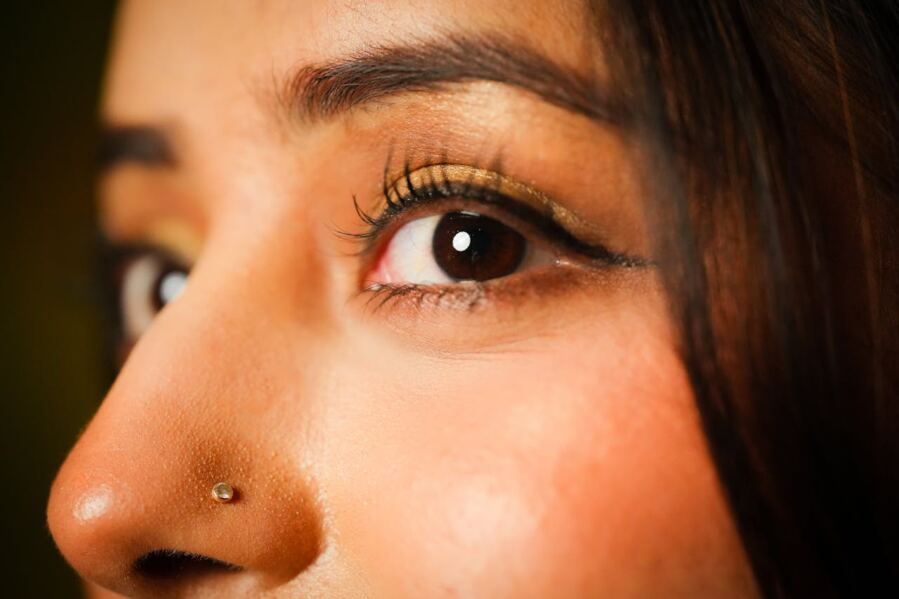
Ask someone to describe a beautiful face and they will probably mention the eyes. Maybe the cheekbones. The jawline, perhaps. Rarely the nose. Which is, it turns out, rather the point. A new study using eye-tracking technology has confirmed something plastic surgeons have long suspected but struggled to prove: the most attractive nose is the one that disappears, the one that quietly does its job at the centre of the face without demanding anyone’s attention. When a nose achieves this kind of invisibility, the eyes get the stage to themselves. When it doesn’t, the whole audience shifts.
The study, published in Plastic and Reconstructive Surgery by researchers at Northwestern University Feinberg School of Medicine in Chicago, is the first to quantify this effect in a non-surgical, demographically diverse population using precise gaze data alongside 3D facial mapping.
Thirty-four volunteer models sat for standardised photographs (frontal, oblique, lateral, and the unflattering worm’s-eye view) while a separate group of 31 observers viewed the images on a Tobii Pro Spectrum eye-tracker, a piece of hardware that can resolve where your gaze lands to within a few millimetres. The observers were told only that they would be looking at faces. No mention of noses. Each image appeared for five seconds, enough time for the eye to make several unconscious journeys across a face and settle into whatever pattern feels most natural. The researchers logged fixation duration, revisit frequency, and time to first contact for three regions: the eyes, the nose, and the mouth. They then cross-referenced all of that with attractiveness ratings that the observers completed immediately afterwards.
Where the Eyes Actually Go
The results were, depending on your perspective, either deeply intuitive or genuinely strange.
Observers spent roughly 0.81 seconds fixating on noses rated unattractive, compared to 0.72 seconds for attractive ones. That 90-millisecond gap might sound trivial, but in perceptual terms it’s not. Previous research in rhinoplasty patients has shown that a 130-millisecond decrease in nasal fixation time follows a successful nose job, meaning the shift detected here, in people who hadn’t had surgery at all, captures something close to the full range of naturalistic variation the face can produce. Unattractive noses were also revisited more often, as if the observer’s gaze kept getting tugged back against its own instincts.
“Simply put: unattractive noses stick out, and detract attention from other facial features, such as a person’s beautiful eyes or mouth,” says Robert D. Galiano, senior author and plastic surgeon at Northwestern. “Many of our rhinoplasty patients focus on specific things they don’t like about their nose, without considering how the nose influences overall nasal perception.”
The downstream effects on gaze are where the findings get particularly interesting. It’s not just that observers looked more at unattractive noses; they looked less at everything else that usually matters. Observers with attractive noses received an average of 1.92 seconds of eye fixation, compared to 1.69 seconds for those with noses rated unattractive, a difference of nearly a quarter of a second across a five-second viewing window. The mouth, meanwhile, absorbed significantly more attention when the nose was disharmonious: 0.65 seconds versus 0.54. The researchers interpret this as a kind of compensatory wandering, the gaze reaching for another socially expressive feature when its preferred destination, the eyes, has been crowded out. Heatmaps generated from the data make this starkly visible: warm red pooling over the eyes in attractive-nose conditions, then bleeding downward toward nose and mouth when nasal attractiveness drops.
What the study did not find is almost as instructive as what it did. The traditional neoclassical canons (those classical-era ratios that divided the face into thirds and the nose into proportional segments) had no significant relationship with attractiveness ratings in this cohort. Nasal width, similarly, didn’t matter much. Tip deviation (the degree to which the nasal tip skews sideways) did affect attractiveness, but only when observers rated isolated nose images, cropped out of the face entirely. In full-face photographs, the same tip asymmetries registered as essentially unremarkable. The implication is that the face assesses its own features in context, integrating everything it sees rather than auditing each part separately.
Interrater reliability for nasal attractiveness ratings was, charitably, modest: an intraclass correlation coefficient of about 0.12 to 0.16 depending on the viewing condition. That’s slight agreement, meaning that individual observers varied considerably in what they considered an attractive nose. Yet the group-level gaze patterns were consistent. Beauty, when it comes to noses, may be difficult to agree on, but ugliness, or rather, disharmony, reliably pulls attention in the same direction regardless of who’s looking.
What Surgeons Can Do with This
There are legitimate limits to what the study can claim. All images were static, and real-world faces move; a nose that reads as subtly off in a photograph might read differently in conversation, when expression and animation complicate the picture. The observer pool skewed predominantly White despite a more diverse model cohort, which potentially biases what counts as attractive toward particular cultural norms. The researchers acknowledge this and call for broader cross-cultural replication. Dynamic stimuli, video rather than photographs, are a logical next step.
For surgeons, the practical takeaway is about expectation-setting as much as technique. “By showing how attractive noses enhance facial harmony by blending into the face, our study has practical implications for aesthetic surgery, particularly in guiding patient expectations and surgical planning,” Galiano says. A patient who arrives fixated on a specific nasal feature (a slight bump, a tip that drifts a degree or two) may be seeing something real but misunderstanding what it does. The nose’s job, aesthetically speaking, is to not have a job. To be present enough to anchor the face and absent enough to let the eyes do the actual work of connection. Whether surgeons can predictably engineer that kind of invisibility, especially now that 3D imaging and real-time gaze tracking are becoming feasible tools in surgical planning, is a question the field is only beginning to ask.
Frequently Asked Questions
Does this mean a “perfect” nose by classical beauty standards isn’t actually attractive?
Essentially, yes. The study found that traditional neoclassical canons, the proportional ratios that dominated aesthetic thinking for centuries, had no significant relationship with how attractive observers found a nose. What mattered wasn’t conforming to an ideal geometry but blending into the overall face. A nose can be mathematically “correct” and still draw uncomfortable amounts of attention if it doesn’t harmonise with the features around it.
Why do unattractive noses pull the gaze toward the mouth as well?
The researchers think this is compensatory gaze behaviour. When a nose is visually prominent, it disrupts the observer’s natural tendency to settle on the eyes, the most socially expressive part of the face. Deprived of that anchor, the gaze drifts to the next most expressive region, which is the mouth. It’s less a judgement about the mouth and more an unconscious search for stable social ground when the usual route is blocked.
Is a 90-millisecond difference in gaze time actually meaningful in real life?
More than it sounds. Other research has found that rhinoplasty reduces nasal fixation by around 130 milliseconds, and that’s the difference between a face that looks operated-on and one that looks entirely natural. The 90-millisecond gap this study detected comes from ordinary variation in the general population, with no surgery involved. It suggests that relatively subtle differences in nasal harmony produce gaze shifts that are, in perceptual terms, substantial.
Could surgeons actually use eye-tracking data to plan rhinoplasty procedures?
That’s the direction the researchers are pointing. At present, surgical planning relies heavily on photographs, 3D scans, and the surgeon’s trained aesthetic eye. Adding real-time gaze data to that process could, in principle, help predict how a proposed change will shift an observer’s attention across the face before any surgery is performed. It remains technically ambitious, but the hardware already exists; the challenge is building predictive models robust enough to guide clinical decisions.