

Every time a clinician runs a probe across a pregnant abdomen, a remarkable act of physics plays out in the tip of that device. The material inside converts electricity into vibration so precisely that it can sketch a face before birth. These materials, called relaxor ferroelectrics, have powered ultrasound scanners, sonar systems, and microphones for decades. And yet, right up until last week, nobody could directly measure the atomic structure responsible for their extraordinary properties. Researchers had working theories, computer models, decades of indirect evidence. What they didn’t have was a three-dimensional view of what was actually happening inside.
That gap has now closed. A team from MIT and several collaborating institutions has published the first direct, volumetric characterization of the atomic structure of a relaxor ferroelectric, reported in Science. The results don’t just settle a long-running debate in materials science; they expose a layer of chemical disorder that existing models hadn’t fully accounted for, which means those models were, in a sense, wrong in ways nobody quite realised.
The difficulty isn’t hard to understand, even if the solution took decades to arrive at. Relaxor ferroelectrics get their properties from tiny regions within the crystal where atoms shift slightly out of their usual positions, generating local electric polarization. These polar nanoregions, as they’re called, interact in complex ways that produce the materials’ signature behaviour: enormous electromechanical coupling, broad dielectric response, sensitivity that strains the imagination. But these nanoregions are only a few nanometres across, they’re disordered, and they extend in three dimensions. Conventional electron microscopy collapses that third dimension entirely, projecting a 3D crystal onto a 2D image and averaging everything together. It’s a bit like trying to map a city by photographing it from directly above: informative, but inevitably incomplete.
The technique that broke the impasse is called multi-slice electron ptychography, or MEP. It’s an emerging approach in which a nanoscale probe of high-energy electrons is scanned across a material in overlapping steps, collecting a diffraction pattern at every position.
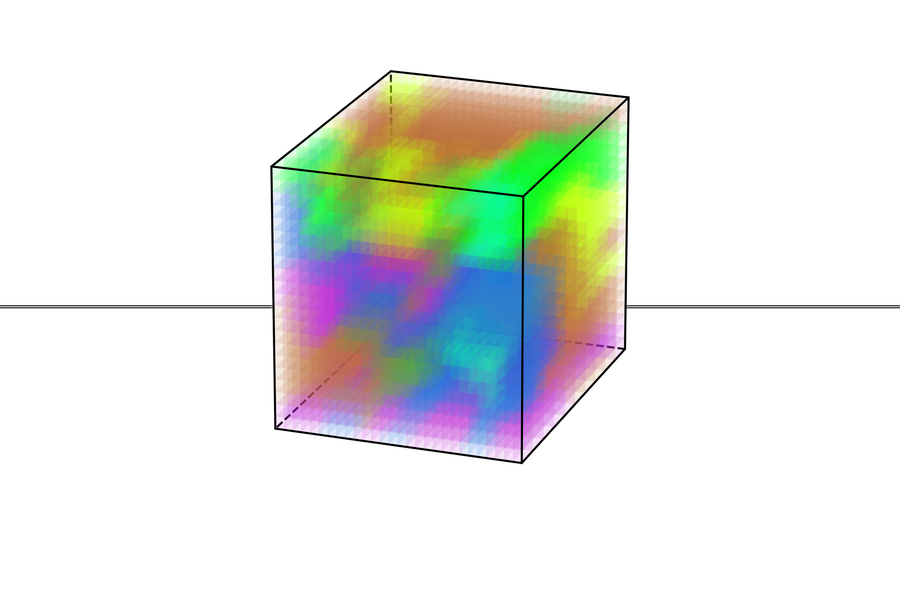
“We do this in a sequential way, and at each position, we acquire a diffraction pattern,” says Menglin Zhu, a postdoc at MIT and co-first author on the paper. “That creates regions of overlap, and that overlap has enough information to use an algorithm to iteratively reconstruct three-dimensional information about the object and the electron wave function.” The result is something like a CT scan of the crystal, slice by slice, down to the level of individual atom columns. Twenty-three slices, each roughly a nanometre thick, stacked into a complete volumetric portrait of the material’s polar and chemical architecture.
A Surprise in the Disorder
What the team found didn’t match what the best simulations had predicted. The polar nanodomains were smaller than expected, more disordered, and crucially, the chemical arrangement of atoms on the crystal’s B sublattice (where magnesium, niobium, and titanium atoms sit in varying configurations) was scrambled to a degree that previous models hadn’t incorporated. “We realized the chemical disorder we observed in our experiments was not fully considered previously,” says Michael Xu, a postdoc at MIT and the paper’s other co-first author. “Working with our collaborators, we were able to merge the experimental observations with simulations to refine the models and better predict what we see in experiments.”
That refinement required a kind of back-and-forth between experiment and theory that the field had arguably been waiting for. Existing computer simulations of the material (a lead magnesium niobate-lead titanate alloy, used in sensors, actuators, and defense systems) had assumed a partially ordered arrangement of atoms on one of the crystal’s sublattices, with niobium occupying an alternating rocksalt pattern. The MEP data suggested that in the composition they were studying, that ordering had essentially collapsed, replaced by something closer to fully random chemical disorder with only hints of short-range structure remaining. When the team fed that finding back into the molecular dynamics simulations, the results snapped into agreement with experiment, including some features, particularly high-angle charged domain walls, that the earlier models had never predicted at all.
“Previously, these models basically had random regions of polarization, but they didn’t tell you how those regions correlate with each other,” Xu says. “Now we can tell you that information, and we can see how individual chemical species modulate polarization depending on the charge state of atoms.” The connection matters because it’s not just static disorder. Regions rich in low-valence magnesium atoms act as sinks that pull surrounding polarization toward them; niobium-rich regions push it outward. The material’s electric behaviour is, in a sense, a direct readout of its chemistry, atom by atom.
Models That Actually Reflect Reality
James LeBeau, MIT’s Kyocera Professor of Materials Science and Engineering and the paper’s corresponding author, was brisk about the implications. “Now that we have a better understanding of exactly what’s going on, we can better predict and engineer the properties we want materials to achieve,” he says. The broader point he’s making is one that tends to get buried in the technical literature: materials design increasingly relies on simulation, and simulation is only as good as the models it runs on. LeBeau notes that as AI tools and computational methods have grown more sophisticated, materials science has leaned harder on simulation, incorporating more complexity into design. But without a way to validate whether those models actually reflect what atoms do, the whole enterprise risks becoming garbage in, garbage out. The MEP technique, he argues, finally gives researchers a way to check.
There are limits, of course. The team worked on thin films under specific strain conditions, and the findings are most directly applicable to the particular composition they studied, around the morphotropic phase boundary where the material’s properties peak. Whether the fully disordered model holds across a broader range of compositions, temperatures, and external fields will require further work. The discrepancy between simulated and experimentally observed domain sizes (polar nanoregions are larger in real samples than in the fully disordered simulation) suggests something is still missing, perhaps a degree of residual short-range niobium ordering that the models don’t yet capture correctly.
The research community has sometimes described the problem of understanding relaxors as resembling the old parable of blind men and an elephant, each technique revealing a different part of the picture without any one of them grasping the whole. Scattering experiments give averaged structural information; simulations give atomistic detail; conventional microscopy gives 2D projections. MEP’s contribution is that it works at a scale and in a format that can be directly compared to simulation output, closing the gap between what theory predicts and what experiment actually observes.
The implications reach well beyond ultrasound probes. Relaxor ferroelectrics are candidates for next-generation energy storage, where their high dielectric response could allow capacitors to store far more energy per unit volume. They’re under investigation for precision sensors, medical imaging upgrades, and potentially for some classes of memory device. All of those applications depend on tuning the material’s properties, which depends on understanding what controls them, which, it turns out, required seeing the atoms in three dimensions first.
“This study is the first time in the electron microscope that we’ve been able to directly connect the three-dimensional polar structure of relaxor ferroelectrics with molecular dynamics calculations,” Xu says. The technique is already being applied to other chemically complex materials. The question now is how many other well-used, poorly understood substances are waiting for the same treatment.
DOI / Source: https://doi.org/10.1126/science.ads6023
Frequently Asked Questions
Why haven’t scientists been able to see inside these materials before now?
Conventional electron microscopy compresses a three-dimensional crystal into a two-dimensional image, averaging out the depth information that matters most in relaxor ferroelectrics. The polar nanoregions responsible for their properties are only a few nanometres across and arranged in all three spatial dimensions, so any technique that collapses depth was always going to miss part of the picture. Multi-slice electron ptychography collects overlapping diffraction patterns that can be used to reconstruct the structure slice by slice, something like a CT scan at the atomic scale.
Does this mean existing ultrasound and sensor technology was built on wrong assumptions?
The devices work fine; the issue is with the theoretical models used to design next-generation materials. Engineers have been tuning relaxor ferroelectrics empirically for decades, adjusting composition and processing conditions through trial and error. What this research changes is the ability to predict, rather than simply discover, how changes to the material’s chemistry will affect its performance. Models that assumed a partially ordered atomic arrangement will need to be revised to reflect the fuller chemical disorder the MIT team observed.
Could better models lead to significantly improved energy storage materials?
Possibly, though the path from atomic insight to practical device is rarely short. Relaxor ferroelectrics already hold interest for high-density capacitors because of their unusually high dielectric response, and understanding the chemical conditions that maximise that response could guide the design of new compositions. Whether that translates to a breakthrough in, say, electric vehicle energy storage depends on manufacturing challenges that materials science alone can’t solve, but having accurate predictive models is a necessary step.
What is the “polar slush” that researchers keep referring to?
It’s a model for how polarization is organised inside relaxor ferroelectrics, somewhere between the completely random arrangement of a glass and the perfectly ordered alignment of a conventional ferroelectric crystal. Instead of stable, large polarized domains that flip together under an electric field, a relaxor has a shifting landscape of tiny nanodomains with gradually varying polarization directions, separated by diffuse walls. The slush metaphor captures the idea that it’s partly structured, partly fluid, and sensitive to temperature and strain in ways that a simple ordered crystal isn’t.
What other materials could this imaging technique be applied to?
The researchers suggest that any chemically complex or structurally disordered material could potentially benefit from the same approach, including high-entropy alloys, complex oxide semiconductors, and other ferroelectric systems. The key advantage of multi-slice electron ptychography is that it produces three-dimensional structural data at the atomic scale that can be directly compared against simulation output, bridging a gap that has limited progress in modelling disordered materials more broadly.