

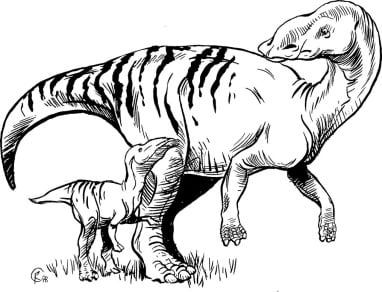
Teeth tell the truth. It’s one of the few things paleontologists can more or less rely on: rock-hard, slow-decay, chemically stubborn, teeth preserve the details of a life that softer tissues surrender in the first centuries of burial. Which is why John Hunter, an associate professor of evolutionary biology at Ohio State University, spent considerable time peering at the fossilized dental batteries of juvenile Maiasaura, a duck-billed dinosaur from the Late Cretaceous of Montana, and noticing something the fossils had been trying to say for 75 million years. The babies’ teeth were worn differently than the adults’. Not slightly differently. Significantly.
That asymmetry, it turns out, probably reflects parental feeding behavior so sophisticated it had no real precedent on land at the time, something that looks, rather remarkably, like the provisioning behavior of modern nesting birds.
Hadrosaurs had extraordinary teeth. Rather than a simple set of individual molars, they maintained “dental batteries,” tight mosaics of closely packed tooth families, each containing several vertically stacked replacement teeth that erupted as older ones wore away, a system functionally analogous to the high-crowned grinding teeth of horses and cattle but arrived at through a completely different evolutionary path. Infant Maiasaura had smaller batteries with fewer tooth families, but the key observation in Hunter’s study (co-authored with Christine Janis of the University of Bristol) concerns not the size but the pattern of wear surfaces. Two types can be distinguished: shearing surfaces, steep and striated, generated by dragging fibrous plant material across the teeth; and crushing surfaces, flatter and more horizontal, left by pulping softer food items without obvious directional structure.
Juvenile specimens showed roughly twice the proportion of crushing wear. In adults, shearing dominated overwhelmingly.
What Mammal Teeth Can Tell Us
To make sense of that difference, Hunter and Janis turned to living herbivorous mammals whose diets are reasonably well understood. Across dozens of species, from tapirs to wildebeest to sun bears, the proportion of tip-crushing wear on the molars tracks closely with the proportion of non-fibrous items in the diet; grazers eating mostly tough grass stems show almost pure shearing, while frugivorous species show substantially more crushing. The correlation is strong (r-squared of 0.79, for those who reckon that sort of thing matters). When the hadrosaur specimens were overlaid on that regression, juvenile Maiasaura clustered with low-fiber mammalian specialists, the fruit-eaters and berry-pickers, while adult hadrosaurs fell squarely among the high-fiber browsers and grazers.
“The urge for a bird to feed a youngster is a very old behavior,” Hunter said. “What we’re providing is that evidence for that behavior probably goes much further than the origin of birds, perhaps to the origin of dinosaurs.”
The working interpretation is that adult Maiasaura were selectively provisioning their nest-bound young with berries, buds, and other protein-rich, low-fiber plant material, food of considerably higher caloric density than the coarser browse the adults themselves consumed. This is precisely the provisioning strategy of what ornithologists call nidicolous birds, species whose young hatch in an altricial (helpless) state and remain in the nest for weeks, entirely dependent on parental feeding. Modern examples include most songbirds, raptors, and herons. The parallels with Maiasaura stack up uncomfortably well: nests closely spaced in colonial groups, young with poorly ossified limbs suggesting they couldn’t walk let alone forage, and bone histology indicating explosive growth rates during the first year (some estimates put nestling periods at around 40 to 75 days).
Other explanations can’t be entirely ruled out. Adults might have been partially regurgitating pre-masticated food, breaking down fiber before delivering it, which would also produce dietary differences without requiring the adults to select different plants. Or, alternatively, the juveniles might have been foraging for themselves, targeting tender growth near the nest. Hunter considers that last option unlikely, given that the fossil evidence consistently shows juvenile remains associated with nest sites rather than scattered through the wider habitat, but the paper is appropriately careful not to claim certainty it doesn’t quite have.
There’s also a methodological caveat worth sitting with: adult dental batteries of Maiasaura itself weren’t available for the study, so adult wear data comes from related saurolophine hadrosaurs. If adult Maiasaura turned out to have more crushing wear than their cousins, the dietary difference would shrink. The authors flag this honestly; it’s an obvious target for future work.
Older Than Birds
What perhaps deserves more attention is what the finding implies about when parental care of this kind emerged. It almost certainly predates birds. The theropod lineage that eventually produced birds diverged from the broader dinosaur family tree long before Maiasaura’s ancestors evolved, and if provisioning behavior was already present in ornithischian hadrosaurs, a completely separate branch, then it’s plausible the behavior arose independently at least twice, or, perhaps more interestingly, that it reflects something fundamental about the pressures of raising fast-growing young in colonial settings. Maiasaura’s name, chosen by Jack Horner and Robert Makela when they described the species in 1979, means “good mother lizard.” The teeth suggest it might have earned that name more fully than anyone then realised.
“The further back in time you go, the less of a fossil record you have, so paleontologists have to draw from different sources of inspiration from different parts of the living,” Hunter said. The next step, he suggests, might be examining even younger specimens, embryos or hatchlings rather than nestlings, for dental microwear that could pin down whether the dietary difference begins before or after the parents start feeding. Teeth, after all, may have more to say.
DOI: 10.1016/j.palaeo.2026.113707
Frequently Asked Questions
Does this mean dinosaurs were warm-blooded and looked after their young like birds do?
Not exactly, though the two ideas are related. The study doesn’t directly address metabolism, but it does add to a growing body of evidence that at least some dinosaurs had bird-like parental care: keeping young in the nest, growing them fast, and actively feeding them. Maiasaura young hatched in a helpless state and appear to have depended on adults for food for weeks, a pattern far closer to nesting sparrows than to, say, a sea turtle that buries its eggs and never returns.
How can you tell what an animal ate from how its teeth are worn?
Different foods leave different marks. Fibrous plant material like tough leaves and grass stems drags across tooth surfaces in a directional way, producing linear striations and steep “shearing” facets. Softer items like berries and buds pulp against flatter surfaces, leaving rounded pits with no preferred direction. Scientists have mapped these wear patterns against the known diets of living herbivorous mammals and found a strong statistical relationship, which can then be applied to fossil specimens. It’s not a perfect read on diet, but it gives reliable information about the proportion of tough versus soft food in the mix.
Could the adults have just been eating the same food as their young, and the different wear patterns mean something else?
The researchers considered this. One alternative is that the crushing wear in juveniles simply reflects the mechanical properties of a younger, differently shaped jaw rather than a different diet. But several other lines of evidence point toward a genuine dietary difference: juvenile remains are restricted to nest sites (making self-foraging unlikely), growth rate data suggests young Maiasaura needed a high-protein diet to sustain their rapid expansion, and the wear differences are statistically very similar to those seen between low-fiber and high-fiber feeders in living mammals.
Is this the oldest known example of parental feeding in dinosaurs?
It’s among the most direct evidence, but hadrosaurs are relatively recent in the dinosaur story, appearing in the Late Cretaceous around 80 million years ago. Whether similar feeding behavior existed in earlier dinosaur groups is harder to assess because the fossil record becomes thinner and dental analysis of this kind requires well-preserved specimens. Hunter’s observation is that the behavior “probably goes much further than the origin of birds, perhaps to the origin of dinosaurs” itself, which would push the timeline back another 100 million years or more, but testing that will require new fossils and new methods.
