

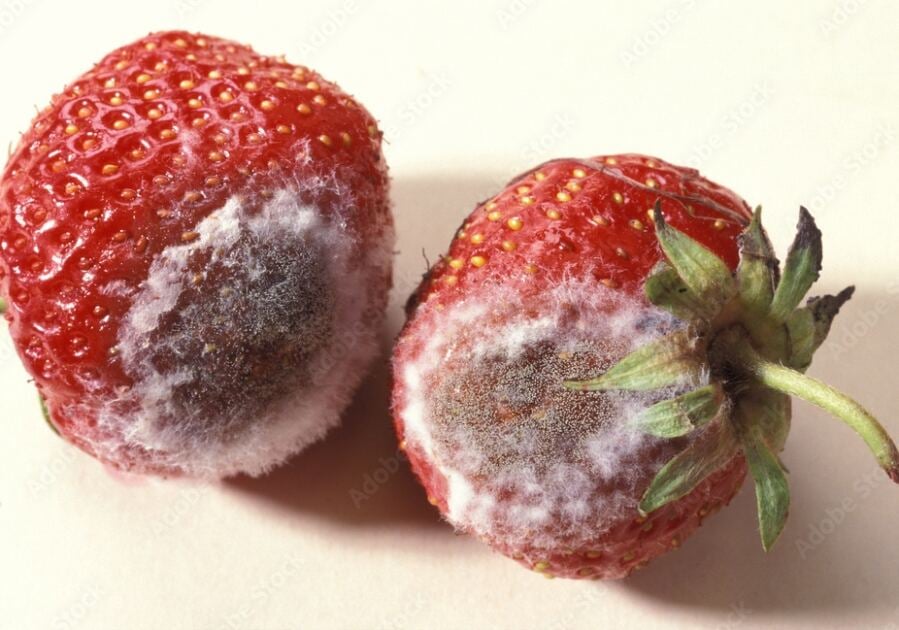
Pick up a punnet of blueberries from any supermarket shelf and there’s a reasonable chance, depending on how long they’ve been sitting there, that you’ll spot it: a faint grey fuzz creeping across the skin. That’s Botrytis cinerea, the most promiscuous plant pathogen on Earth. It infects more than 1,500 species. Grapes, lettuce, soybeans, roses, your grandmother’s geraniums. For decades, crop scientists have tried and mostly failed to breed resistance into the plants it destroys. Now a pair of studies from UC Davis suggests the field may have been solving the wrong problem entirely.
The assumption, reasonable enough on its face, was that plants broadly resemble each other in how they fend off fungal attack. Different decorations perhaps, but the same underlying architecture. “It’s like they might do little decorations on the Christmas tree, but it’s always a Christmas tree,” said Dan Kliebenstein, a professor in the UC Davis Department of Plant Sciences who led both studies. His team’s data demolished that picture. For some plants it isn’t a Christmas tree at all. It’s a saguaro cactus.
What they found, when they infected 57 plant genotypes from 15 different eudicot species with 72 genetically diverse isolates of the fungus, was that each plant was mounting a response that was fundamentally its own. Tomatoes were doing one thing, celery something else entirely, sunflowers something different again. The defences were so specific to each host that the information encoded in one plant’s resistance genes was, in a very real sense, useless for breeding resistance into another. “It’s why we could never figure out how to move information from one plant to help another become resistant, because what one plant is doing doesn’t actually do anything for the other plant,” Kliebenstein said.
A Pathogen That Tastes Before It Attacks
The second finding was stranger still. Gray mold doesn’t carry a master key. It doesn’t attack every plant with the same toolkit, hoping something works. When it lands on a strawberry leaf, the fungus reads the plant’s own chemical signature and reconfigures accordingly. Land on a tomato and it runs a different programme. Kliebenstein reached for an unexpectedly vivid comparison: “The pathogen is like a human. At some level, it knows it’s attacking a strawberry, and there’s one set of things it should do. If it’s attacking a tomato, it knows it’s attacking a tomato and it decides to do something completely different.”
The mechanism is chemical. Plants produce a kind of metabolic fingerprint: resveratrol in grapes, alpha-tomatine in tomatoes, glucosinolate derivatives in cabbages and mustard plants. These molecules are defences, or at least that’s what they evolved to be. But Botrytis has learned, over evolutionary time, to read them as cues. The plant is essentially announcing its identity, and the fungus is listening. Transcriptome profiling at 48 hours after infection showed the pathogen switching on different clusters of genes depending on which host it encountered, a modular strategy the researchers describe as combining a stable metabolic core with a highly plastic, host-responsive layer. The fungus, in Kliebenstein’s framing, is tasting the difference between a strawberry and a tomato and then deciding how to proceed.
Intriguingly, nearly all 72 isolates could infect all 15 host species. There was no strict specialisation, no particular strain of Botrytis that was a strawberry specialist or a tomato specialist. The genetic variation among isolates explained the largest share of lesion size within any given plant (somewhere between 15% and 45% of total variance), but that variation was in the magnitude of the attack rather than its basic feasibility. This is a pathogen that has built generalism out of transcriptional flexibility rather than genomic compartmentalisation, which is somewhat unusual. In many specialist fungi, virulence genes cluster together in rapidly-evolving genomic hotspots. In Botrytis, the relevant genes are scattered across the genome, regulated rather than restructured.
Two Steps to the Right
The implications for disease control are either sobering or galvanising, depending on how you look at it. Gray mold causes somewhere between 5% and 10% crop loss across fruits and vegetables globally, affecting everything from wine grapes to cut flowers. Billions of dollars of produce. Decades of resistance breeding have chipped away at this problem by trying to strengthen individual crops, one at a time, against a pathogen that simply adjusts its approach. “They suggest that everything we’ve been trying on the plant or fungus side is probably always going to be doomed to fail, and instead we should be looking at how the pathogen knows what it’s attacking,” Kliebenstein said.
That’s a significant pivot. If the fungus’s ability to infect broadly depends on its capacity to detect and respond to individual host cues, then disrupting that detection mechanism might neutralise its generalism in one move rather than fifty. Confuse the fungus’s ability to identify its host and it can’t mount the right programme. A disorientated pathogen might then fail to suppress the plant’s own defences before those defences have time to kick in. In theory, this kind of intervention could work across multiple crops simultaneously, unlike the current crop-by-crop approach that the researchers are politely suggesting has been hitting a wall.
Kliebenstein, perhaps understandably, was fairly direct about the magnitude of this conceptual shift: “We’ve been hitting ourselves against a brick wall and we just never thought about this. Now we might have realized, oh, if we take two steps to the right, the brick wall ends.”
What Comes Next
There are meaningful caveats. The gene clusters responsible for host detection haven’t yet been identified specifically; the transcriptome data maps which genes are activated on different hosts, but the upstream sensing mechanism, the molecular equivalent of the fungus’s taste buds, remains to be pinned down. Functional validation in living crops is still ahead. The study also covered only eudicots, roughly the flowering plants with two seed leaves, so it’s not yet clear how broadly the plasticity model extends across the plant kingdom. And some of the host-specific transcriptional patterns were more consistent across Botrytis isolates than others, suggesting the picture is more variable than a clean two-module model implies.
Still, the research represents the most comprehensive cross-species transcriptomic dataset assembled for any fungal plant pathogen, covering 72 isolates across 15 species in a single experimental framework. The question of how a single pathogen can be simultaneously devastating to strawberries and lettuce and orchids has resisted a satisfying answer for years. It turns out the answer might be that it doesn’t try the same trick twice. What that implies for disease control strategies, and how far along the path from transcriptome data to deployable crop protection that actually gets us, is the problem the field will spend the next decade working out.
The studies were published in Proceedings of the National Academy of Sciences. Source: doi.org/10.1073/pnas.2521414123
Frequently Asked Questions
Why has breeding disease-resistant crops against gray mold been so difficult?
The answer, according to this research, is that scientists were working from a false assumption: that different plants defend themselves in broadly similar ways against fungal attack. In fact, each plant species appears to mount a defence that is fundamentally its own, which means resistance traits developed in one crop offer almost no guidance for engineering resistance in another. The new findings suggest the focus should shift away from plant defences entirely and toward the pathogen’s ability to detect its host.
How does Botrytis cinerea “know” which plant it is attacking?
The fungus appears to read chemical signals produced by the plant, including defensive compounds such as resveratrol in grapes, alpha-tomatine in tomatoes, and glucosinolates in plants like cabbage and mustard. Rather than acting as effective repellents, these molecules seem to function as identity markers that the fungus uses to switch on the right set of attack genes. Exactly how it detects these signals at the molecular level is a key question that future research needs to answer.
Could disrupting the fungus’s host-detection ability protect multiple crops at once?
That’s the central hope the research opens up. If gray mold’s broad host range depends on its ability to sense and respond to individual plant chemistries, then blocking that sensing mechanism could, in theory, render the pathogen ineffective across many crops simultaneously. This would be a significant advantage over current approaches, which must be engineered crop by crop. Whether that strategy is practically achievable depends on identifying the specific genes involved in host recognition and finding a way to interfere with them.
Is gray mold actually that serious a problem for global food supply?
It causes an estimated 5% to 10% crop loss across a wide range of fruits and vegetables, including grapes, lettuce, soybeans, and strawberries, as well as economically valuable cut flowers. That scale of consistent loss across so many different crops, combined with the failure of previous control strategies to make substantial headway, is what makes this particular pathogen such an enduring target for plant disease research.
