

Every 80 minutes or so, a faint patch of sky toward the constellation Ara flickers. A burst of radio waves, sharply polarized, lasting a few minutes, then gone. Sometimes it switches off entirely for hours. For the better part of two years, a radio telescope in outback Western Australia kept catching the same beat, over and over, with the stubborn regularity of a metronome.
Astronomers have a name for signals like this: long-period radio transients, or LPTs. They have also, until now, had almost no idea what makes them.
“Long-period radio transients have puzzled astronomers for years,” says Kovi Rose, a PhD student at the University of Sydney and CSIRO who led the work. There are only about a dozen known, and for most of them the source has been anyone’s guess. Slow-spinning neutron stars were the early favorite. Trouble is, a neutron star turning that lazily, once every hour or two rather than once a second, shouldn’t be able to fling out radio bursts at all, at least not according to the physics we think we understand.
So Rose and an international team went looking for the culprit behind one of them. They found two stars.
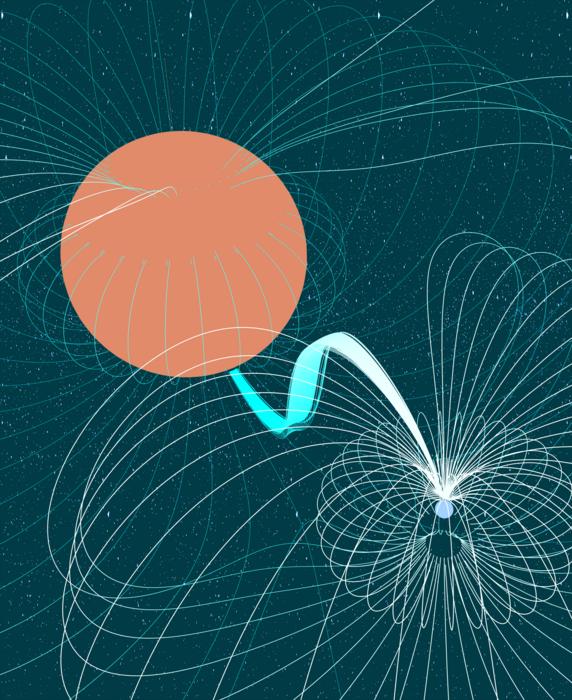
The system, catalogued with the unlovely designation ASKAP J1745-5051, sits somewhere between roughly 1,300 and 30,000 light years away (the distance is genuinely hard to pin down, more on that later). At its heart is a white dwarf: the burnt-out core of a dead star, about the size of Earth but packing close to the mass of the Sun. Whipping around it, completing a full orbit in just over an hour, is a red dwarf weighing perhaps a tenth of what the Sun does. They are close. Far too close for comfort. The white dwarf is pulling its companion apart, dragging streams of gas off the smaller star and onto itself.
That cannibalism is the engine. As the stolen material spirals in it heats up and screams in X-rays, while the tangled magnetic fields of the two stars slam together and generate the radio bursts. The whole thing runs on the clockwork of the orbit, which is why the signal repeats so faithfully.
Here is the clue that gave the game away. The radio pulses and the X-ray pulses, though they keep the same period, don’t arrive together. “But interestingly, the radio and X-ray signals don’t peak at the same time, which tells us they’re being produced in different regions of the system,” says Rose. In other words the X-rays come from where the gas crashes down near the white dwarf, and the radio comes from somewhere else entirely, out where the two magnetic fields meet and wrestle. To confirm the picture, the team caught the system’s fingerprint in optical light too, using telescopes in Chile: the telltale emission lines of hydrogen and helium that mark out a particular beast called a magnetic cataclysmic variable, a class of accreting white dwarf binary that astronomers have studied for decades, just never as the source of an LPT.
The Jupiter Connection
One detail genuinely surprised them. Within the radio bursts sat a fine, narrow ripple in frequency, a pattern of stripes astronomers call modulation lanes. The only other place in the cosmos this exact effect had ever been seen in a binary is the Jupiter-Io system, where the moon Io ploughs through Jupiter’s magnetic field and lights up the gas giant in radio waves. Seeing the same signature here suggests pockets of plasma sitting between us and the source, scrambling the beam on its way out, like light bending through frosted glass.
The system is rare in another way. It is only the third LPT ever caught emitting X-rays, and the first where astronomers have nailed down why those X-rays come and go on a schedule. “Some similar objects had been linked to binary systems before, but this is the first one where we can clearly see both stars and the accretion process in action,” says Tara Murphy, head of physics at Sydney and a chief investigator at the gravitational-wave research center OzGrav.
What the Two Stars Still Won’t Say
Not everything is tidy. That troublesome distance, anywhere from about 0.4 to 9 kiloparsecs depending on which method you trust, leaves a lot of the system’s properties loosely constrained. The team can’t yet measure how fast the white dwarf itself spins, which matters for sorting out exactly what kind of magnetic variable they’re dealing with. And whether the same machinery explains every LPT out there, or just this one and its cousins, is wide open.
Still, the appeal of a system like this goes beyond solving one puzzle. These are conditions you simply cannot build in a lab, magnetic fields of millions of gauss, matter falling at a fair fraction of light speed, plasma behaving in ways no terrestrial experiment can mimic. “These systems are natural laboratories,” says Rose, places to test how matter behaves when the magnetic fields are monstrous and the gravity is brutal. The hope is that ASKAP J1745-5051 becomes a reference, a Rosetta stone, against which the other puzzling transients can be read. Decode this one and you have a key to the rest. Or so the thinking goes.
The team now plans to keep watching, stitching together radio, optical and X-ray observations to work out precisely where and how each kind of light is born. There are more of these objects out there, almost certainly, waiting in the survey data. “We’re only just beginning to understand this new class of cosmic events,” says Rose.
Source: Rose, K. et al., Nature Astronomy (2026). https://doi.org/10.1038/s41550-026-02882-x
Frequently Asked Questions
Why couldn’t astronomers just assume these signals came from pulsars like they used to?
Because the timing doesn’t add up. Classic pulsars spin once every second or faster, but long-period radio transients pulse only once every few minutes or hours, and the physics that powers a normal pulsar shouldn’t work at those sluggish speeds. That mismatch is exactly what pushed researchers to hunt for a different kind of source, and in this case they found one.
How do two stars end up producing a signal this regular?
The regularity comes straight from the orbit. A white dwarf and a much smaller red dwarf circle each other in just over an hour, and as the dead star strips gas off its companion, the infalling material and the clashing magnetic fields generate bursts locked to that orbital rhythm. So the “clock” you’re hearing is really two stars going around each other.
Is it true that this system shows the same effect we see at Jupiter?
Yes, in a specific and surprising way. The radio bursts carry a fine striped pattern in frequency, called modulation lanes, that until now had only ever been seen in binaries at Jupiter and its moon Io. Finding it in a pair of distant stars hints that clouds of plasma are sitting in the beam’s path, and it gives astronomers a fresh handle on what’s happening inside the system.
What’s stopping scientists from fully explaining every signal like this?
Two big things: distance and spin. The system’s distance is only loosely known, which blurs estimates of its true brightness and size, and the white dwarf’s own rotation rate hasn’t been measured yet. Until those gaps close, it’s hard to say whether the same mechanism explains the whole emerging family of these transients or just a subset of them.