
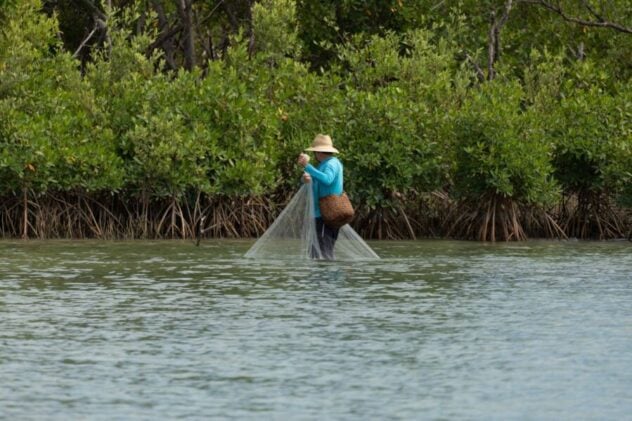
A mangrove keeps a careful appointment with the sea. Twice a day the tide climbs through its roots, drops a fresh skim of mud, and retreats, and the tree builds itself a little higher on the leavings. Do this for a few centuries and you get something extraordinary: a forest sitting on metres of black, waterlogged, carbon-stuffed soil, a sink so dense it puts ordinary woodland to shame. The arrangement only works, though, if the flooding lasts exactly as long as the plant can tolerate. Not a minute more.
That tolerance is now the crux of an uncomfortable question. As seas rise, do mangroves bank more carbon or start coughing it back up?
For years the field leaned optimistic. Go out, sink a core, measure the soil, and you tend to find that rising water makes a stand of mangroves store carbon faster, not slower, because deeper flooding traps more sediment and lets organic matter pile up. It is a tidy, reassuring result, and it has been recorded again and again. “Research about carbon storage in mangroves is usually based on field observations, and such studies have found that carbon storage can increase as sea levels rise,” says Dr Arya Iwantoro, who carried out the work at the University of Exeter and is now at the University of Plymouth.
The trouble is what a single core can’t see. “But this may not reveal the wider picture of what is happening across the forest as a whole,” Iwantoro adds.
So his team built something to look at the whole thing at once. Rather than model the mud, or the trees, or the carbon in isolation, they stitched all three together into one machine: a coupled simulation that tracks water sloshing through tidal channels, sediment settling and washing away, mangroves colonising and dying back, and the slow accounting of carbon going into and out of the soil. “In effect, we created three models in one to assess the way these complex ecosystems may respond to rising seas,” says Iwantoro.
They ran a virtual embayment, ten kilometres by five, through the IPCC’s sea-level scenarios, from a gentle 29-centimetre rise by 2100 to a brutal 1.1 metres, and watched the forest sort itself out.
What emerged was a split verdict, and it depends entirely on how far back you stand. Zoom right in and the old optimism holds: in more than 98 per cent of the existing mangrove area, rising water did push carbon accumulation up, at least to begin with. The deeper, longer floods relieved trees that had been sitting too high and dry, and they fattened up nicely. Pull the camera back to the scale of the whole forest, though, and the picture inverts. Total carbon storage fell. The reason is brutally simple geometry: the sea drowns the muddy flats where new mangroves would otherwise take root, so even as surviving trees do well, the forest as a whole loses ground it can never get back. Local good news, landscape bad news, and the two had been quietly conflated for years.
Then there is the matter of where the carbon goes once a tree gives up. Mangroves are fussy about flooding for a reason. “Mangrove plants are highly specialised, and they require a certain duration of flooding with each tide,” says Luisa Fernanda Gómez Vargas, also at Exeter. Exceed that window and the plants drown and die back. What happens next is the part that should worry anyone counting on these forests: “Mortality and erosion of carbon-rich soils can turn mangroves from a carbon sink (storing carbon) into a source (releasing it),” she says. In the harshest scenario the model ran, the simulated forest did exactly that, tipping over from soaking up carbon to leaking it offshore. Roughly three-quarters of the mangroves simply drowned where they stood. Fewer than one in ten patches survived the full run.
Survival, it turned out, was mostly about address. Trees growing close to the tidal channels, where the current keeps shovelling in fresh sediment, could ride out far steeper rates of rise, in some spots tolerating more than five times the threshold beyond which mangroves are generally thought to fail. Further from a channel, sediment-starved, they went under fast. Same forest, wildly different fates, separated by a few hundred metres of mud.
But the channels are not simply lifelines. The same rising water that feeds them also makes them grow, widening and biting deeper into the forest, and as they cut they chew through the very soils where centuries of carbon lay buried, flushing it out to sea. In about a fifth of the mangrove-covered area, that erosion stripped out the stored carbon entirely. The thing that saves the trees nearest the water is also the thing that robs the bank.
None of this is a verdict on real-world mangroves yet; it is one idealised embayment, a single species, a deliberately stripped-down world built to expose the mechanism rather than forecast a particular coast. The researchers are upfront about that. What it does do is puncture the comfortable habit of scaling up from a handful of soil cores to an entire forest, and from one forest to a coastline. “Our findings emphasise that understanding the coastal landscape as a whole is crucial when predicting how mangroves might respond to climate change, and how we can protect them,” says Dr Barend van Maanen, who leads the mangrove and carbon project at Exeter. These are forests we lean on for storm protection, fisheries and livelihoods, not just carbon, which makes getting the sums right rather more than an academic nicety.
Blue carbon has become a currency, traded and banked against our emissions on the assumption that what a mangrove stores, it keeps. This work is a quiet reminder that the ledger has a tide running through it, and that the sea may yet ask for some of it back.
Frequently Asked Questions
Why does the difference between local and landscape carbon storage matter?
Because the two can point in opposite directions at once. Soil cores taken in surviving mangrove stands can show carbon piling up faster under rising seas, which looks like good news, while the forest as a whole is shrinking and losing carbon as the sea drowns the flats where new trees would grow. If you scale up from the cores alone, you can badly overestimate how much carbon a coastline will actually hold.
Is it true that mangroves can release the carbon they have stored?
Yes, under the right conditions. When trees drown and die, their carbon-rich soils stop being topped up and can be eroded by the tidal channels carving through the forest. In the model’s most extreme sea-level scenario, the simulated forest flipped from absorbing carbon to exporting it offshore.
How does being near a tidal channel help a mangrove survive?
Channels are the main highways for sediment, so trees beside them get a steady resupply of mud that lifts the soil surface and lets them keep pace with rising water. In the simulation, mangroves near sediment-rich channels withstood far higher rates of rise than those stranded further inland. The catch is that those same channels widen and deepen as seas rise, eroding buried carbon as they go.
Does this mean real mangrove forests are doomed?
Not as such. The study is a deliberately simplified model of a single idealised bay with one mangrove species, designed to reveal how the mechanism works rather than predict any particular coast. Its main message is about method: that protecting and accounting for blue carbon means looking at the whole coastal landscape, channels and all, not just a few sampling points.
ScienceBlog.com has no paywalls, no sponsored content, and no agenda beyond getting the science right. Every story here is written to inform, not to impress an advertiser or push a point of view.
Good science journalism takes time — reading the papers, checking the claims, finding researchers who can put findings in context. We do that work because we think it matters.
If you find this site useful, consider supporting it with a donation. Even a few dollars a month helps keep the coverage independent and free for everyone.