

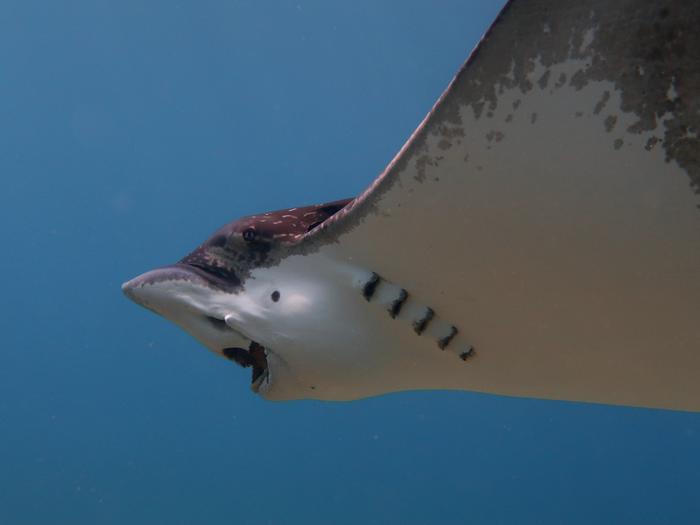
A whitespotted eagle ray does not eat a clam quietly. It pins the shell against crushing plates in its jaw and breaks it apart in a rapid sequence of fractures, each one a sharp broadband snap that travels through the water. Thirteen of them, give or take, to finish off a hard clam. Fewer for a banded tulip snail. To a hydrophone sitting on the seabed, the whole event sounds a bit like someone stepping on gravel, and that, it turns out, is enough to identify what just got eaten.
Researchers at Florida Atlantic University have built a machine learning system that listens for those crunches and works out which species of mollusk a ray is consuming. The appeal is obvious once you consider how hard these interactions are to watch.
Hard-shelled mollusks, clams and snails and the like, do quiet but essential work in coastal ecosystems. They filter water, stabilize shorelines, prop up biodiversity. Yet they are under pressure from ocean acidification and from expanding populations of mobile predators that crack them open for a living. Working out how much damage those predators actually do has been close to impossible, because rays forage in murky subtidal water where divers and cameras struggle to follow them. The process matters, ecologists have known that for decades, but quantifying it was another thing entirely.
The crucial point is that predation is not silent. Every shattered shell leaves an acoustic fingerprint.
A library of crunches
To build a reference library of those fingerprints, the team turned to four captive eagle rays in a circular tank roughly ten metres across, recording with a synchronized camera-and-hydrophone rig as the animals worked through live prey. Three species provided enough crushing events to train on: the hard clam, the banded tulip, and the crown conch. In all, the researchers isolated 7157 individual cracks, each lasting about 0.12 seconds, and grouped them into feeding events. A clam took a median of thirteen cracks to process. A crown conch around ten. The banded tulip, just five, with the first crack carrying noticeably more energy than the ones that followed.
“Shell-crushing sounds contain a surprising amount of ecological information about predator-prey interactions and feeding behavior,” says Laurent Chérubin, a research professor at FAU’s Harbor Branch Oceanographic Institute and the study’s corresponding author.
Pulling those sounds out of a real ocean recording is the genuinely hard part, because the sea is noisy, replete with boat engines, snapping shrimp, sediment shifting on the bottom. The system works in stages. First a matched filter sweeps the audio for anything shaped like a crack, deliberately set to a low threshold so it misses nothing, even at the cost of flagging a lot of rubbish. A second layer, combining mel-frequency features with a support vector machine, then throws out the false alarms. Surviving cracks get sorted by prey species using a mix of methods, from random forests to convolutional neural networks to long short-term memory networks, each trained to read the subtle structure of the sound. One slightly counterintuitive finding stood out: the most elaborate AI was not always the most useful. A streamlined approach built on gammatone features, which loosely mimic how the ear itself processes sound, came within a whisker of the heavy deep-learning models while demanding a fraction of the computing power.
That efficiency is not a footnote. It is arguably the whole point if you want to leave a sensor in the water for months.
“The computational efficiency of GTCC-based models makes them especially well-suited for autonomous underwater platforms with limited power and processing capacity, enabling long-term monitoring in remote marine environments where high-performance computing is not practical,” says first author Ali Ibrahim, an assistant professor in FAU’s College of Engineering and Computer Science.
From the tank to the open water
Then came the real test. A model trained entirely on tank recordings was turned loose on data from the wild, gathered three ways: clams crushed by hand to mimic a ray, a tag riding on a free-swimming animal, and a recorder parked on the seabed next to a patch of planted clams. The animal-borne experiment is the one that catches the eye. Over two and a half hours, a tagged female ray off Bermuda triggered 17 feeding events, and the system flagged exactly 17, the same count a human expert had logged by hand, sorting them into ten hard clam meals and seven banded tulips. At the fixed station, where the prey was known to be hard clam, the classifier got the species right with full confidence by reading the whole sequence rather than any single ambiguous crack. Detection held up out to roughly fifty metres before path loss began to swallow the signal.
There are caveats, naturally, and the team is candid about them. Tank acoustics distort broadband sounds, so the training data carries a built-in bias. Two rays cracking shells at once, or a hermit crab masquerading as snail prey, would likely confuse the current models. And three mollusk species is a thin slice of the thousands out there.
Still, the method does something that visual observation never could: it scales.
“From an ecological perspective, this technology opens the door to quantifying predator impacts in a way we’ve never been able to do before,” says Matt Ajemian, the study’s senior author and director of FAU’s Fisheries Ecology and Conservation Lab. Being able to remotely detect and classify feeding events, he adds, means predation pressure can be measured across whole ecosystems rather than in scattered one-off sightings. For shellfish farms and reef-restoration projects trying to figure out how much of their stock is vanishing down the throats of rays, that is a practical question with money attached.
What intrigues Ajemian most, though, is what the sounds might reveal next. “Acoustic patterns reflected not only prey type, but also handling strategies and processing time, raising the possibility that researchers may eventually be able to distinguish individual feeding behaviors and even prey size classes based on these sounds.” A future in which a hydrophone could tell you not just that a ray ate a clam, but which ray, and how big the clam was. We are not there yet. But the gravel-crunch of a feeding ray, once just noise, is starting to sound a lot like data.
Source: Ibrahim et al., Ecological Informatics (2026), DOI: 10.1016/j.ecoinf.2026.103795
Frequently Asked Questions
How can a recording tell clams and snails apart just from the crunch?
Each shell breaks in its own way. A hard clam needs many separate fractures to open, a banded tulip far fewer, and the spacing and spectral shape of those cracks differ between species. The system reads a whole sequence of cracks rather than a single sound, which is what lets it call the prey correctly even when one crack on its own would be ambiguous. The detail it can extract goes further than most people would expect from what amounts to underwater noise.
Why bother when you could just watch the rays feed?
You usually can’t. These rays forage in cloudy subtidal water where divers and cameras lose track of them, which is exactly why predation rates on shellfish have gone unmeasured for so long. A hydrophone records continuously, in the dark, without disturbing the animal, so it captures feeding that no observer would ever see. That gap between what matters ecologically and what we can actually witness is the whole reason the approach is useful.
Is it true that a simpler model beat the cutting-edge AI here?
Nearly. The most accurate classifier was a heavy deep-learning network, but a far lighter method based on gammatone features came within a fraction of a percent while using a tiny share of the computing power. For a sensor that has to run for months on battery underwater, that trade-off tilts strongly toward the simpler tool. It’s a useful reminder that the fanciest model isn’t always the right one for the job.
Could this actually be used to protect shellfish farms?
That’s one of the clearer applications. Aquaculture operations and reef-restoration projects often suspect rays are eating their stock but have no good way to measure it, and a deployed acoustic monitor could quantify that loss directly. Whether it works reliably across many sites and species still needs testing, but the field trials so far are encouraging.