
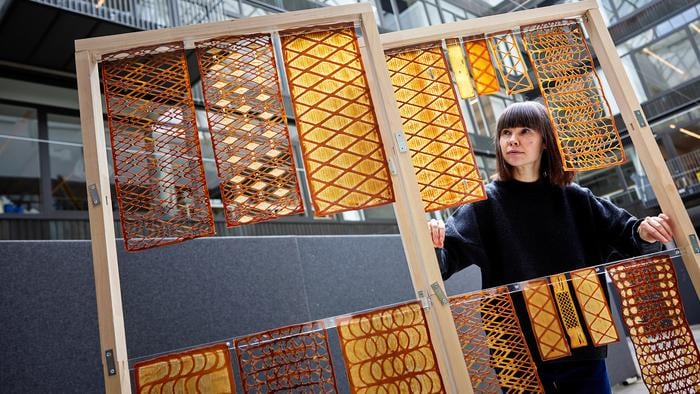
First you kill the yeast. Heat it to 80C for half an hour until nothing in it is alive, then fold it together with wood fibres, a little seaweed extract, some plant-derived glycerol and water until the whole lot turns into a soft, jelly-like paste. It looks a bit like something you would pipe onto a cake. What comes next is the surprising part: a robotic arm squeezes that paste, layer by layer, into a flat patterned tile that dries at room temperature into a translucent sheet you could hang on a wall. No kiln, no curing oven, no plastic.
This is architecture grown from baker’s yeast, and a team at Chalmers University of Technology in Sweden reckons it could one day stand in for some of the most stubbornly unsustainable bits of our built environment. Think daylight screens, room partitions, decorative wall panels, the sort of interior elements usually moulded from plaster, plastic or synthetic textiles.
The motivation is hard to argue with. Construction is a famously dirty business, accounting for roughly a third of the planet’s raw material depletion and a similar share of its solid waste, much of it material designed to last for centuries and then sit in landfill for centuries more. Concrete, steel, glass, gypsum, the petroleum-based plastics: all of it pulled from finite, non-renewable stock. The Chalmers approach inverts that logic almost entirely. Their material is made from organisms and plant matter that regrow on their own, and when it has outlived its use it can simply biodegrade back into the soil.
“I’ve always been interested in the combination of architecture and living materials, and essentially this research is about creating an architectural material made entirely from organic, renewable ingredients,” says Malgorzata Zboinska, a professor at Chalmers and the study’s leader. “By combining biomaterials with digital manufacturing, we can take a novel approach to both the design and production of architectural components.”
The recipe, published in Frontiers of Architectural Research, is more particular than it first sounds. Each ingredient earns its place: the cellulose fibres from wood give tensile strength and help the printed shape hold; the alginate, drawn from brown seaweed, keeps the dimensions stable as it dries; the glycerol acts as a plasticiser, lending flexibility and warding off cracks. The yeast itself is the binder, the thing that holds the whole mess together and gives the paste the gloopy consistency a 3D printer needs.
What is striking is that yeast here is doing nothing it was ever bred to do. No fermentation, no rising dough, no beer. It is being used purely as biomass, as bulk structural matter, which is something nobody appears to have tried in architecture before.
Why a microbe beats a mushroom
Why yeast, of all things? Partly because it is gloriously easy to come by. The microbe doubles itself roughly every 90 minutes, and the researchers note that a few milligrams of starter culture can yield several tonnes of the stuff inside a week in a factory setting. It will happily grow on cheap, sugar-rich leftovers from agriculture and papermaking, and breweries already churn out vast quantities of spent yeast as a by-product they often just discard. There is also a quieter, more technical reason. Because yeast is a single-celled organism, the material it produces comes out unusually uniform, unlike the fungal alternative that has dominated this corner of green building so far. “Yeast grows exponentially. It does not require strictly controlled environments and is not particularly sensitive to contamination,” says Zboinska. “Because it consists of single-celled organisms, we can produce a more homogeneous, predictable material.”
That fungal alternative is mycelium, the rooty thread network of mushrooms, which has had plenty of attention as a building material but comes with headaches: it moulds easily, its strength varies batch to batch, it grows slowly, and crucially it cannot be 3D printed directly. Yeast sidesteps most of that.
The team learned to tune the stuff with real precision. By tweaking how the yeast cells were treated, whole or ruptured, they could switch the material between a stiff structural role and a softer, more pliable one; intact cells behave as a filler, burst ones as a binder. The strongest tiles reached a tensile strength of about 2.7 megapascals and could stretch a quarter of their length before breaking, which is roughly in line with comparable bio-based films. Their largest prints, tiles measuring 20cm by 50cm, shrank by as little as 6 per cent and stayed almost perfectly flat as they dried. And the look of the thing is adjustable too: transparency can be dialled from near-opaque to letting through a third of the light that hits it, the colour shifts across four natural yellow-to-brown tones, and the surface can be made solid, perforated or somewhere in between.
Designing for decay
There is something philosophically odd, and rather appealing, about a building material that is meant to fall apart. Traditional architecture chases permanence; this does the opposite, on purpose. “This challenges the traditional notion that materials must last forever, or at least have as long a physical life cycle as possible,” says Zboinska. “Instead, we can think in terms of shorter life cycles and even view the ageing or degradation of the material as part of the design.”
None of this is ready for your living room yet, mind. The researchers are candid that the material so far only works as thin sheets and surfaces, not load-bearing structure, and that the hard questions remain unanswered: how it copes with damp, how it behaves in a fire, how it ages over years rather than days. One promising hint did emerge from the heat tests, where the yeast and glycerol seemed to stop the material burning away completely in a way pure cellulose does not, which might point to decent fire-safety potential down the line. Might. There is a lot still to verify.
What excites Zboinska most is not the tile itself but where the idea leads. The yeast cells in these prototypes are dead, deactivated before mixing, but the broader field of engineered living materials imagines components that are still, in some sense, alive and working. “This could, for example, involve self-healing materials or materials that purify the air by neutralising harmful substances and pollutants,” she says, calling the present work an important first step. A wall that mends its own cracks, or quietly scrubs the air you breathe, grown from the same humble microbe that leavens bread. Not bad for a by-product nobody wanted.
Source: Novel 3D printable yeast-based materials for architectural applications, Frontiers of Architectural Research.
Frequently Asked Questions
Is the yeast in these walls actually alive?
No. The yeast is deactivated by heating before it is ever mixed into the printing paste, so the finished tiles contain dead microbial biomass rather than living cells. It works purely as structural matter, the bulk and the binder that holds everything together. The researchers see truly living, self-repairing versions as a future goal rather than what they have built so far.
Why use yeast instead of mushroom-based materials, which are already popular in green building?
Mycelium, the thread network of mushrooms, has dominated bio-based architecture but is slow to grow, prone to mould, inconsistent in strength and cannot be 3D printed directly. Yeast doubles roughly every 90 minutes, resists contamination and, being single-celled, produces a far more uniform and predictable material. That combination is what makes it printable into precise, repeatable shapes.
Could you build an actual house out of this?
Not yet, and probably not in the structural sense any time soon. The material currently works only as thin sheets and surfaces such as screens, partitions and wall coverings, and cannot bear loads. Key questions about moisture resistance, fire safety and long-term ageing still need answering before it moves much beyond the lab.
What happens to a yeast tile at the end of its life?
That is rather the point of it. Because every ingredient is organic and renewable, the material is biodegradable and can return to nature once it is no longer needed. The team even argues that designers should embrace this, treating a material’s ageing and breakdown as part of the design rather than a flaw to engineer away.
ScienceBlog.com has no paywalls, no sponsored content, and no agenda beyond getting the science right. Every story here is written to inform, not to impress an advertiser or push a point of view.
Good science journalism takes time — reading the papers, checking the claims, finding researchers who can put findings in context. We do that work because we think it matters.
If you find this site useful, consider supporting it with a donation. Even a few dollars a month helps keep the coverage independent and free for everyone.