

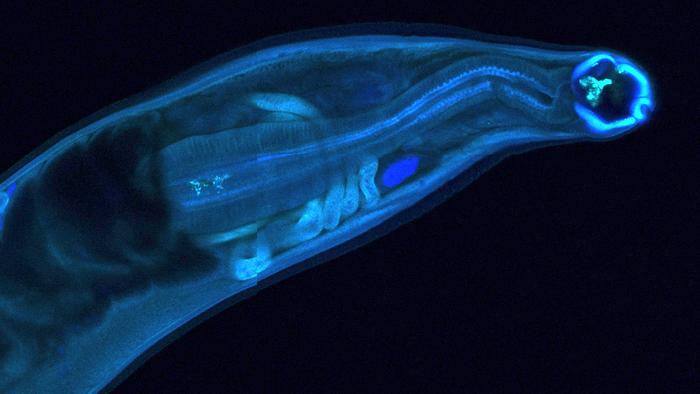
Researchers genetically modified hookworms to produce an antibody, then tested the approach in hamsters. The antibody entered the animals’ bloodstream and partially neutralised tetrodotoxin, providing an early proof of concept rather than a human treatment.
This is not science fiction. On 3 June, researchers at Washington University School of Medicine reported the first successful genetic engineering of the human hookworm, a modest parasite that has infected hundreds of millions of people across the tropics for millennia, and which now, for the first time, has been conscripted into service as a living pharmaceutical factory.
The hookworm, Ancylostoma ceylanicum, is evolution’s masterclass in persistence. It survives inside the human gut for years, sometimes decades, by secreting a chemical arsenal, perhaps a thousand different molecules, that pacifies the immune system and maintains a fragile, ancient truce with its host. It cannot multiply inside a person. The population remains fixed. Remove it with a single dose of antiparasitic medicine, and it’s gone in twenty-four hours. This biology, counterintuitive as it sounds, makes the creature an oddly elegant drug platform.
Makedonka Mitreva, the senior researcher on the project, had spent more than twenty years decoding the hookworm’s secrets. She understood its genome at a level few scientists on Earth do. So when the Defence Advanced Research Projects Agency asked if parasites might be engineered to produce therapeutics, she recognised something her colleagues did not: hookworms had already solved the hardest problem in drug delivery—how to live inside a human host without killing it.
“The hookworm has spent millions of years perfecting how to assure long-term survival inside a human host,” Mitreva said, “and how to get molecules out of its body and into ours. We asked: What if we could add one more molecule to the roughly thousand things the worm already secretes, something therapeutically useful to people?”
The geometry of a living pill
The proof-of-concept target was tetrodotoxin, the paralyzing neurotoxin in pufferfish—weaponisable, lethal, and medically without cure. The research team selected an antibody fragment, s16-HuScFv, engineered in human cells, that could partially neutralise the toxin. But first, they had to make a hookworm produce it.
This required solving problems that hadn’t been solved before. CRISPR-Cas9, the revolutionary gene-editing tool, had never been successfully deployed in hookworms. No one had identified safe harbours in the hookworm genome—regions where new DNA could integrate without disrupting critical genes. The organism’s thick cuticle, evolved to shield it from the host immune system and environmental stress, resisted standard transfection techniques.
Using two decades of genomic data, the team identified two candidate insertion sites by analyzing which genes were most highly expressed across the worm’s life cycle, reasoning that active chromatin would be more accessible. They selected one—GSH2, upstream of a gene called ACEY_002225—and used computational tools to design guide RNAs that would target CRISPR machinery to that exact location. They tested electroporation and lipofection, methods for forcing DNA into cells. Electroporation won. Overlapping guide RNAs outperformed single ones. The specifics mattered immensely; the living system punished carelessness.
The transgene itself was a delicate construction. The antibody sequence had to be preceded by a signal peptide—a molecular address tag—that would direct the newly synthesised protein into the hookworm’s secretory pathway rather than leaving it trapped inside cells. The team tested seven different signal peptides. One from an abundant hookworm protein called ASP-1 performed best, successfully routing the antibody out of the worm and into the host.
They inserted the construct into hookworm eggs using optimised electroporation. The eggs hatched into larvae, which were fed to Syrian golden hamsters. The worms matured inside the hamster intestines. Within days, the researchers collected blood from the infected animals and tested it against tetrodotoxin using cultured nerve cells.
The serum from animals infected with the genetically modified worms partially neutralised tetrodotoxin—approximately 16 per cent of the toxin’s lethal effects were blocked. Blood from control animals infected with unmodified worms showed zero neutralisation.
The platform beneath the proof
The modest success masks something larger. The team demonstrated vertical transmission of the transgene—F1 eggs produced by F0 worms were themselves transgenic, capable of passing the modification to offspring. Gene expression analysis using RNA sequencing showed that inserting the antibody gene did not disrupt neighbouring genes or trigger any genome-wide dysregulation. The worms developed normally, matured, reproduced, and secreted functional protein into the host bloodstream.
What was achieved is end-to-end: insertion works. Expression works. Secretion works. The protein functions. But the level of antibody detected in blood was below the limit of quantification—suggesting, paradoxically, that the platform is wildly under-optimized. Mitreva and her colleagues have already identified optimisations: stronger promoters, more efficient signal peptides, codon-optimised coding sequences, perhaps inducible systems that could control when the worm produces its therapeutic cargo.
The intestine itself may be the real opportunity. Hookworms live in the gut and secrete most of what they produce directly into the local tissue environment rather than the bloodstream. Therapeutic concentrations in the intestine could be substantially higher than what reaches circulation—an advantage for conditions like inflammatory bowel disease, where you want a drug present where the pathology lives.
“We demonstrated here that the concept works end to end,” Mitreva said. “From that starting point, we can optimise the platform and think carefully about which diseases stand to benefit most from a delivery system that is continuous, targeted and long-lasting.”
Chronic inflammatory diseases—Crohn’s disease, ulcerative colitis—are natural candidates. So are food allergies, where sustained delivery of small amounts of allergen into the gut might gradually retrain the immune system. Conditions where patients now require repeated injections, where non-adherence is a barrier to treatment, where you need a drug present continuously, silently, for years. These are the diseases the hookworm platform was made for.
The technical foundation is solid. Good manufacturing practice protocols already exist for preparing and storing cryopreserved human hookworms. The infection can be cleared instantly with a single oral dose of antiparasitic medication. The worms cannot reproduce in the human gut, so the population stays fixed, controlled. If safety concerns emerge, the infection ends.
Yet the ethical and regulatory path forward is steep. Deliberately infecting people with parasites, even modified ones, requires rigorous safety trials, biocontainment strategies, perhaps the engineering of suicide genes into the worms themselves—switches that would activate if the organism ever escaped the host environment. The researchers know this. Mitreva emphasises it. The work published last week is only the first mile of a much longer journey.
But what Mitreva’s team has done is demonstrate that the journey is navigable. The hookworm, a parasite that has shadowed human evolution for millions of years, learning to survive inside us with extraordinary grace, now sits at the threshold of a strange new purpose. It has always been a master of molecular intimacy with its host. Engineers have simply asked it to add one more skill to its ancient repertoire.
The worm, indifferent to meaning, obliges.
Source: Nature Communications, 10.1038/s41467-026-73447-9
Editor’s note: This article was updated on September 14, 2026, to align its headline and wording more closely with the evidence and sources.