
You did everything right. The apple at your desk, the side salad, the bowl of grapes after dinner, all five portions ticked off before the day was out. And yet the compound most likely to keep your heart beating for longer may have barely registered in your body at all. That, at least, is the uncomfortable message buried in a large new analysis of what more than 30,000 people actually ate.
The compounds in question are flavanols, a family of plant chemicals found in tea, cocoa, berries, apples and certain beans. They are not vitamins, and your body does not strictly need them to survive, which is rather the point of all the fuss.
Here is where it gets interesting. In the COSMOS trial, the biggest randomised study of these polyphenols ever run, a daily dose of 500 milligrams of flavanols cut deaths from cardiovascular disease by 27 per cent. That is a striking number for something you can, in principle, eat. The obvious assumption, the one that has underpinned decades of public-health advice, is that anyone dutifully eating their fruit and veg must already be getting plenty. The new work, published in the journal Food & Function by scientists from Reading, Harvard, UC Davis and the confectionery-and-nutrition firm Mars, set out to check whether that assumption holds.
It doesn’t. Across two large cohorts, one American and one British, fewer than one in five people reached the 500-milligram mark.
And these were not people slacking on their greens. The researchers leaned on two urinary biomarkers rather than the notoriously slippery food diaries, measuring molecules with tongue-twisting names that the body produces only after flavanols pass through it. Even among participants who hit the recommended five portions a day and scored well on overall diet quality, only around a fifth crossed the threshold linked to a healthier heart.
“Most people assume that eating plenty of fruit and vegetables covers this, but what this research shows is that the specific choices you make matter far more than the total amount,” says Javier Ottaviani, the paper’s lead author. A handful of blackberries, a whole apple, a cup of green tea alongside lunch, he suggests, could shift the dial in a way that a banana and a carrot simply won’t.
Not All Five-a-Days Are Created Equal
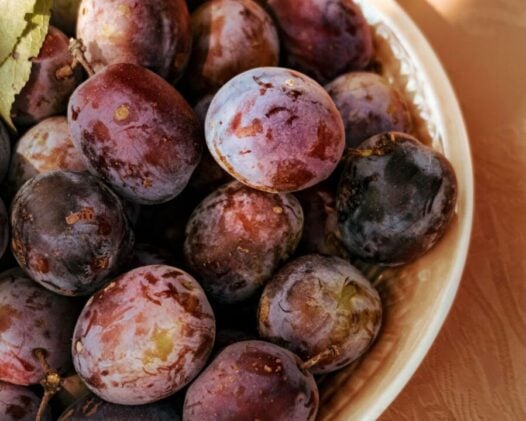
The arithmetic, once you see it, is faintly absurd. A punnet of plums delivers something like 450 milligrams of flavanols in one go; a cup of green tea, around 200. A medium apple with the skin on manages perhaps 110, blueberries a modest 80. The trouble is that flavanol content swings wildly even within a single fruit. The team notes that levels of one key flavanol, (-)-epicatechin, can vary more than tenfold between apples of the very same variety, depending on the cultivar, the weather, when it was picked and how it was stored. Put bluntly, it could take anywhere from two apples to twenty-nine to land the dose tested in COSMOS. So your apple a day might be doing the job, or it might be doing almost nothing, and you would have no way of telling them apart.
What gives the figures their bite is the way they were collected. Rather than trusting people to recall what they ate, which study after study has shown to be optimistic at best, the team measured flavanol breakdown products directly in urine, using two markers with slightly different half-lives so they captured both the last couple of hours and the wider day. The thresholds were even set generously, deliberately tilted to overcount the people clearing the bar. Which means the true picture is, if anything, a little bleaker than the one in the paper.
The British data threw up a wrinkle that is harder to wave away. In the UK cohort, the people who adhered most closely to national dietary guidelines were actually the least likely to hit the flavanol target.
Why? Probably tea, oddly enough. Tea is one of Britain’s great flavanol sources, and the keenest guideline-followers were not necessarily the keenest tea-drinkers. Even so, the gap between best-practice eating and the heart-protective dose was real, and it points to the same conclusion on both sides of the Atlantic.
Whether We Need New Numbers
So should the advice change? The researchers are careful not to tear up five-a-day, a message that earns its keep on plenty of other grounds. But they argue the headline number is no longer enough on its own. An expert panel in the US has already floated a target of 400 to 600 milligrams of flavanols a day for cardiometabolic health, and this study hands that idea a good deal of ammunition.
“Five-a-day is the right message, but we may need to think more carefully about which five,” says Gunter Kuhnle of the University of Reading. Get that right, and the humble blackberry starts to look less like a snack and more like a small, deliberate act of cardiology.
Read the full study in Food & Function (DOI: 10.1039/D6FO00867D)
Frequently Asked Questions
Why does it matter which fruit and vegetables I eat, if I’m already hitting five-a-day?
Because the heart-protective compounds called flavanols are spread very unevenly across produce. A punnet of plums or a cup of green tea can deliver hundreds of milligrams, while a banana or a carrot contributes almost none. Hitting your five portions tells you nothing about whether you reached the flavanol dose linked to lower cardiovascular risk, which is where the food you pick becomes the deciding factor.
Is it true that healthy eaters can still fall short on flavanols?
Surprisingly, yes. In the large new analysis, even people who met dietary guidelines and scored well on overall diet quality mostly failed to reach the 500-milligram threshold. In the UK group, the closest adherents to official advice were actually the least likely to hit it, partly a quirk of who drinks the most tea.
How much of a difference do flavanols actually make to heart health?
In the COSMOS trial, the largest study of its kind, a daily intake of 500 milligrams of flavanols was associated with a 27 per cent reduction in deaths from cardiovascular disease. That is a meaningful effect for a compound found in everyday foods, which is exactly why researchers are pushing to work out how people can reliably reach that level.
What’s the easiest way to get more flavanols into my day?
Reach for the high-flavanol options: berries such as blackberries and plums, apples eaten with the skin on, broad beans, and tea, particularly green tea. A single cup of tea or a punnet of berries can outweigh several low-flavanol portions combined, though natural variation means no single food is a guaranteed fix.
ScienceBlog.com has no paywalls, no sponsored content, and no agenda beyond getting the science right. Every story here is written to inform, not to impress an advertiser or push a point of view.
Good science journalism takes time — reading the papers, checking the claims, finding researchers who can put findings in context. We do that work because we think it matters.
If you find this site useful, consider supporting it with a donation. Even a few dollars a month helps keep the coverage independent and free for everyone.