

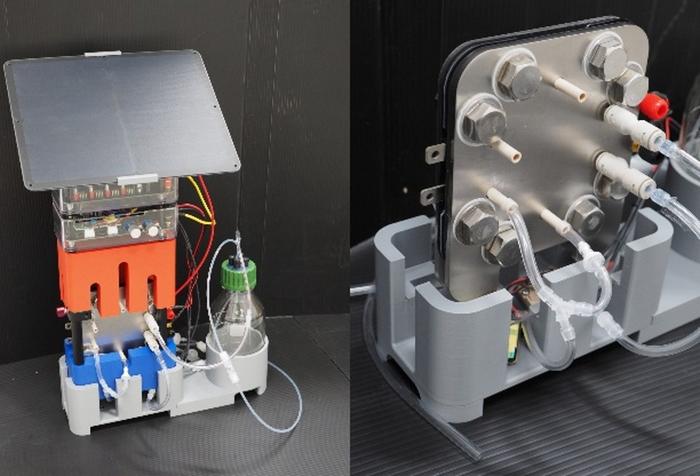
On a partly cloudy morning in Osaka, on the rooftop of a university building, a squat box of titanium and plastic membranes began quietly turning carbon dioxide into liquid fuel. No one was watching over it. No one needed to. When the sun rose, it started; when the sun set, it stopped. In between, as clouds rolled across the sky and the light wavered, the machine simply adjusted itself, sipping whatever power the panels above it could spare and converting water and CO2 into pure formic acid.
What it lacked is the interesting bit. There was no battery. There was no bank of control electronics deciding, moment to moment, how to squeeze the most juice out of the solar cells. That hardware, normally the costly heart of any solar-fuel rig, had been left out entirely.
Artificial photosynthesis is meant to do roughly what a leaf does, only on our terms: take sunlight, water and carbon dioxide, and stash the energy in a chemical you can keep. In most setups, an electrolyzer sits at the center, converting electricity from solar panels into stored chemical energy, in this case formic acid. The snag is that sunlight is a fickle supplier. Its strength shifts with weather and time of day, and a solar cell has one particular voltage at which it delivers maximum power, a sweet spot that drifts as conditions change.
To chase that sweet spot, engineers normally bolt on a system called maximum power point tracking, or MPPT. It works, but it usually leans on a battery and extra electronics to keep the energy flowing smoothly.
Here lies the contradiction that nagged at the team behind this latest work. The whole point of solar fuel is to make energy cheaply, yet the standard fix for stability is an expensive battery. You end up with two things storing solar energy, the battery and the fuel, doing essentially the same job. Redundant, and pricey with it.
So the researchers, led by Yasuo Matsubara and Yutaka Amao at the Research Center for Artificial Photosynthesis at Osaka Metropolitan University, working with Iida Group Holdings, asked an awkward question. What if the electrolyzer could track the sun’s sweet spot on its own?
Heat Doing the Job of Hardware
Their answer turns on a quirk of physics. Tucked inside the electrolyzer is a solid-state electrolyte, a material whose electrical resistance behaves backwards compared with what you might expect: as it warms up, it conducts more freely rather than less. And an electrolyzer running hard, under bright sun, naturally heats up.
“As sunlight increases, the electrolyzer naturally heats up. The system is designed so that this warming causes the electrical resistance to drop, allowing electricity to flow more freely,” explains Amao. “This makes the system automatically adjust its electrical behavior.”
So the device tracks the panel’s maximum power point not with a microchip weighing voltages against currents, but through plain thermodynamics. Bright sun, more heat, less resistance, more current. Dim light, cooler cell, higher resistance, less current. The chemistry and the heat transfer do the regulating between them, with low-power pumps nudging the flow of water to fine-tune how much heat the system sheds. The team calls it a chemical MPPT, and as far as they can tell, it is the first of its kind for this style of electrolyzer. “This self-regulating behavior helps keep fuel production more stable throughout the day and automates the system, while reducing dependence on batteries and costly external components,” Amao adds.
They had reason to be hopeful. The technology had already done a public turn at the Osaka Kansai Expo 2025, where a version of it powered a small exhibit. “We were confident that it would be successful, as we previously showcased this research at the ‘Joint Pavilion Iida Group × Osaka Metropolitan University’ exhibition as part of the Osaka Kansai Expo 2025,” says Matsubara. “It successfully generated enough formic acid to power a miniature diorama in the pavilion, showing its potential as an efficient artificial photosynthesis system that could potentially be used to charge applications in our homes.”
From Diorama to Rooftop
The real test came on a rooftop in Sugimoto, Osaka, back in May 2024, on a day that kept clouding over. A standalone device, four electrolyzers wired in series behind a commercial monocrystalline-silicon panel, ran unattended from dawn to dusk. Over that single day it churned out something like 3.3 kilograms of formic acid solution, around 3 per cent by weight, at better than 98 per cent purity, straight from CO2 and pure water. Crucially, the concentration held fairly steady even as the light came and went, which is exactly the behavior the battery is normally there to provide.
The numbers that matter most, at least to the people in this field, are two. The system made use of about 85 per cent of the electricity its panel could generate, and it converted roughly 2 per cent of incoming solar energy into formic acid, a figure the team reckons is state of the art for this kind of net efficiency once you count the power drawn by the pumps and controllers.
None of which makes this a finished product. Two per cent is a long way from the conversion efficiencies that would trouble an oil refinery, and formic acid, useful as it is, is a modest fuel. There is also the matter of how long the kit lasts. The researchers are frank that the device’s future hinges almost entirely on the durability of the electrolyzer, and long-term testing is still going. (It is worth noting, too, that two of the authors work for the company that funded the study, which holds a patent application on the method.)
Still, there is something appealing about the basic move here, which is to let the awkward physics of the system solve its own problem rather than papering over it with more electronics. Strip out the battery, and you strip out cost, complexity and one more thing to break. If the electrolyzers prove they can take the punishment of years of daily cycling, a machine like this could sit on a roof and sip the sun, no minder required, turning a greenhouse gas into something you can pour into a tank.
For now it lives between two worlds: a diorama at a world’s fair, and a box on a rooftop that ran all day on nothing but sunlight and air. The leaf, after all, never needed a battery either.
DOI / Source: 10.1039/D5EL00177C (EES Solar)
Frequently Asked Questions
Why does ditching the battery matter for solar fuel?
The goal of solar fuel is to store sunlight as a cheap, stable chemical, but the usual way to keep production steady relies on a costly battery, which quietly undercuts that goal. Removing it cuts cost and complexity and gets rid of one more component that can fail. It also resolves an oddity where the battery and the fuel were both doing the same job of storing solar energy.
How does a machine track the sun without any control electronics?
It leans on a material inside the electrolyzer whose electrical resistance drops as it heats up, the opposite of most materials. Bright sun makes the device run hotter, resistance falls, and more current flows; weak light cools it down and current eases off. That self-heating behavior naturally keeps the system near the solar panel’s most efficient operating point, no microchip required.
Is formic acid actually a useful fuel?
Formic acid is a liquid that can store hydrogen and feed certain fuel cells, which makes it an appealing way to bottle up solar energy. The Osaka device made it at better than 98 per cent purity straight from carbon dioxide and water. It is a modest fuel rather than a petrol replacement, but its real value here is as a stable, pourable form of stored sunlight.
What’s stopping this from going on rooftops tomorrow?
The system converts only about 2 per cent of incoming solar energy into fuel, and the bigger unknown is how long the electrolyzer survives years of daily cycling. The researchers say the device’s future depends almost entirely on that durability, and long-term testing is ongoing. Until those numbers are in, it remains a promising demonstration rather than a finished product.
