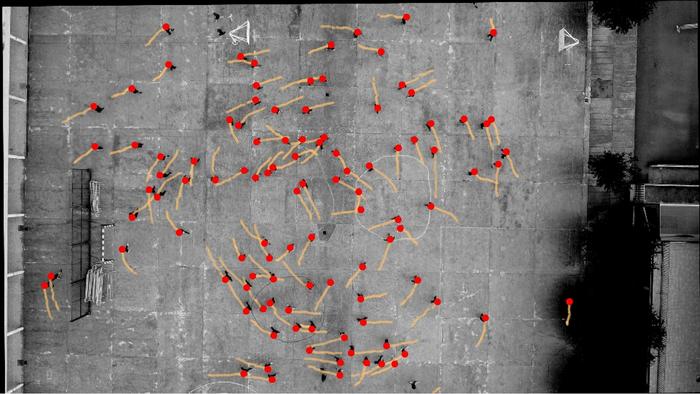
Thirty-two times out of thirty-three, the crowd turned the same way. Left. Always left, looping counterclockwise around the enclosure like water circling a drain, and the researchers watching the overhead footage hadn’t gone looking for any of it. They were trying to work out how to keep pandemic-era pedestrians two meters apart. What they found instead was a quiet, stubborn asymmetry buried in the way human beings move.
The team, working across Spain and Japan, had set up the usual sort of experiment: volunteers milling about inside a circular arena, cameras mounted overhead, software tracking every footstep. Social distancing was the goal. The spiral was an accident.
“When analyzing the experiments, my colleagues realized by chance, that in 32 out of 33 experimental trials, as people moved and turned, they noticeably preferred to turn counterclockwise,” says Claudio Feliciani, a project associate professor at the University of Tokyo who was eventually pulled into the puzzle from across the world. The numbers were hard to argue with. But numbers rarely explain themselves, and this is where the story gets genuinely odd.
Because the obvious explanations kept falling apart. You might reasonably assume people turn whichever way suits them in the moment, with no group-wide pattern at all. “This was completely unexpected as, at least instinctively, when people walk around randomly, you imagine people turn as their needs suit them with little sign of an overall preference,” says Feliciani. And yet. “There was a definite, measurable tendency for people to turn counterclockwise over clockwise, all things being equal.”
Ruling Out the Usual Suspects
Good practice, when you stumble onto something weird, is to attack it from every angle until something cracks. So that’s what they did, across five separate experimental campaigns. Culture was the first suspect, which is why the Japanese team got involved in the first place. In Spain, pedestrians passing one another tend to dodge to the right; in Japan, they drift left. Different countries, different ingrained habits. If avoidance manoeuvres were driving the spiral, the two nations should have spun in opposite directions.
They didn’t. Both went counterclockwise.
Then came the walls. Maybe the boundary of the arena was nudging people round, sort of like a marble in a bowl. So the researchers took over a hundred and seven teenagers out to a 50 by 60 metre schoolyard in Pamplona, an open space with effectively no boundary to push against, and watched them roam. The counterclockwise drift held. If anything it was cleaner. They ruled out handedness, footedness, eye dominance, sex, even group size: none of it made a meaningful dent. “It likely does not come from the eyes, because we tried to patch people’s left or the right eyes and the bias was still there,” says Feliciani. They also, gently, dismissed the more exotic theories that people kept proposing. “Some people asked us if it might be large-scale phenomena like the Coriolis force or Earth’s magnetic field, but this seems unlikely given what we have managed to point to so far.”
It Was Never a Crowd Thing
Here is the twist that reframes everything. For decades, the going assumption in crowd science has been that collective patterns, the lanes and waves and swirls you see in busy streets, emerge from people reacting to each other. The group is supposed to be more than the sum of its parts. But when the team finally sat over two hundred volunteers in an enclosure and had them walk completely alone, one at a time, the spiral didn’t vanish. The bias was right there in the solitary walker, statistically unmistakable (a Wilcoxon test put the odds of a fluke below one in a thousand). Which means the counterclockwise pull isn’t something a crowd conjures up together. Each of us, apparently, carries a faint leftward lean already, and a crowd just makes it visible.
The team even checked whether some unspoken social rule might be steering things, surveying 168 people about which way they’d expect to walk. If anything, the responses leaned the other way, toward clockwise, which is precisely the opposite of what everybody actually does. So much for politeness as an explanation.
The children are the loose thread worth tugging. In a Japanese nursery, five-year-olds set loose to run around during a music activity didn’t just drift counterclockwise, they committed to it, nearly the whole room wheeling in unison. “Of all these things, the only thing that stood out was that kids tend to have a stronger bias for the counterclockwise direction, so probably age plays a role in making the effect weaker or stronger,” says Feliciani. That hints the tendency is something we’re born with and slowly learn to override, rather than something we pick up.
So what is it? Nobody can say yet, and Feliciani is refreshingly blunt about that. The smart money is on something mechanical, baked into the body itself. “Our results may appear as a minor insignificant discovery, but in nature, most phenomena related to locomotion show that animals mostly walk without directional preference. The strong bias found in people hints to some asymmetry at the biomechanical level.” There are echoes elsewhere in the living world: ants that bear left when scouting new ground, budgerigars favouring one side through a gap, blindfolded people who, robbed of landmarks, spiral helplessly in circles thanks to some drift in their inner sense of straight-ahead.
The practical payoff could be real enough, mind you. Museums, airports, stadium forecourts, the great churning plazas of the world: design them to flow with the body’s natural lean rather than against it, and crowds might just move a little easier. Whether the bias survives the chaos of a genuinely crowded real-world space is still an open question. The next step is to zoom in on individuals and hunt for the biomechanical tell, which is fiddlier than it sounds.
Feliciani, for his part, can’t quite let go of one stray observation. “There are some interesting parallels to certain sports. Some running and driving competitions are always, but inexplicably, taken on courses that run counterclockwise.” Athletics tracks. Speed skating. Horse racing in much of the world. All of it spinning the same way we apparently want to walk. “But that’s an investigation for another time.”
Frequently Asked Questions
Do people really prefer to turn left when walking?
Yes, on average. Across five experiments in Spain and Japan, the vast majority of pedestrians showed a measurable tendency to drift counterclockwise, meaning they curved to their left, even when walking alone with no one to follow. The effect is subtle in any one person but consistent enough to show up reliably across crowds.
Is the counterclockwise bias caused by being right-handed?
Apparently not. The researchers tested handedness, footedness, and eye dominance, and none of them explained the drift. They even had volunteers walk with one eye patched and the bias stayed put. Whatever causes it sits deeper than these familiar markers of left-right asymmetry, and the precise origin is still unknown.
Why does it matter which way crowds turn?
Because crowd flow shapes how safely and comfortably we move through airports, stations, museums and public squares. If people share a built-in directional lean, planners could design circulation routes that work with it rather than against it, easing congestion. It also overturns a long-held assumption that such patterns emerge only from people reacting to one another.
Could the spin be down to Earth’s rotation or magnetic field?
Almost certainly not. People floated those ideas, but the researchers consider forces like the Coriolis effect or geomagnetism highly unlikely given the evidence. The bias shows up in single walkers indoors, points to something in human biomechanics, and seems strongest in young children, which fits an internal cause rather than a planetary one.
The full study appears in Nature Communications: Individual locomotor bias drives counterclockwise motion in pedestrian crowds.