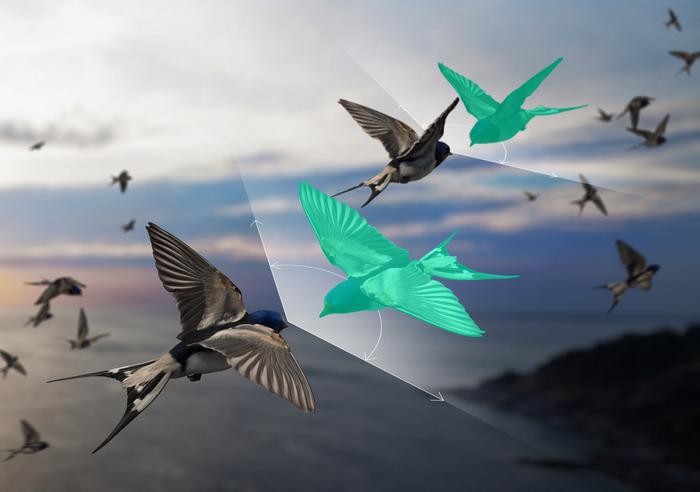
A starling in a murmuration watches the birds ahead of it and the birds beside it. The one behind it, though? Ignored. It might as well not exist. And because that starling never adjusts course for the neighbor trailing it, the whole shimmering flock quietly violates one of the oldest rules in physics: that every action has an equal and opposite reaction. Newton, in a sense, does not apply to birds.
He does not apply to a lot of things, it turns out. Swarms of bacteria, crowds of people, the cells knitting themselves into tissue: in all of these, the parts respond to only some of what surrounds them, and the influence runs one way rather than both.
Physicists call these lopsided couplings non-reciprocal interactions, and for years they have been a genuine headache. The trouble is not that the systems are mysterious; you can write down the equations of motion well enough. The trouble is that almost every powerful tool in a theorist’s kit, the energy functions, the shortcuts, the fast simulation methods, assumes the give-and-take of Newton’s third law. Strip that away and the toolbox more or less empties out. “Whatever we normally teach our students in theoretical mechanics,” says Marin Bukov of the Max Planck Institute for the Physics of Complex Systems in Dresden, ultimately rests on action and reaction.
So Bukov and his colleagues did something a bit sneaky. Rather than rebuild mechanics from scratch for the awkward cases, they smuggled the awkward cases back into the framework that already works.
A Fictitious Partner for Every Bird
The move, published this week in Nature Physics, hinges on inventing things that aren’t there. For every real component in the system, the team adds an auxiliary partner, a kind of mathematical ghost with no physical existence. They then arrange the interactions so that the original one-way couplings are reproduced exactly by perfectly reciprocal couplings between the real parts and their invented twins. “The trick behind the new theory,” says Ricard Alert, a biophysicist on the team, “is that it constructs a partner for each component of the system, a fictitious partner that doesn’t exist in nature.”
For the starling, the recipe is oddly literal. You place an imaginary bird directly in front of each real one, pointed in precisely the opposite direction. Alert calls it the elegant solution: describe the flock as if it were a well-behaved reciprocal system, even though it plainly isn’t, and let the phantom birds absorb the asymmetry.
There’s a catch, and it’s the heart of the thing. The ghost has to mirror its real counterpart, antiparallel, locked at a fixed angle, and that mirror condition has to hold for the whole calculation to collapse back down into the original one-way physics. What the Dresden group proved is that you only need to impose this constraint once, at the very start. Set it up correctly at time zero and the equations carry it forward on their own, the phantom forever shadowing its bird, so that the doubled, fictitious system keeps generating the true dynamics of the real one for all time. Lose the constraint and you’d just be simulating some other, reciprocal world that happens to share the same starting point.
Borrowing the Old Tools Again
Why go to all this bother? Because once the system wears the disguise of a proper energy-based model, the borrowed machinery roars back to life. The team showed that Monte Carlo simulation, a workhorse method that was essentially off-limits for non-reciprocal systems, now reproduces the same steady states as the brute-force approach, right down to a matching critical temperature where the flock flips from ordered to disordered. It even handles the restless cases that never settle, the perpetual chase-and-run patterns that drift sideways and never stop.
And there’s a bonus that comes free with the symplectic structure they smuggled in. Using rapid periodic driving, a trick borrowed wholesale from the quantum world, they can selectively switch off the interactions along one direction of a lattice, effectively shearing a two-dimensional sheet of spins into a stack of disconnected one-dimensional chains. A dimensional crossover conjured by a drive.
It is worth being clear about what the embedding does and doesn’t do. It adds no new physics; the birds were always going to flock the way they flock. What it adds is reach. Roughly a century of scattered attempts to write Hamiltonians for dissipative systems, going back to the 1930s, never quite cracked the general non-reciprocal case. This one does, at least for the broad class of pairwise interactions. The authors run their construction through five real experimental systems, from light-driven Janus particles to little walking robots, to show it isn’t a one-trick affair.
What lingers is a question the Dresden team can’t yet answer. Their playground so far is classical, birds and colloids and spins on a grid. But the same quantum-matter group spends its days on electrons that conspire to produce magnetism and lossless current. Whether one-way interactions might brew up genuinely new collective quantum behavior is, for now, wide open. “We still know very little about this,” Moessner admits, “and that is precisely what makes this so fascinating.”
Frequently Asked Questions
Do flocks of birds really break a law of physics?
Not in the sense of cheating physics, but they do break Newton’s third law as it’s usually stated. A bird responds to the birds in front of and beside it, not the ones behind, so its influence on a neighbor isn’t matched by an equal and opposite influence coming back. Physicists call this a non-reciprocal interaction, and it shows up in swarms, crowds, and living tissue too.
What is an auxiliary degree of freedom, in plain terms?
It’s an invented partner variable with no physical reality, added purely to make the math behave. By pairing each real component with a mirror-image ghost and coupling them reciprocally, the researchers reproduce the original one-way dynamics inside a framework that assumes give-and-take. The ghosts never need to exist; they just need to be bookkept correctly.
Why does being able to simulate these systems matter?
Efficient simulation is how researchers study things like the collective motion of cells in the body or the swirling of a swarm. Without an energy-based description, scientists were largely stuck running slow, direct simulations of the raw equations. The new method unlocks faster, better-understood tools that were previously unusable for these systems.
Could this lead to anything in quantum physics?
That’s the open hope. The team works on quantum materials where particles cooperate to produce effects like magnetism, and they suspect non-reciprocal interactions might generate entirely new forms of collective quantum behavior. Nobody knows yet, which is part of what makes the direction exciting.
The full study appears in Nature Physics: Hamiltonian description of non-reciprocal interactions.