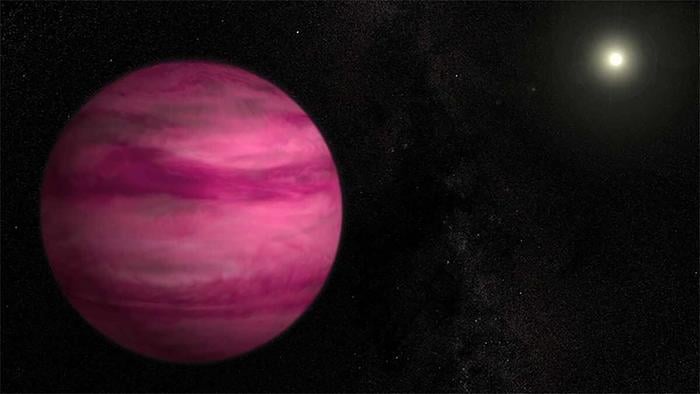
For more than a decade, one of the strangest worlds in our cosmic neighborhood kept slipping out of reach. Astronomers had a picture of it, a faint rosy speck beside a sun-like star 57 light-years away, but its light was so feeble that the biggest telescopes on Earth could stare at it through an entire night and still come up empty. They knew it was there. They simply could not read it.
That world is GJ504b, better known by its nickname, the Pink Planet. And it has just given up a peculiar secret: skies laced with salt.
The breakthrough came from the James Webb Space Telescope, which finally cracked open the spectrum of this elusive object. A spectrum is essentially starlight (or in this case, the planet’s own faint glow) split into its component colors, each color betraying the fingerprint of a different molecule. Webb did in roughly two hours what ground-based observatories had failed to do across years of trying. “In the past, other astronomers observed the companion for an entire night with some of the biggest telescopes in the world to obtain a spectrum,” says Aneesh Baburaj, a postdoctoral astronomer at Northwestern University who led the work. “And they could not see the object. With JWST, our entire observation took around two hours, and we were successful.”
What Webb returned was a mess in the best possible sense. The data refused to behave.
When Baburaj and his colleagues fed the spectrum into their atmospheric models, the simulated version of the planet only matched reality if it contained features that made no physical sense. Something was missing. The fix, it turned out, was to add clouds, and not the water-vapor wisps you might imagine drifting over a temperate world. The team tested three different cloud recipes against the data.
“We tried three different types of clouds, and salt clouds fit best,” says Baburaj. “When we accounted for salt clouds, it subdued the signature of molecules hidden deeper in the companion’s atmosphere. Then, the results became physically possible.”
Why a Planet Bakes at Oven Temperature
To understand why salt should drift through the air of an alien world, it helps to know just how odd the Pink Planet really is. Discovered in 2013, GJ504b weighs roughly 25 times as much as Jupiter, which plants it right on the blurry frontier between a giant planet and a brown dwarf, those failed stars that never grew massive enough to ignite. Astronomers hedge their bets and call it a planetary-mass companion. It is also ancient, somewhere between 2.5 billion and 4 billion years old, and time has let it cool. Most directly imaged exoplanets blaze at 1000 degrees Celsius or more; this one sits at a mere 290 degrees Celsius, about the heat of an oven baking bread. In a sky that cold, ordinary rock and iron clouds sink out of view, and exotic condensates, salts like potassium chloride and zinc sulfide, become the stuff that clouds are made of.
Theorists had predicted exactly this more than 15 years ago. The trouble was that nobody had ever shown salt clouds were genuinely necessary to explain what we observe, rather than merely possible in principle.
A Family Resemblance, Written in Metal
The salt is not the only intrigue here. Webb’s spectrum revealed a rich chemical stew, including water vapor, methane, carbon dioxide, ammonia and hydrogen sulfide, and it hinted that GJ504b is unusually rich in heavy elements. That matters, because the abundance of metals in a world’s atmosphere is one of the few clues we have to how it was born. The team found carbon enriched roughly two-and-a-half times over its host star and oxygen about twice over, a pattern that leans, tentatively, toward the planet having assembled the way planets do, by gathering gas and solids in a disk. But the case is not closed; the data could still permit a more star-like origin.
There is a tidy detail buried in all this. The planet orbits about 43 astronomical units from its star, which places it just inside where carbon monoxide would have frozen out of the original planet-forming disk. Its chemistry matches a birthplace right about there, meaning it probably formed roughly where we find it, without any dramatic long-haul migration across the system.
The deeper prize, though, is the method. Cold, faint worlds have long been the blind spot of exoplanet astronomy, too dim for the instruments that handle their hotter siblings with ease. Jupiter itself, with its ammonia-ice clouds, remains beyond reach of this kind of analysis, but the salt clouds of GJ504b suggest the gap is narrowing. “This is the first time we’ve found that salt clouds are critical to explaining the spectrum of an object,” says Baburaj. “It’s a good reminder to account for clouds in our models.” A reminder, in other words, that the coldest, dimmest, most stubborn objects out there may have the most to say, once we finally learn how to listen.
Source: Baburaj, A. et al. (2026). JWST-TST High Contrast: First Direct Spectroscopy of GJ 504 b Reveals Clouds and Possible Metal Enrichment. The Astronomical Journal, 172, 28. https://doi.org/10.3847/1538-3881/ae6919
Frequently Asked Questions
Why would a planet have clouds made of salt instead of water?
It comes down to temperature. The Pink Planet sits at around 290 degrees Celsius, far too warm for water-ice clouds but cool enough that the rock and iron vapors that form clouds on hotter worlds have sunk out of sight. In that narrow temperature window, compounds like potassium chloride and zinc sulfide condense into clouds, much the way water does in Earth’s milder air. It is a regime astronomers had theorized about for over a decade but struggled to confirm.
How can astronomers see salt clouds if salt has no obvious spectral fingerprint?
They cannot see the salt directly, which is part of what makes the finding clever. Salt clouds leave no clear signature at the wavelengths Webb observed, so the team inferred them indirectly: their models only made physical sense once a salt cloud layer was added to mute the signals from deeper in the atmosphere. The clouds revealed themselves by the absence they explained.
Is the Pink Planet actually a planet?
That is genuinely unsettled. At about 25 times Jupiter’s mass, GJ504b straddles the boundary between giant planets and brown dwarfs, which are objects too small to have ever ignited as stars. Its enrichment in heavy elements leans toward a planet-like birth, but the evidence is not yet strong enough to rule out a more star-like origin, which is why researchers cautiously call it a planetary-mass companion.
Why does it matter that Webb could study such a cold, faint world?
Cold, dim worlds have been the hardest exoplanets to characterize, often beyond the reach of ground-based telescopes entirely. Cracking the spectrum of one of the coldest ever imaged, in just two hours, shows astronomers are closing in on objects that were effectively unreadable before. That opens a path toward studying atmospheres far more like the giant planets in our own solar system.