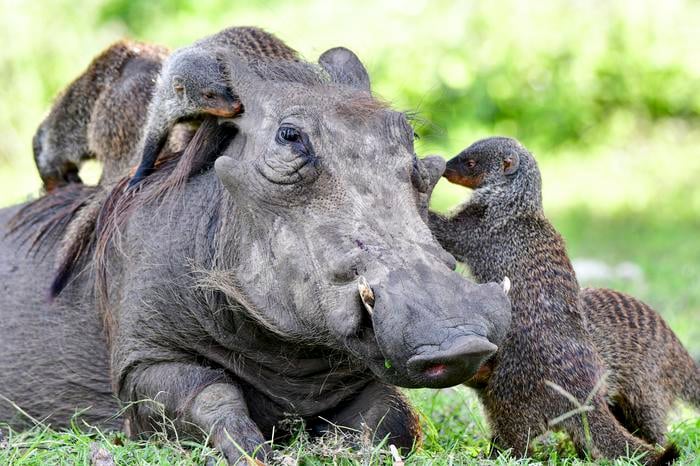
A warthog drops to its knees in the dust, then rolls onto its side and goes still, flank exposed to the sun. To a banded mongoose, this is an invitation. The mongoose moves in and starts working through the bristles, picking off ticks and other parasites, and the warthog lets it happen, all of it, because both animals are getting something out of the arrangement. Nobody taught them a shared language. And yet here they are, two species with almost nothing in common, coordinating a transaction in real time.
Scenes like this turn up across the living world, far more often than you might think. The trick that makes them work, according to a sweeping new review, is information: the cues and signals that let one species tell another what it wants.
The paper, published in Animal Behaviour, pulls together examples from birds, fish, insects and mammals into a single framework for how animals talk across the species boundary. It is a genuinely large undertaking, 58 authors drawn from anthropology, biology and linguistics, grown out of a workshop held at Cambridge back in 2023. What unites the cases is a deceptively simple problem. Two animals that do not share a sensory world, a nervous system, or any evolutionary history of talking to each other somehow manage to align their behaviour closely enough to both come out ahead.
“From the examples we know, individuals coordinate their actions to access shared resources, like food, or to exchange resources for services, such as protection from predators,” says Dr Katie Dunkley of the University of Oxford, who led the work. The review’s real interest, though, lies one level down: in how the sharing of information makes that close coordination possible at all.
Take the greater honeyguide, a small African bird that has been working with people for longer than recorded history. It produces a distinctive chattering call to recruit a human partner, then leads them, call and response, toward a bees’ nest it cannot break into on its own. The humans get honey. The bird gets the wax, exposed once the nest is cracked open. Both sides signal throughout, the human with calls or whistles or the knock of an axe against a trunk, the bird with that insistent chatter, and the whole exchange only holds together because each one keeps telling the other to follow.
Cues, Signals, and the Difference That Matters
Here the review leans on a distinction that does a lot of quiet work. A cue is incidental information, a trait or behaviour that happens to be useful to whoever is watching, even though it never evolved to communicate anything. A signal is the opposite: a trait shaped by evolution precisely to change another animal’s behaviour. The honeyguide’s call is a signal. The foraging movements of a dolphin, which Brazilian fishers read as a sign to cast their nets, may be only a cue, a by-product the humans have learned to exploit. Most researchers still treat the dolphin case conservatively, as a cue rather than a signal, because nobody has yet shown the animals are deliberately addressing the people. It is exactly this blurry middle, where a cue looks as though it might be turning into a signal, that the authors find most revealing about how communication gets started in the first place.
The cleaner fish offer a tidier version of the same logic. Species such as Labroides dimidiatus advertise themselves with bright, high-contrast blue coloration, a billboard that says I am a cleaner, not a meal, while client fish strike a stiff head-down or tail-down pose to ask for service. Clients even prefer the bluer, more saturated cleaners, perhaps reading colour as a proxy for quality. None of it is foolproof. A blenny called the false cleanerfish has evolved to mimic that same blue advertisement, then darts in to bite a chunk out of the client instead of grooming it, which is the kind of con that keeps the whole system honest by punishing the gullible.
Signals can vary wildly even within a single partnership. “In some forms of interspecies cooperation, cues and signals vary depending on the ecological context, the species involved, and whether the signal is inherited or learned,” says senior author Dr Jessica van der Wal of the University of Cape Town. Honey-hunters across Africa, it turns out, call to honeyguides in regional accents, near enough to local dialects, while the birds respond to whatever their neighbourhood humans happen to use. The flexibility runs deep, and she notes that it shows just how adaptable this cross-species communication can be.
Borrowed Words and Broken Conversations
Where do these signals come from? Often, it seems, from somewhere else entirely. The honeyguide’s guiding call shares notes with the begging call its chicks use to con foster parents into feeding them, a hand-me-down from its long career as a brood parasite, repurposed for a deal with humans. Some lycaenid butterfly larvae, meanwhile (and roughly three-quarters of the six thousand-odd lycaenid species strike up some relationship with ants) secrete chemicals and drum out vibrations that don’t just summon ant bodyguards but chemically tweak the ants’ aggression and even their brain dopamine. Signals borrowed, signals coerced. Cooperation, on this telling, is rarely as wholesome as it looks from the outside.
And it can be lost. Because so much of this depends on learning, passed from elder to juvenile, from parent to chick, the conversation can simply go quiet if the chain breaks. The review points to Twofold Bay in Australia, where killer whales once herded baleen whales toward waiting human hunters and were rewarded with the carcass. When the Indigenous Thaua people were displaced, a key orca killed and the prey thinned out, the cooperation collapsed and that orca group vanished from the bay. A whole shared dialect, gone.
What the synthesis ultimately argues is that interspecies cooperation sits in an awkward, fascinating gap between two better-studied worlds: the broad mutualisms of plants and pollinators, and the tight teamwork of animals cooperating with their own kind. It has to manage the exploitation risks of the first while pulling off the real-time coordination of the second, all across a sensory gulf. That double demand, the authors suggest, may be exactly why genuine cooperation between species stays comparatively rare. “Studying how information flows between species gives us a powerful window into how communication systems originate, change and sometimes coevolve,” says Dunkley.
For now, the honest answer is that most of this remains unmapped. Dr van der Wal is blunt about it: “We still have much to learn about how these systems function and evolve.” The catalogue, in other words, is nowhere near closed, and the next entry might be hiding in plain sight at a watering hole somewhere, a transaction nobody has yet thought to listen in on.
https://doi.org/10.1016/j.anbehav.2026.123611
Frequently Asked Questions
What is the difference between a cue and a signal?
A cue is incidental information: a trait or behaviour that another animal finds useful even though it never evolved to communicate. A signal evolved specifically to influence the behaviour of whoever perceives it. A honeyguide’s recruiting call is a true signal, while a foraging dolphin’s movements, which fishers read as a prompt to cast their nets, are usually treated as a cue the humans have learned to exploit.
How can two species cooperate without a shared language?
They rely on simple, broadly readable cues and signals rather than fine-grained vocabulary. A client fish’s stiff pose or a warthog rolling onto its side conveys “I want this service” clearly enough to cross the species line, without either animal needing to recognise the other as an individual or share its sensory world.
Is interspecies cooperation common in nature?
It occurs across birds, fish, insects and mammals, but it is comparatively rare, and the review argues this is no accident. Coordinating in real time across mismatched sensory systems, while guarding against partners that might cheat, is a demanding combination that few species manage to pull off.
Can these cooperative partnerships disappear?
Yes. Because many of the signals are learned and passed between generations rather than hardwired, the cooperation can collapse when that transmission breaks down. The review cites killer whales in Australia’s Twofold Bay, whose partnership with human hunters ended after the displacement of Indigenous people and a decline in prey, taking the local orca group with it.