

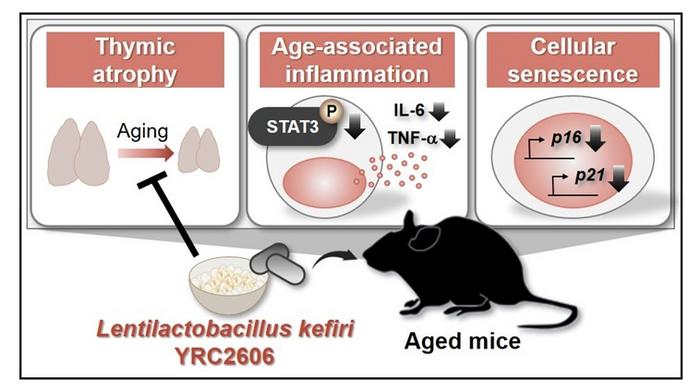
Your immune system doesn’t just weaken with age. It turns destructive, flooding tissues with inflammatory signals that accelerate disease and dismantle the organs meant to protect you. A team in Japan fed aged mice a heat-killed bacterium from kefir for eight weeks and reversed measurable signs of this decline.
The bacterium, Lentilactobacillus kefiri YRC2606, reduced chronic inflammation and restored immune organ health in animals roughly equivalent to humans in their sixties. It was dead—inactivated by heat—meaning it doesn’t need to survive digestion to work.
Immunosenescence is what happens when aging immune cells stop dividing but keep pumping out inflammatory molecules. This creates systemic inflammation tied to cardiovascular disease, neurodegeneration, and cancer. Interleukin-6 activates a protein called STAT3 that sustains the inflammatory loop, and that pathway became the focus of the research published in the Journal of Functional Foods.
The Thymus Started Growing Again
After treatment, mice showed a higher thymus index compared to untreated aged animals. The thymus is an immune organ that withers sharply with age, and its decline is a reliable marker of immune collapse. Researchers at Shinshu University found that YRC2606-treated mice also had lower expression of p16 and p21, two proteins that flag senescent cells.
Blood samples revealed reduced IL-6 and tumor necrosis factor alpha. Phosphorylation of STAT3 was suppressed in immune cells.
The team exposed mouse spleen cells to lipopolysaccharide, a bacterial toxin that triggers inflammation. Cells pretreated with YRC2606 produced far less IL-6. Peptidoglycan from the bacterial cell wall showed similar effects, suggesting this structural component drives the activity.
Another lactic acid bacterium tested as a control did almost nothing. The effect appears strain-specific, likely tied to YRC2606’s particular cell wall composition.
“YRC2606 will be useful for the treatment of age-associated diseases, for example, as an ingredient in functional foods or dietary supplements designed to maintain immune function in older adults,” Hiroka Sasahara, a doctoral student at Shinshu University, explains.
Shelf-Stable, No Refrigeration Required
Because the bacterium is heat-inactivated, it sidesteps stability problems that complicate live probiotic products. Standard dose conversion suggests the mouse intake corresponds to levels already present in some dietary supplements.
Japan has one of the world’s fastest-aging populations. The authors estimate that applying this approach could reduce healthcare costs tied to immune decline, though human trials haven’t started. Fermented milk products have been consumed for generations, but this is the first demonstration that an inactivated kefir strain can regulate the IL-6/STAT3 pathway and reverse thymic atrophy in aged animals.
The researchers are already working with Yotsuba Milk Products to explore commercial applications.