

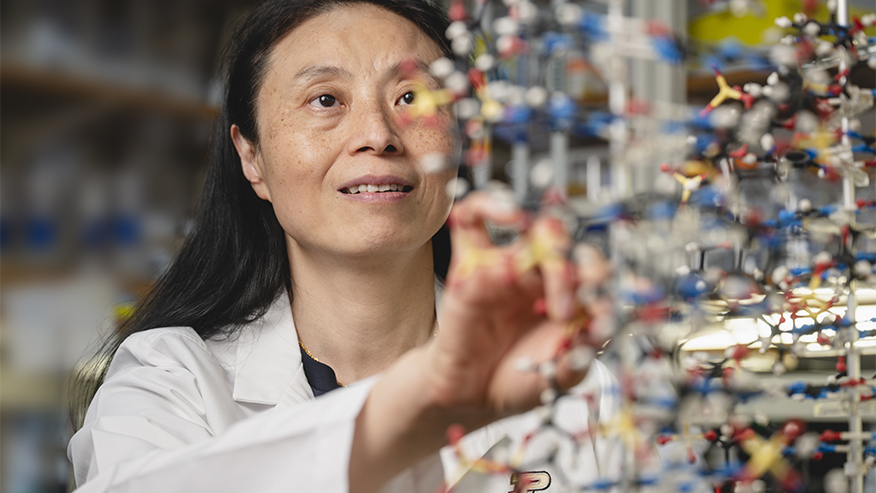
Inside every cancer cell, the MYC gene pushes growth into overdrive. But nature built in a way to hit the brakes. Scientists at Purdue University have now shown, in atomic detail, how a protein called nucleolin latches onto a special DNA knot to slow the runaway gene. Their study, published April 18 in Science, could guide a new class of cancer drugs.
When DNA is copied, parts of it can fold into unusual shapes. One of those shapes is a G-quadruplex, a compact knot formed in stretches rich in the base guanine. In the MYC gene, this knot acts like a natural roadblock, making it harder for the cell’s machinery to keep reading and producing growth signals.
“We think this system evolved naturally in the context of cancer. It’s like a braking system. So now we’re asking, ‘How can we use this for drug discovery?'”
The Purdue team captured the first high-resolution image of this brake in action. Using x-ray crystallography, they found that nucleolin grips the MYC G-quadruplex with four of its domains, like beads wrapping around a knot in string. Each connection is weak on its own, but together they form a very strong hold that stops transcription in its tracks.
The real surprise is how nucleolin binds. Instead of clamping down on the core of the knot, it hooks onto the small loops and dangling ends. That unusual strategy may be a general rule for how proteins recognize these DNA knots, giving researchers a new way to think about gene regulation.
“We can see how this modular protein binds to all four of the loops of the globular DNA G-quadruplex structures, creating a very strong binding.”
For cancer treatment, the implications are direct. MYC drives most blood cancers and many solid tumors, yet has long been considered “undruggable.” The new structure shows how to help nature do the job: stabilize the knot and strengthen nucleolin’s grip. A drug that makes the brake last longer could lower MYC activity enough to slow or stop cancer growth.
The finding also adds a new chapter to basic biology. G-quadruplexes turn up in many genes, not just MYC, and nucleolin seems to prefer these knots across the genome. That means they may act as a broader regulatory system, shaping how our genes are turned on and off.
Still, questions remain. G-quadruplexes are fleeting, and nucleolin has other jobs in the cell. Turning this brake into a safe, lasting therapy will take years of work. But for now, scientists have a detailed map of how the natural brake works, and that map may finally point to a path forward in the long quest to shut down MYC.
Journal: Science, Vol. 388, Issue 6744, April 18, 2025. DOI: 10.1126/science.adr1752