

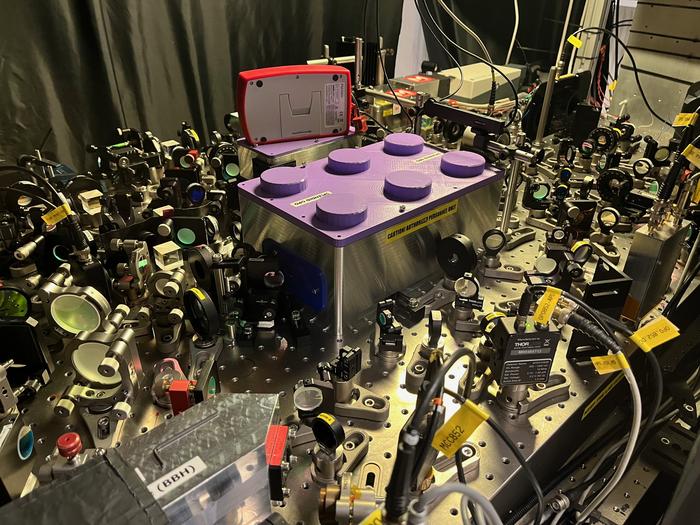
A team at the University of Copenhagen’s Niels Bohr Institute has unveiled a hybrid quantum network that dramatically improves the precision of sensors used in fields from gravitational wave astronomy to biomedical diagnostics.
Their system, published in Nature, leverages entangled light and a tunable atomic spin ensemble to suppress quantum noise across a broad frequency range—pushing sensitivity beyond the so-called standard quantum limit that has long constrained measurement technologies.
How the Quantum Network Works
At the heart of the advance is a clever combination of two quantum tricks: frequency-dependent squeezing of light and a “negative mass” atomic spin system. Squeezed light is engineered so that its quantum noise is reduced in one property (like amplitude or phase), but the Copenhagen team’s approach allows this noise reduction to shift dynamically across frequencies. This is achieved by sending the squeezed light through a cloud of cesium atoms, whose collective spin can be tuned to rotate the phase of the light depending on its frequency.
The atomic spin ensemble can even invert the sign of the noise, enabling the system to simultaneously suppress both the disturbance caused by measurement (back-action noise) and the uncertainty in the measurement itself (detection noise). As Professor Eugene Polzik explains in the study, “The sensor and the spin system interact with two entangled beams of light. After the interaction, the two beams are detected and the detected signals are combined. The result is broadband signal detection beyond the standard quantum limit of sensitivity.”
Why This Matters: Compact, Versatile, and Powerful
Traditional methods for achieving frequency-dependent squeezing—like those used in gravitational wave detectors such as LIGO—require massive, complex optical setups with filter cavities hundreds of meters long. The new system achieves similar performance on a tabletop, opening the door to more practical and widespread use.
- Broadband quantum noise reduction: The system suppresses quantum noise over an octave in the acoustic frequency range, crucial for applications from gravitational wave detection to MRI.
- Flexible wavelength targeting: The entangled light source can be tuned across a wide optical spectrum, making it adaptable to different sensing technologies.
- Compact design: The entire setup fits on a standard laboratory table, unlike the kilometer-scale filter cavities in current observatories.
- Potential for quantum communication: The architecture could be adapted for use in quantum repeaters and quantum memories, enhancing secure long-distance communication.
Key Experimental Details
The researchers generated an Einstein–Podolsky–Rosen (EPR) state of light at two wavelengths: 1,064 nm (signal) and 852 nm (idler). The idler beam interacts with a cesium atomic spin ensemble, which can be tuned to act as a positive or negative mass oscillator. By carefully controlling the magnetic field and the phase of the light, the team demonstrated frequency-dependent conditional squeezing—reducing quantum noise below the shot noise limit across a broad frequency band.
A notable technical achievement, not highlighted in the press release, is the system’s ability to maintain quantum-noise-limited performance down to the gravitational-wave backaction-dominant regime. The 8-cm-long atomic cell used in the experiment provides a phase rotation equivalent to a 5-meter-long optical filter cavity, and with further tuning, this could be extended to 10 meters—an impressive feat for such a compact device.
Looking Ahead: From the Cosmos to the Clinic
The hybrid quantum network’s versatility means it could soon enhance the sensitivity of gravitational wave detectors, allowing scientists to detect fainter signals from cosmic events like black hole mergers. In medicine, it could sharpen the resolution of MRI scans or enable earlier detection of neurological disorders. The system’s architecture also lays the groundwork for advances in quantum communication and distributed quantum sensing.