
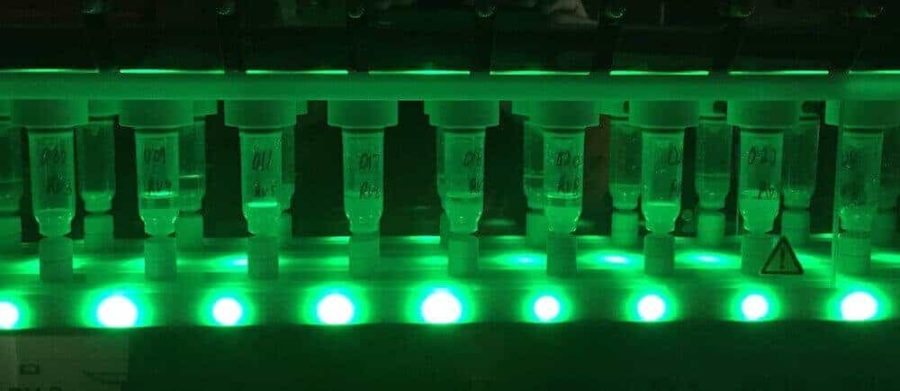
Earlier this year, Berkeley Lab’s Molecular Foundry got a new suite of robotic synthesis tools called the Overture and the Symphony X (pictured above), automated chemical synthesizers that assemble custom molecular structures called peptoids.
Peptoid nanostructures, pioneered at Berkeley Lab, have molecular shapes similar to biological molecules like proteins, but are made with synthetic building units akin to plastics. Ultimately, peptoids could be used to make enzymes, antibodies, or chemical sensors that are more rugged than those that occur naturally, says Ron Zuckermann, senior scientist and facility director of the Biological Nanostructures Facility User Program at the Molecular Foundry.
Zuckermann’s team was responsible for the development of the first robot chemists, precursors to machines like Symphony X; in 1993, he won a patent for the first “automated apparatus for use in peptide synthesis.”
Now, the synthesizers are faster and can produce larger quantities of materials for a growinguser community. Symphony X, for one, can make 24 compounds in parallel. The process of assembling small molecules into larger peptoids, says Zuckermann, is “like threading one bead on a necklace after another—tedious work if you didn’t have robots to do it.”
ScienceBlog.com has no paywalls, no sponsored content, and no agenda beyond getting the science right. Every story here is written to inform, not to impress an advertiser or push a point of view.
Good science journalism takes time — reading the papers, checking the claims, finding researchers who can put findings in context. We do that work because we think it matters.
If you find this site useful, consider supporting it with a donation. Even a few dollars a month helps keep the coverage independent and free for everyone.