
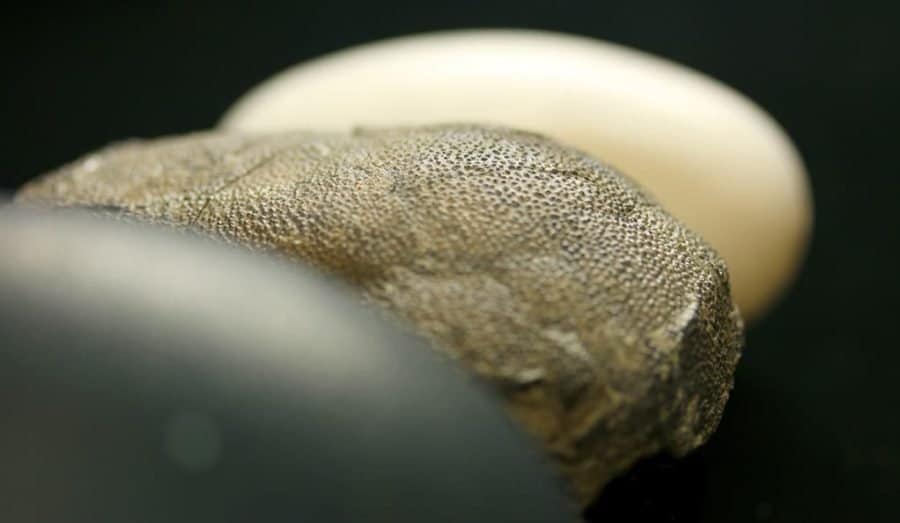
After garnering worldwide attention last year for her research on the origins of egg color in birds, Yale paleontologist Jasmina Wiemann has taken a second look at her eggshells.
Wiemann had found that all colors and spots on modern birds’ eggs derived from a single evolutionary source among dinosaurs. Part of the finding came from an analysis of pigments found in 18 fossil dinosaur eggshell samples from around the world. Wiemann’s team tested for the presence of two eggshell pigments and found them in eggshells belonging to Eumaniraptoran dinosaurs, which include small, carnivorous dinosaurs such as Velociraptor.
But a lingering question within the scientific community had to do with whether pigments found in the shells of dinosaur eggs actually meant the eggs looked different to the naked eye. A certain level of pigment may have existed in the chemical make-up of the shells without manifesting in the outward color of the eggs, some observers noted.
“We demonstrate that our analytical approach actually targets egg color and not only egg pigmentation, as we need substantial concentrations of the red pigment, protoporphyrin, to elicit a positive signal for egg color,” Wiemann said. “The result is the same. Egg color had a single evolutionary origin in eumaniraptorans.”
A previous study by a different research team had analyzed pigmentation in the eggshells of Siamese crocodiles. That study speculated that pigmentation, but not egg color, may have originated with archosaurs (a group that includes dinosaurs, birds, and crocodiles).
“We had the opportunity to directly address their question and test — thanks to the Yale Peabody Museum of Natural History’s egg collection — if there is, indeed, evidence for the red pigment in Siamese crocodile eggshells,” Wiemann said. “We showed that there are no detectable quantities of protoporphyrin in the eggshells of Siamese crocodiles.”
ScienceBlog.com has no paywalls, no sponsored content, and no agenda beyond getting the science right. Every story here is written to inform, not to impress an advertiser or push a point of view.
Good science journalism takes time — reading the papers, checking the claims, finding researchers who can put findings in context. We do that work because we think it matters.
If you find this site useful, consider supporting it with a donation. Even a few dollars a month helps keep the coverage independent and free for everyone.