

Key Takeaways
- Researchers developed HOBIT, an implant that produces biologic drugs continuously by using engineered cells and an oxygen generator.
- This device solves oxygen supply issues that typically limit the effectiveness of implanted cell therapies.
- During tests, HOBIT maintained stable drug levels for three biologics with different half-lives, significantly outperforming traditional methods.
- The project aims to support complex drug regimens for chronic conditions like HIV and diabetes without frequent medication adjustments.
- Future research will test HOBIT in larger animal models and explore its potential for various diseases beyond the initial focus.
Consider what managing HIV looks like on a good day. A pill in the morning, maybe two, taken at roughly the same time so the drug concentration in your blood stays within the narrow window where it actually works. Miss a dose and that window closes. Take one late and you’re back to calculating whether you’ve missed it or doubled up. Now imagine managing that alongside type 2 diabetes, where another drug with a completely different timetable needs to stay at its own steady level in your blood. The pharmaceutical arithmetic of chronic illness is relentless, and for millions of people it never stops. A team of researchers from Northwestern University, Rice University, and Carnegie Mellon University think they may have found a way to make most of it disappear.
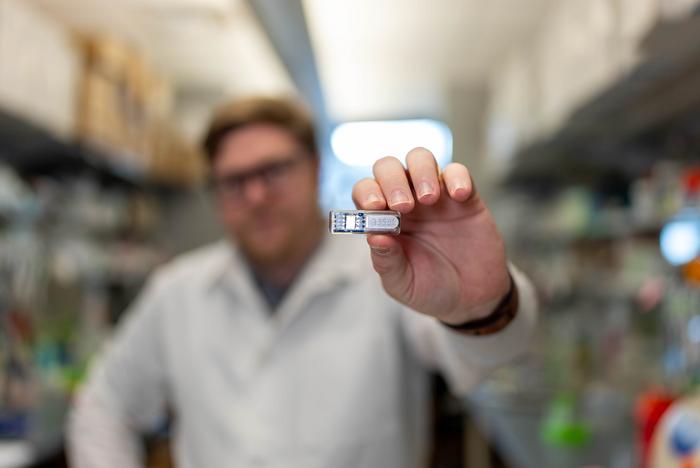
Their device is roughly the size of a folded stick of gum. Implanted under the skin, it contains living cells, engineered to produce biologic drugs continuously, around the clock, without the patient doing anything at all.
The idea of stuffing drug-producing cells into an implant isn’t new, exactly. Cell therapy researchers have been circling the concept for years. The stubborn problem has always been oxygen: pack enough cells together to produce a clinically useful amount of medicine and they start competing for the oxygen they need to survive. Pack them more loosely and the device isn’t producing enough drug to matter. In a low-oxygen environment like the space under the skin, this becomes an almost intractable engineering problem. Most approaches ended up in the same place: the cells died off, the drug levels fell, the experiment ended.
HOBIT (hybrid oxygenation bioelectronics system for implanted therapy) is a small implantable device, roughly the size of a folded stick of gum, that contains living engineered cells capable of producing biologic drugs continuously inside the body. A built-in electrochemical generator splits nearby water molecules to produce oxygen directly at the site of the cells, keeping them alive and productive in the low-oxygen environment under the skin. The device also includes wireless electronics and a battery to regulate oxygen production without any action from the patient.
When large numbers of cells are packed into a small implant, they quickly deplete the oxygen available in surrounding tissue and begin to die. Without a steady oxygen supply, cells that are meant to produce drugs for months or years can become non-functional within days. HOBIT solves this by generating oxygen locally, inside the implant, which allows cells to be packed at densities around six times higher than conventional encapsulation approaches while remaining viable for at least a month in animal testing.
In the proof-of-concept study, researchers engineered cells to produce three different biologics simultaneously: a broadly neutralising anti-HIV antibody, a GLP-1-like peptide used in type 2 diabetes treatment, and leptin, a hormone that regulates appetite and metabolism. These three compounds have quite different half-lives in the bloodstream, making the combination a deliberately challenging test of the platform’s ability to sustain complex drug regimens over time.
The current research is a proof-of-concept study in small animal models, and the team plans to move next to larger animal models before any human trials could be considered. Significant questions remain around battery life and replacement schedules, long-term immune responses, and regulatory pathways for multi-drug implantable devices. The researchers describe their 31-day viability result as a starting point rather than a ceiling, and the timeline to clinical use is likely measured in years rather than months.
The researchers believe the platform is broadly adaptable, because the engineered cells can in principle be programmed to produce a wide range of biologic drugs. Future applications the team has mentioned include transplanted pancreatic cells for diabetes treatment, and the device’s architecture is designed to accommodate different cell types and therapeutic targets. Whether any particular application makes it through development and regulatory approval is a separate question, but the modular design is intended to make the platform flexible across disease areas.
The Northwestern-led team tackled this differently. Rather than trying to coax more oxygen from the surrounding tissue, they built a device that makes its own.
Called HOBIT (hybrid oxygenation bioelectronics system for implanted therapy), the system integrates engineered cells with a miniature electrochemical oxygen generator. The generator splits water molecules nearby to produce oxygen directly inside the implant, where the cells are, rather than relying on diffusion from surrounding tissue. The device also carries its own battery and wireless electronics, which regulate oxygen production and communicate with external hardware. It is, in other words, a self-contained biochemical factory: cells that produce medicines, kept alive by electronics that produce the oxygen those cells need.
The results from animal testing were striking. The team engineered cells to produce three different biologics simultaneously: a broadly neutralising anti-HIV antibody, a GLP-1-like peptide used in type 2 diabetes treatment, and leptin, a hormone that regulates appetite and metabolism. These three compounds have quite different half-lives in the bloodstream, which makes the combination a deliberately hard test. “Traditional biologic drugs often have very different half-lives,” said Jonathan Rivnay, who co-led the project from Northwestern, “so maintaining stable levels of multiple therapies can be challenging.” In animals implanted with HOBIT devices, blood measurements showed all three biologics remained at stable levels throughout a 30-day study period. In animals whose implants lacked the oxygenation system, the shorter-lived molecules became undetectable within a week.
The difference in cell survival was equally clear. By the end of the month, roughly 65 percent of cells in the oxygenated devices were still viable, compared with around 20 percent in the controls. Rivnay and his team believe the reason is straightforward: because the device produces oxygen locally, the cells don’t have to compete for it. The result is that HOBIT can support cell densities about six times higher than conventional encapsulation approaches, which means clinically useful doses can fit in a device small enough to implant with a minimally invasive procedure.
There’s a secondary engineering feat buried in that number. The challenge of keeping cells alive in an implant isn’t just about oxygen supply; it’s about doing so without the device becoming a giant battery that needs constant wired charging or monthly replacement. The HOBIT team appears to have threaded this needle. Their wireless system is designed for power efficiency, though the question of how long the battery lasts in practice, and what the eventual charging or replacement schedule looks like for human patients, remains one of many open questions. The researchers describe the 31-day viability figure as a proof of concept, not a ceiling.
The immune system is another complication. Engineered foreign cells implanted in the body tend to provoke immune reactions, which is partly why the field has spent decades on encapsulation strategies. HOBIT addresses this by housing cells in a protected chamber that shields them from immune attack while still allowing drugs to diffuse out into surrounding tissue. The approach isn’t unique to this device (encapsulation is a standard cell therapy strategy), but integrating it with active oxygen generation in a wireless, battery-powered system is something closer to new territory.
What makes the study particularly interesting is the choice to demonstrate multi-drug delivery rather than single-drug delivery. Most implantable cell therapy research has focused on one biologic, partly because it simplifies the engineering and partly because regulatory approval becomes considerably more complex once you’re delivering multiple compounds from a single device. The HOBIT team’s decision to run three simultaneously, across three different half-lives, reads as a deliberate signal that their platform is designed for complexity rather than around it.
The researchers plan to test the technology next in larger animal models and to explore disease-specific applications, particularly around transplanted pancreatic cells for diabetes treatment. Rivnay has suggested that devices of this kind could eventually function as programmable drug factories inside the body, able to deliver therapeutic regimens too complex to maintain through conventional drug schedules. That’s a long way from a rat study published in a journal, and the team is careful about the language. But the underlying idea, that bioelectronics and cell therapy might eventually converge into something genuinely new, is already being taken seriously by groups beyond this one. DARPA funded part of this work. So did Breakthrough T1D, the type 1 diabetes research organisation. The funders, at least, seem to reckon the gamble is worth taking.
For someone managing three chronic conditions and counting out pills every morning, the mathematics of that gamble probably don’t look very long at all.
DOI / Source: https://doi.org/10.1016/j.device.2026.101106