

There is something unsettling about a glow that appears only when everything else has been subtracted, a residue that persists after every familiar source has been accounted for. And it is this leftover light that now pushes dark matter back into the center of cosmic attention.
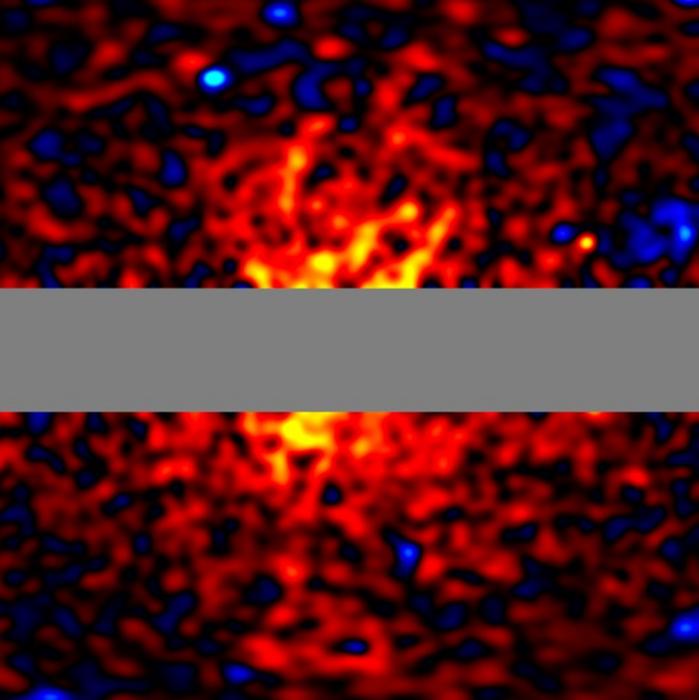
In a new analysis of fifteen years of NASA Fermi Gamma ray Space Telescope data, astronomer Tomonori Totani of the University of Tokyo reports a halo shaped gamma ray excess surrounding the Milky Way, with an unexpected peak near 20 GeV. The work appears in the Journal of Cosmology and Astroparticle Physics and it leans into a possibility that has eluded astrophysics for decades: direct evidence of dark matter annihilation in our own galactic halo.
The study digs into a part of the sky that researchers know is difficult to parse. The region of interest sits above and below the Galactic plane, spanning the inner halo where bright astrophysical backgrounds often drown out subtle signals. Totani modeled every conventional contributor he could, from point sources and cosmic ray interactions to the diffuse structures of Loop I and the Fermi bubbles. After peeling those layers away, he found something unusual. A spherically symmetric emission lingers, strongest around twenty billion electronvolts, fading at lower and higher energies. It is a spectrum that feels oddly tailored and, to Totani, telling.
“We detected gamma rays with a photon energy of 20 gigaelectronvolts (or 20 billion electronvolts, an extremely large amount of energy) extending in a halolike structure toward the center of the Milky Way galaxy. The gamma ray emission component closely matches the shape expected from the dark matter halo,” said Totani.
The match is not only spatial. The energy distribution mirrors what theoretical models expect from the annihilation of weakly interacting massive particles, or WIMPs, particularly those that destroy one another by producing bottom quarks or W bosons. The implied particle mass, around half to nearly one teraelectronvolt, slides neatly into decades of speculation about heavy, slow moving dark matter candidates. The inferred annihilation rate is higher than some canonical limits, especially those derived from dwarf galaxies, but the paper argues that uncertainties in halo density profiles leave room for reconciliation. What emerges is a picture that has just enough structure, and just enough mystery, to prompt attention rather than dismissal.
A Signal That Refuses To Go Away
Signals of this sort have surfaced before, although most have faded under the weight of systematic uncertainties. Totani presses directly on that history by testing the excess against alternative background models, including the standard LAT template that incorporates adaptive patches to track the real sky. The halo component appears anyway, stubborn and sharply peaked. Residual maps look clean, with the spherical morphology persisting across varied modeling approaches. Even when the radial profile softens slightly near the center, the shape remains close to what an NFW style dark matter halo would predict.
That persistence fuels the bolder interpretation, one that Totani does not shy away from. To him, the data are not simply compatible with dark matter annihilation. They may be revealing it outright. The thought lands with a kind of quiet gravity, not because it answers every open question, but because it gestures toward a more direct observational handle on a substance that has so thoroughly defined modern cosmology while keeping its identity concealed.
“If this is correct, to the extent of my knowledge, it would mark the first time humanity has seen dark matter. And it turns out that dark matter is a new particle not included in the current standard model of particle physics. This signifies a major development in astronomy and physics,” said Totani.
The claim is tempered by the necessary caveats. Independent analyses must verify the signal. Other astrophysical explanations, even if presently disfavored, must be ruled out with care. And the ideal test lies in repetition. If dwarf galaxies embedded within the Milky Way halo show the same twenty GeV signature, the argument for WIMP annihilation would sharpen considerably.
Totani leaves that door open. More Fermi LAT data may accumulate. Other instruments may join the hunt. For now, the halo excess stands as a reminder that the universe still offers clues in the narrow energy bands where theory and observation meet. It is a hint, fragile but persistent, that the invisible mass shaping our galaxy may finally be leaving a trace bright enough to follow.
Journal: Journal of Cosmology and Astroparticle Physics
DOI: 10.1088/1475-7516/2025/11/080
