

Scientists have used artificial intelligence to design more than 1,500 materials that can selectively emit heat at different levels, potentially keeping buildings cooler and slashing energy bills.
The machine learning approach, detailed in Nature, represents a major advance in creating custom thermal materials that could be applied like paint to roofs, walls, and even clothing.
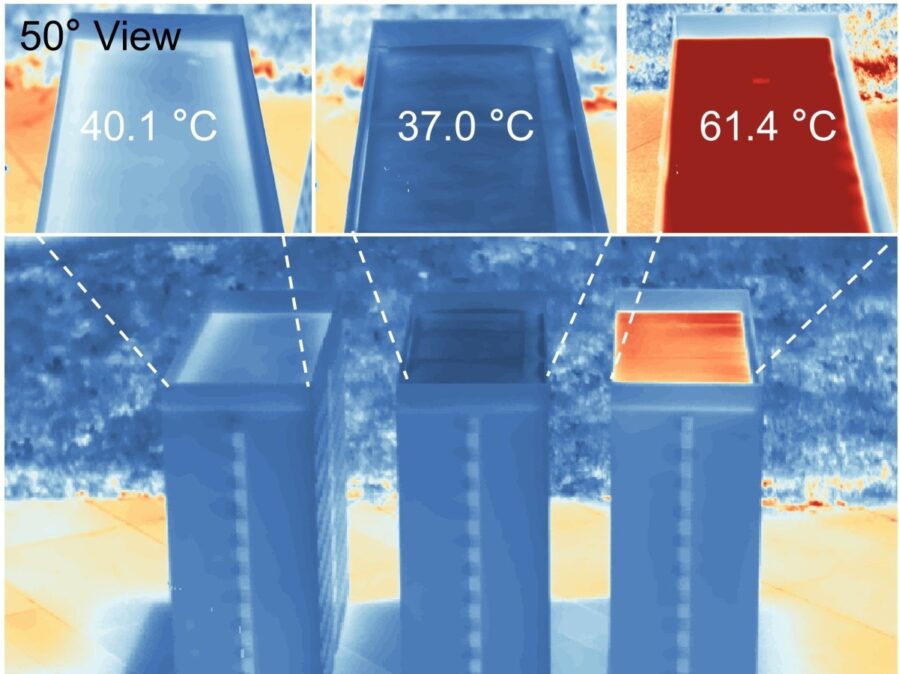
Researchers from the University of Texas at Austin and international partners developed thermal meta-emitters that demonstrated remarkable cooling performance in real-world tests. When applied to model buildings, one material kept roof temperatures 5-20 degrees Celsius cooler than conventional paints after four hours of direct sunlight—cooling that could save 15,800 kilowatt-hours annually in hot climates like Rio de Janeiro.
Beyond Trial and Error
Traditional development of these specialized thermal materials has been painstakingly slow, relying on trial-and-error methods that often produce suboptimal results. The new AI framework changes that by automatically exploring millions of possible combinations of three-dimensional structures and materials to find optimal designs.
Yuebing Zheng, a professor in UT Austin’s mechanical engineering department who co-led the study, emphasized the significance: “Our machine learning framework represents a significant leap forward in the design of thermal meta-emitters. By automating the process and expanding the design space, we can create materials with superior performance that were previously unimaginable.”
The researchers created a comprehensive library of 32 basic three-dimensional structural building blocks inspired by nature—spheres, cylinders, ridges, and triangular prisms—along with 30 different materials. Their AI system can combine these elements in countless ways, generating tens of thousands of unique thermal emitter designs.
Seven Classes of Smart Materials
The team developed seven distinct categories of thermal meta-emitters, each optimized for specific applications:
- Broadband emitters: High heat emission across all infrared wavelengths for above-ambient cooling or space applications
- Band-selective emitters: Targeted emission in specific atmospheric windows for maximum terrestrial cooling efficiency
- Dual-band emitters: Emission in two separate atmospheric windows for enhanced cooling under various conditions
- Thermal camouflage materials: Designed to hide heat signatures for military applications
What makes these materials particularly effective is their ability to reflect sunlight while simultaneously emitting heat at precise infrared wavelengths. This dual action—staying cool in sunlight while actively radiating heat to space—creates powerful cooling effects without requiring electricity.
Real-World Performance
The researchers fabricated and tested four representative materials to validate their AI predictions. The results were striking: measured performance closely matched computer predictions, confirming the accuracy of their machine learning approach.
One band-selective material achieved near-perfect performance with 96% solar reflectivity and 92% emissivity in the optimal atmospheric window. Another broadband emitter maintained over 96% solar reflectance while emitting 92% of absorbed heat across the entire infrared spectrum.
In outdoor cooling tests, the materials maintained temperatures below ambient air even during peak midday sun. Under clear sky conditions, one material achieved a 5.9°C temperature drop at midday. In urban environments with heat radiating from surrounding buildings, a band-selective material outperformed both broadband emitters and commercial white paint.
From Labs to Rooftops
Perhaps most importantly, these materials can be manufactured using simple, room-temperature processes and applied like conventional paint. One formulation involves mixing powdered ingredients into a solution that can be brushed, sprayed, or spin-coated onto various surfaces including metal, glass, plastic, and brick.
The energy savings potential is substantial. Computer simulations of a four-story apartment building in tropical climates showed annual energy savings reaching 75 megajoules per square meter—equivalent to about 15,800 kilowatt-hours for an entire building roof. For context, a typical air conditioning unit consumes about 1,500 kilowatt-hours per year.
Co-author Kan Yao noted the technology’s broader applicability: “Machine learning may not be the solution to everything, but the unique spectral requirements of thermal management make it particularly suitable for designing high-performance thermal emitters.”
Beyond Buildings
The applications extend far beyond building cooling. These materials could be integrated into textiles for better cooling clothing, applied to vehicle surfaces to reduce heat buildup, or used in spacecraft thermal management systems. Urban planners could deploy them to combat the heat island effect that makes cities hotter than surrounding areas.
The AI framework itself represents a significant advance in materials discovery. Traditional optimization methods might generate a few dozen design candidates over months of work. This system produces 2,500 candidates per second, vastly accelerating the discovery process.
The research also revealed underlying physical principles governing thermal emission, with the AI automatically identifying clusters of materials and structures that work best for different wavelength ranges. This knowledge could guide future materials development even beyond thermal applications.
As extreme heat becomes more common due to climate change, materials that can provide passive cooling without electricity consumption become increasingly valuable. These AI-designed thermal emitters offer a glimpse of how machine learning might help solve real-world problems by discovering solutions that human intuition alone might never find.