

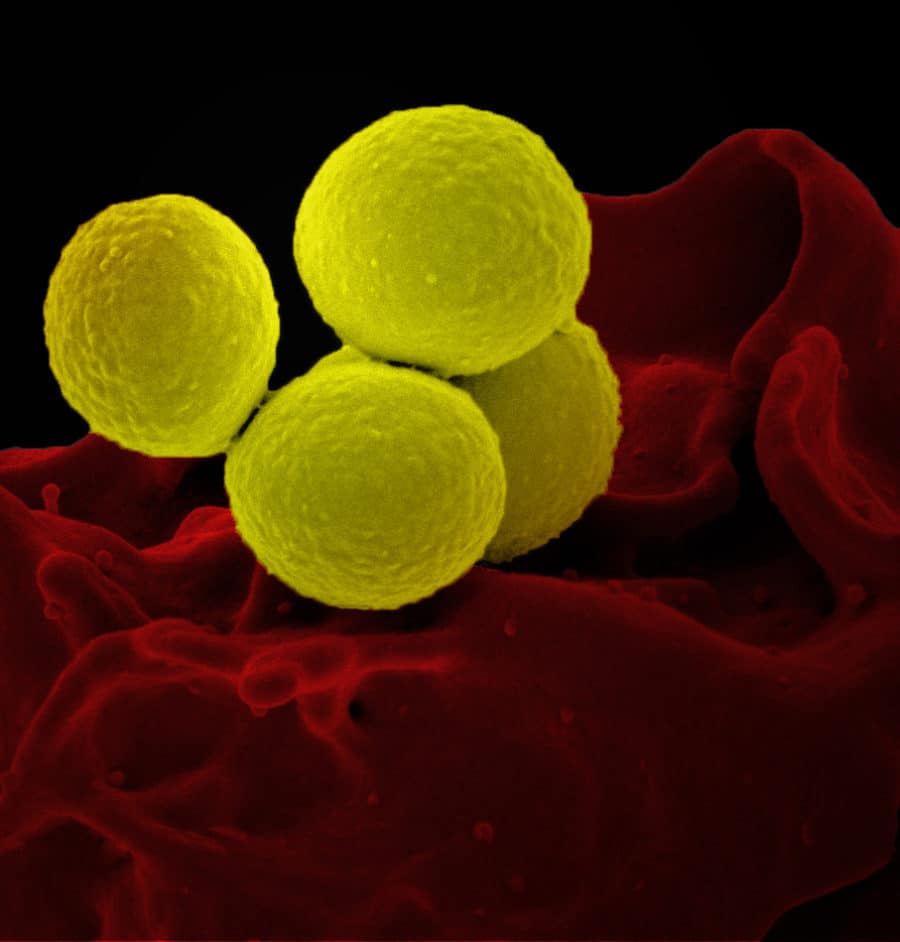
MIT researchers have successfully used artificial intelligence to design entirely new antibiotics that can kill drug-resistant bacteria, including the notorious MRSA superbug and antibiotic-resistant gonorrhea. The breakthrough demonstrates AI’s potential to explore vast chemical territories that human scientists have never ventured into before.
The research team, led by James Collins from MIT’s Institute for Medical Engineering and Science, generated over 36 million theoretical compounds using generative AI algorithms. From this massive digital library, they identified promising candidates that are structurally unlike any existing antibiotics and appear to work through novel mechanisms.
“We’re excited about the new possibilities that this project opens up for antibiotics development,” Collins said in the MIT News release. “Our work shows the power of AI from a drug design standpoint, and enables us to exploit much larger chemical spaces that were previously inaccessible.”
The Growing Crisis of Antibiotic Resistance
The urgency behind this work cannot be overstated. Over the past 45 years, only a few dozen new antibiotics have received FDA approval, and most are merely variations of existing drugs. Meanwhile, bacterial resistance continues to evolve, with drug-resistant infections causing nearly 5 million deaths annually worldwide.
Targeting Gonorrhea with Fragment-Based Design
The MIT team employed two distinct AI approaches in their quest for new antimicrobial compounds. The first method focused on designing molecules to combat Neisseria gonorrhoeae, the bacteria responsible for gonorrhea, which has become increasingly resistant to standard treatments.
Starting with a library of 45 million chemical fragments composed of basic elements like carbon, nitrogen, oxygen, fluorine, chlorine, and sulfur, the researchers used machine-learning models to predict antibacterial activity. After filtering out potentially toxic compounds and those resembling existing antibiotics, they narrowed their focus to about 1 million candidates.
“We wanted to get rid of anything that would look like an existing antibiotic, to help address the antimicrobial resistance crisis in a fundamentally different way,” explained Aarti Krishnan, a postdoc and lead author of the study published in Cell. “By venturing into underexplored areas of chemical space, our goal was to uncover novel mechanisms of action.”
Through computational analysis, the team identified a promising fragment called F1. They then used two generative AI algorithms to build complete molecules around this fragment. The first algorithm, chemically reasonable mutations (CReM), works by systematically adding, replacing, or deleting atoms and chemical groups. The second, F-VAE (fragment-based variational autoencoder), learns from patterns in over 1 million existing molecules to predict how fragments might be naturally modified.
These algorithms generated approximately 7 million candidates, which were then screened computationally for activity against N. gonorrhoeae. The process yielded about 1,000 promising compounds, though only two could actually be synthesized by chemical vendors—a common bottleneck in drug development.
One of these synthesized compounds, named NG1, proved remarkably effective. It successfully killed N. gonorrhoeae both in laboratory cultures and in mouse models of drug-resistant gonorrhea infection. More intriguingly, NG1 appears to work by targeting LptA, a protein involved in bacterial outer membrane synthesis—representing a completely novel approach to killing bacteria.
Unconstrained Design Against MRSA
For their second approach, the researchers took the constraints off entirely. Rather than starting with a specific fragment, they allowed their AI algorithms to freely generate molecules using only the basic rules of chemical bonding. This time, they targeted Staphylococcus aureus, another dangerous pathogen that includes the MRSA superbug.
The unconstrained approach generated over 29 million compounds. After applying similar filtering processes, the team synthesized and tested 22 molecules. Six showed strong activity against multi-drug-resistant S. aureus in laboratory tests, with the top performer, DN1, successfully treating MRSA skin infections in mice.
Unlike NG1’s targeted approach, these compounds appear to disrupt bacterial cell membranes through broader mechanisms, suggesting multiple pathways to bacterial death. This diversity in action could make it harder for bacteria to develop resistance.
Opening New Frontiers in Chemical Space
The implications extend far beyond these two specific compounds. The researchers have essentially created a new platform for antibiotic discovery that can explore chemical territories no human has ever imagined. Traditional drug discovery often relies on screening existing compound libraries or making incremental modifications to known drugs. This AI-powered approach opens access to what scientists call “dark matter” in chemical space, theoretically possible molecules that simply haven’t been discovered or synthesized.
The timing couldn’t be more critical. Gonorrhea has become increasingly difficult to treat, with some strains resistant to all recommended therapies. MRSA remains one of the most dangerous hospital-acquired infections, resistant to methicillin and other beta-lactam antibiotics that once reliably treated staph infections.
Next Steps and Future Applications
Phare Bio, a nonprofit collaborator in MIT’s Antibiotics-AI Project, is now working to optimize both NG1 and DN1 for further testing. The compounds need additional modifications before they can advance to clinical trials, but the proof of concept represents a significant step forward in the fight against antibiotic resistance.
“In a collaboration with Phare Bio, we are exploring analogs, as well as working on advancing the best candidates preclinically, through medicinal chemistry work,” Collins noted. The team is also excited about applying their platform to other dangerous pathogens, including Mycobacterium tuberculosis, which causes tuberculosis, and Pseudomonas aeruginosa, a common cause of hospital-acquired pneumonia.
The research demonstrates that artificial intelligence isn’t just accelerating existing approaches to drug discover. It’s fundamentally changing how scientists think about finding new medicines. By generating millions of never-before-seen compounds and predicting their properties before synthesis, AI allows researchers to explore vast territories of chemical possibility that would take human chemists centuries to map.
As antibiotic resistance continues to outpace drug development, this AI-powered approach offers hope for staying ahead of evolving bacterial threats through genuinely novel therapeutic strategies.