

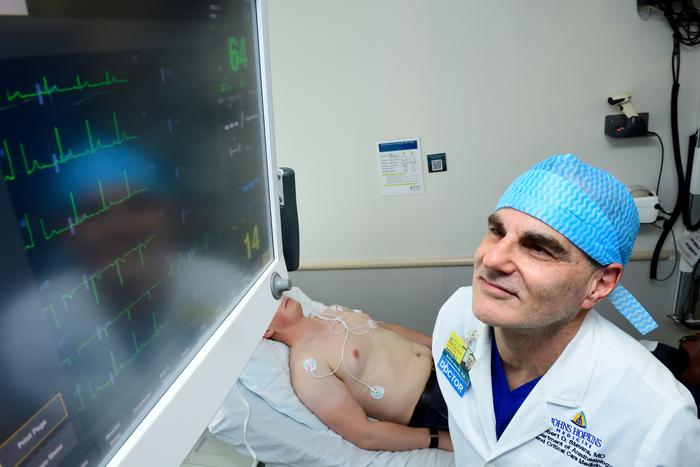
What if a 10-second heart test could tell you whether you’ll survive major surgery? Johns Hopkins researchers have developed an artificial intelligence system that does exactly that, mining hidden patterns from routine electrocardiograms to predict surgical complications with startling accuracy.
The AI model, trained on data from 37,000 patients, achieved 85% accuracy in identifying who would suffer heart attacks, strokes, or death within 30 days of surgery. That’s a dramatic improvement over current risk assessment tools, which doctors get right only about 60% of the time.
Mining Gold From Routine Data
Every patient getting major surgery receives an electrocardiogram, or ECG. It’s standard protocol, measuring the heart’s electrical activity in a matter of seconds. But according to Robert D. Stevens, chief of the Division of Informatics, Integration and Innovation at Johns Hopkins Medicine, these ubiquitous tests contain far more information than meets the eye.
“We demonstrate that a basic electrocardiogram contains important prognostic information not identifiable by the naked eye. We can only extract it with machine learning techniques.”
Stevens and his team suspected the ECG’s squiggly lines captured subtle signs of inflammation, metabolism, fluid balance, and other physiological processes that could predict surgical outcomes. The challenge was teaching a computer to see what human doctors couldn’t.
Working with preoperative ECG data from Beth Israel Deaconess Medical Center in Boston, the researchers trained two different AI models. The first analyzed ECG waveforms alone. The second “fusion” model combined heart rhythm data with 34 other clinical variables like age, gender, and medical history.
Both models outperformed existing risk scores, but the fusion approach proved most powerful. Published today in the British Journal of Anaesthesia, the findings represent a potential paradigm shift in surgical risk assessment.
The 10-Second Crystal Ball
Lead author Carl Harris, a PhD student in biomedical engineering, expressed amazement at the results. The AI could identify specific ECG features associated with post-surgical complications, including prolonged QRS duration, low-voltage complexes, and ST-segment depression.
“Surprising that we can take this routine diagnostic, this 10 second worth of data and predict really well if someone will die after surgery. We have a really meaningful finding that can improve the assessment of surgical risk.”
The implications extend far beyond academic curiosity. Currently, a substantial portion of patients develop life-threatening complications after major surgery, yet doctors lack reliable tools to identify who’s at greatest risk. The new AI system could change those conversations between surgeons and patients.
Stevens envisions a future where ECG results aren’t simply filed away in medical records. Instead, they’d be automatically processed by AI to generate personalized risk assessments, enabling more informed discussions about surgical benefits and dangers.
The technology addresses a critical gap in modern medicine. Despite decades of advances in surgical techniques and monitoring, perioperative risk prediction remains frustratingly imprecise. The Revised Cardiac Risk Index, currently used by doctors, performs only modestly better than chance.
What makes the Hopkins approach particularly compelling is its foundation in routine, inexpensive testing. ECGs cost pennies to perform and require no special preparation. The AI analysis could theoretically be implemented anywhere these tests are already conducted.
The research team used a sophisticated approach called counterfactual analysis to understand which ECG patterns drove their predictions. This explainable AI framework helps build trust by showing doctors exactly why the system flagged particular patients as high-risk.
Looking ahead, the researchers plan to test their model prospectively with patients about to undergo surgery. They’re also curious about what other medical insights might be hiding in ECG data, waiting for AI to uncover them.
Stevens sees this as just the beginning of a transformation in surgical risk assessment. The ability to extract previously invisible prognostic information from routine tests could reshape how medicine approaches one of its most challenging problems: predicting which patients will thrive and which will struggle after major operations.