

Key Takeaways
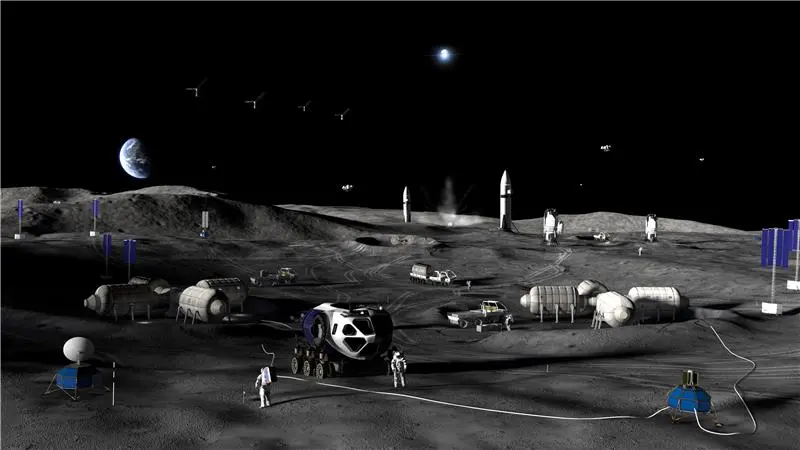
- NASA aims to establish a permanent Moon base through a phased approach starting in 2027, focusing on robotic landers, then semi-habitable infrastructure.
- The agency also plans to launch Space Reactor-1 Freedom, its first nuclear-powered spacecraft to Mars, demonstrating advanced propulsion technology by 2028.
- NASA faces competition from China in lunar ambitions, prompting a focus on both geopolitical and technical achievements in space exploration.
- NASA continues to integrate science missions with engineering, including the Nancy Grace Roman Space Telescope and Dragonfly, aimed at studying dark energy and Titan’s organic chemistry.
- Concerns about the timeline for Artemis III and dependencies on international collaborations highlight potential challenges ahead.
The last human footprints on the Moon are more than fifty years old. Neil Armstrong’s bootprints in the Sea of Tranquility, left in July 1969, remain there today, preserved in the airless cold. Nobody has walked on the lunar surface since December 1972, when Gene Cernan climbed back into the Apollo 17 lunar module and the hatch closed. For half a century, returning to the Moon has been a recurring American ambition, announced, funded, restructured, and eventually cancelled under administration after administration. On Tuesday, at an event NASA called “Ignition,” that pattern was supposed to change. Whether it actually has may depend on something NASA has always struggled with: not engineering, but time.
The announcements were sweeping. A phased lunar base. A nuclear-powered spacecraft en route to Mars before the end of 2028. Up to 30 robotic landers arriving at the lunar surface starting in 2027. And, at the center of it all, a commitment to land astronauts on the Moon and build a permanent human settlement there before the close of the current presidential term.
To understand what that timetable actually means, consider what it requires. A sustained human presence on the Moon involves power systems that can survive the two-week lunar night, habitats capable of withstanding micrometeorite bombardment and radiation levels far higher than those on the International Space Station, pressurized rovers for surface exploration, logistics chains for consumables and spare parts, and telecommunications infrastructure to keep any of it connected to Earth. None of that exists yet. NASA’s plan builds it in three phases, each landing intended to deliver new capability rather than simply repeat the last. Phase one tests mobility, power, and communications using commercial robotic landers, the agency’s CLPS program, and a Lunar Terrain Vehicle. Phase two adds semi-habitable surface infrastructure and incorporates hardware from international partners: a pressurized rover from Japan’s space agency, JAXA, and contributions yet to be confirmed from others. Phase three, when cargo-capable landing systems finally come online, delivers the heavy infrastructure needed for people to stay rather than visit: habitation modules from the Italian Space Agency, a utility vehicle from the Canadian Space Agency, and whatever else the growing coalition of partners can supply.
NASA has outlined a three-phase approach. Phase one focuses on robotic landers and technology demonstrations starting in 2027. Phase two adds semi-habitable infrastructure with international hardware contributions. Phase three, when heavier cargo landing systems come online, delivers the habitat modules and utility vehicles needed for continuous human occupation. The agency has not specified a single target date for when the base would be considered operational.
SR-1 Freedom is NASA’s first nuclear-powered interplanetary spacecraft, planned for launch before the end of 2028. It will use nuclear electric propulsion to travel to Mars, demonstrating a technology that is far more fuel-efficient than chemical rockets over long distances. The mission would also establish the regulatory framework for future nuclear hardware in space, which is considered a prerequisite for crewed missions to Mars and exploration of the outer solar system.
Gateway was designed as a lunar-orbiting outpost to support crewed landings, but the agency has concluded it does not align well with the new priority of establishing surface operations quickly. Rather than scrapping the program entirely, NASA says it will repurpose applicable hardware and redirect international partner contributions toward surface infrastructure that enables more frequent landings.
NASA is exploring a phased approach in which a government-owned core module attaches to the existing International Space Station, followed by commercial modules that gain operational experience while connected to the ISS. Once those modules have demonstrated reliability and market demand has developed, they would detach and operate independently, with NASA becoming one of several customers buying services rather than the sole funder.
Several significant missions are in the pipeline. The Nancy Grace Roman Space Telescope is set to launch as early as fall 2026 to study dark energy. The Dragonfly octocopter launches in 2028 for Saturn’s moon Titan, arriving in 2034 to analyze its organic chemistry. NASA will also deliver the ESA’s Rosalind Franklin rover to Mars in 2028, contributing a mass spectrometer that may conduct the most advanced search for organic molecules ever performed on another planet.
Phased architecture of this kind is sensible. It is also, historically, where ambition and budget begin to diverge.
NASA Administrator Jared Isaacman addressed that tension directly, though not by name. Speaking at the Ignition event, he framed the program not primarily as a scientific or exploratory achievement but as a geopolitical one. “The clock is running in this great-power competition,” he said, “and success or failure will be measured in months, not years.” The subtext does not require decoding. China has made explicit its ambitions for a lunar base, with a target of around 2035 and a track record of largely meeting its stated milestones. For the first time since the original space race, American lunar ambitions are being set against a specific, named competitor with comparable technological capacity and a faster-moving program by some measures. That framing is new. Whether it proves more durable than previous political commitments to Moon exploration remains the genuinely open question.
The agency is also trying to solve a structural problem that has bedeviled space exploration since the shuttle era: the gap between what governments fund and what markets can sustain. In low Earth orbit, the ISS cannot last indefinitely, and the commercial stations meant to replace it have struggled to attract the financing and customer base needed to make them viable without NASA as anchor tenant. The agency’s proposed solution is something of a hybrid: a government-owned core module that attaches to the current station, followed by commercial modules that mature their capabilities in the relatively forgiving environment of ISS proximity before eventually detaching into independent operations. The idea is to build market demand rather than assume it already exists. Whether commercial operators and investors find that framework attractive enough to commit to is the test the RFI released Wednesday, March 25 is designed to answer.
Perhaps the most technically surprising element in Tuesday’s announcements was the least prominently featured. NASA intends to launch Space Reactor-1 Freedom to Mars before the end of 2028, making it the first nuclear-powered interplanetary spacecraft in the agency’s history. Nuclear electric propulsion has been studied, modelled, and proposed for deep-space missions for decades, accumulating a substantial body of theoretical work and a near-complete absence of actual flight hardware. SR-1 Freedom is meant to change that, demonstrating propulsion that is roughly ten times more fuel-efficient than chemical rockets across the journey to Mars, and enabling high-power operations in the outer solar system where solar arrays become progressively less useful. When it arrives at Mars, it will deploy a set of Ingenuity-class helicopters to continue exploring the surface. The flight will also establish the regulatory and launch precedent for nuclear hardware in space, which may ultimately prove as significant as the propulsion itself.
Science is woven throughout the plan, not appended to it. The Nancy Grace Roman Space Telescope launches as early as this fall to probe dark energy and conduct the widest deep-field survey yet attempted. Dragonfly, a nuclear-powered octocopter, launches for Titan in 2028, arriving at Saturn’s largest moon in 2034 to sample its famously complex organic chemistry. NASA will also deliver the European Space Agency’s Rosalind Franklin rover to Mars in 2028, contributing a mass spectrometer for organic molecule detection that could represent the most sensitive search for Martian biochemistry ever conducted. The lunar robotic campaign is designed to serve science simultaneously with engineering: the VIPER rover, delayed for years by various contracting difficulties, and the LuSEE-Night radio telescope experiment among the early manifest, alongside an open call for payloads from universities, research institutes, and international partners that will in effect distribute access to the lunar surface across the scientific community.
There is something genuinely different in the institutional posture NASA described on Tuesday, separate from the specific hardware announcements. The agency is converting thousands of contractor positions back to civil service, embedding technical staff at vendor and subcontractor sites rather than managing from headquarters, and creating pathways for experienced industry engineers to do short stints of government service. Associate Administrator Amit Kshatriya captured the logic bluntly: “Our workforce is the jewel of NASA, and from their leaders, they need clear mission goals, the tools to execute, and to get out of their way.” The implication is that previous NASA programs suffered not from a shortage of talent but from a management structure that had accumulated enough process layers to slow talented people down. That diagnosis is widely shared among former agency engineers. Whether removing those layers is as straightforward as announcing the intention to do so is a different matter.
Some caution is warranted about the Artemis III timeline in particular. The mission, currently scheduled for 2027, has been repositioned as a test of integrated Earth-orbital systems ahead of the Artemis IV lunar landing, rather than a landing in its own right. That is a meaningful change, reflecting genuine engineering realities about the readiness of spacesuits, the human landing system, and life support. The path from Artemis IV to a permanent base involves hardware from at least four international space agencies and a commercial landing system that does not yet exist in its cargo-capable form. Each of those dependencies is a schedule risk. The history of large collaborative space programs is largely a history of those risks compounding.
None of which diminishes what Tuesday represented. The images NASA unveiled, showing Saturn in simultaneous infrared and visible light from the James Webb and Hubble telescopes, were partly symbolic: a reminder of what the agency can do when it has the instruments, the mission clarity, and the time to look. The question now is whether the program described at Ignition will still resemble itself in four years, or whether it will have been restructured once more into something with a different timeline, a different architecture, and a different set of promises about what comes next. The Moon will wait. The bootprints are still there.