

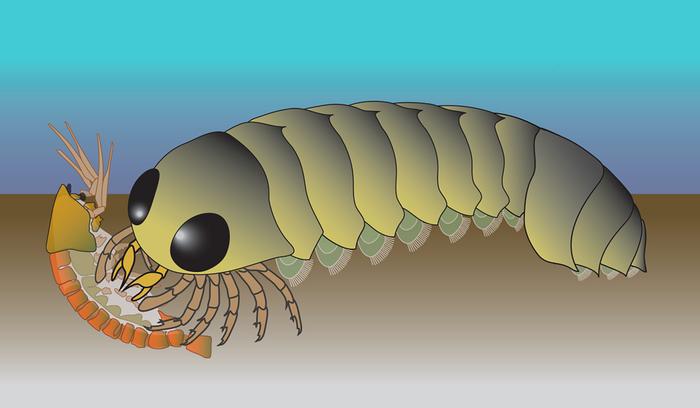
A half-billion-year-old fossil of a tiny marine predator is shaking up long-held assumptions about the origins of spiders and their kin.
According to a new study in Current Biology, the nervous system of Mollisonia symmetrica—a Cambrian-era arthropod—reveals brain features unique to arachnids, suggesting they evolved in the ocean, not on land as previously believed.
The fossil, housed at Harvard’s Museum of Comparative Zoology, preserved rare details of the creature’s brain and nerve cords. These neural patterns matched those found in modern spiders and scorpions, not their traditionally assumed marine relatives like horseshoe crabs. The findings imply that arachnids may have developed their distinctive brain organization in aquatic environments before eventually colonizing land.
Ancient Brain, Modern Clues
Mollisonia had a body plan resembling early chelicerates: a domed headshield, a segmented trunk, and claw-like appendages. But its brain tells a different story. Using light microscopy and statistical comparisons of 115 neural traits across living and fossil arthropods, researchers determined that Mollisonia’s brain was arranged like that of a modern spider—with key cerebral regions flipped in orientation compared to crustaceans, insects, and even horseshoe crabs.
“It’s as if the Limulus-type brain… has been flipped backwards, which is what we see in modern spiders,” explained senior author Nicholas Strausfeld of the University of Arizona.
Key Findings From the Study
– Mollisonia’s brain features include a radiating pattern of ganglia and a reversed sequence of brain regions.
– Its anterior brain region connects to chelicerae—claw-like appendages—similar to spider fangs.
– Phylogenetic analyses place Mollisonia as a close relative of modern arachnids, not horseshoe crabs.
– This supports a marine origin for arachnids before terrestrial adaptation.
Why Brain Arrangement Matters
Co-author Frank Hirth of King’s College London noted that the reversed brain organization likely provided evolutionary advantages: “This is a major step in evolution… likely [conferring] stealth in hunting, rapidity in pursuit, and… dexterity for the spinning of webs.”
Strausfeld added that this neural architecture may also have contributed to arachnids’ extraordinary predatory success, calling the arachnid brain “unlike any other brain on this planet.”
Rewriting the Arachnid Origin Story
Until now, arachnids were thought to have evolved solely after moving onto land. The discovery that their signature brain organization existed in a marine organism from 500 million years ago rewrites this narrative. Mollisonia, and potentially other similar Cambrian arthropods, may have been the aquatic ancestors of today’s spiders, scorpions, and their relatives.
If true, this challenges the idea of a single, land-based origin of arachnids—and raises new questions about how many times these animals transitioned between sea and land.
Journal: Current Biology
DOI: 10.1016/j.cub.2025.06.063