

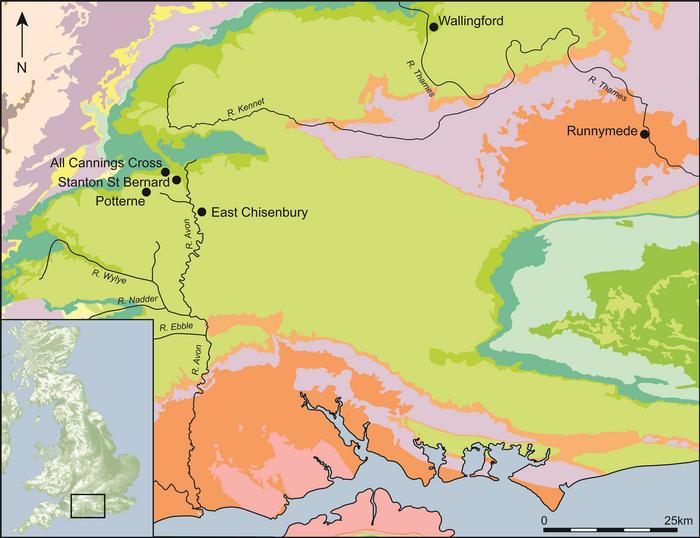
Picture this: massive prehistoric parties where organizers transported pigs from northern England to southern Britain for epic feasting events that attracted thousands of participants. These weren’t simple village celebrations but sophisticated logistical operations requiring coordination across vast territories, and they’re revealing that Bronze Age Europe was far more connected than anyone imagined.
Enormous prehistoric garbage heaps called middens, some covering areas equivalent to five football pitches, contain the remains of these colossal Bronze Age networking events. At Potterne in Wiltshire, archaeologists found evidence of an estimated 15 million bone fragments, testament to feasting on an almost unimaginable scale between 1000 and 500 BCE.
Using cutting-edge isotope analysis, researchers discovered that each geographic region leaves distinct chemical signatures in water and food, which become permanently locked in animal bones. By reading these molecular fingerprints, scientists can trace individual journeys made millennia ago – and the results are stunning.
At Potterne, pork was the meat of choice, with pigs transported from as far as northern England for massive celebrations. Each midden had its own character – Runnymede specialized in cattle drawn from distant regions, while East Chisenbury, just 10 miles from Stonehenge, focused on locally-raised sheep but still drew hundreds of thousands of animals.
The Age of Epic Entertaining
“At a time of climatic and economic instability, people in southern Britain turned to feasting – there was perhaps a feasting age between the Bronze and Iron Age,” explains Richard Madgwick from Cardiff University. These events served as powerful tools for building relationships between communities during turbulent times when bronze’s value was dropping and people were transitioning to iron-based economies.
Carmen Esposito from the University of Bologna, who led the British study, emphasizes the social implications: “We believe this demonstrates that each midden was a lynchpin in the landscape, key to sustaining specific regional economies, expressing identities and sustaining relations between communities during this turbulent period.”
But the feasting evidence represents just one piece of a much larger puzzle revealing Bronze Age Europe as a surprisingly cosmopolitan world. Three groundbreaking studies published this month show that people, animals, and precious metals moved across vast distances, creating networks that stretched from Sardinia to Scandinavia.
Metals and Migrants Tell Ancient Stories
In Germany, elite burial sites around Seddin reveal actual human migration on an extraordinary scale. Researchers analyzing cremated remains from monumental burial mounds discovered that most prestigious individuals buried there weren’t locals at all. Strontium isotope analysis of inner ear bones, which form in early childhood and preserve geographic signatures even after cremation, showed these Bronze Age elites originated from regions as distant as southern Scandinavia, Central Europe, and possibly northern Italy.
“This is reflected in the fact that most buried individuals show a non-local, foreign strontium signature,” notes Kristian Kristiansen from the University of Gothenburg. The findings suggest Seddin functioned as a major international hub between 900 and 700 BCE, attracting elite migrants from across Europe.
Meanwhile, tiny bronze warriors from Sardinia have revealed their own secrets about ancient trade networks. These intricate statuettes called bronzetti, depicting horned-helmet warriors barely four inches tall, were crafted by the Nuraghe culture between 1000 and 800 BCE. Using a revolutionary multi-proxy approach analyzing copper, tin, lead, and osmium isotopes, scientists traced the geographic origins of their raw materials with unprecedented precision.
“The results show that bronzetti was primarily made from copper from Sardinia, sometimes mixed with copper from the Iberian Peninsula,” explains Daniel Berger from the Curt-Engelhorn Center for Archaeometry, who developed the analytical method. Surprisingly, despite having local tin sources, Sardinian metalworkers imported tin from Spain and Portugal, suggesting sophisticated trade preferences rather than simple resource availability.
The connections run even deeper than metal trade. Those distinctive horned helmets adorning Sardinian bronze warriors appear remarkably similar to artifacts found in Denmark and Sweden, hinting at cultural exchanges spanning the entire continent. The resemblance to Scandinavian petroglyphs and the famous Vikso helmets suggests these weren’t coincidental design choices but evidence of shared artistic traditions.
The combined evidence suggests the Late Bronze Age wasn’t a time of cultural isolation but of unprecedented connectivity. Whether through feast logistics transporting English pigs to Wiltshire celebrations, migration patterns bringing foreign elites to German burial grounds, or trade networks moving Spanish tin to Sardinian workshops, Bronze Age Europeans were building relationships and exchanging goods across distances that would challenge even modern organizers.
This research transforms our understanding of prehistoric European society, revealing sophisticated networks that laid the groundwork for classical civilization. The Bronze Age, it turns out, was Europe’s first truly connected age – and it all started with some seriously impressive dinner parties.
Sources
“Multiproxy analysis unwraps origin and fabrication biographies of Sardinian figurines” published in PLOS ONE https://doi.org/10.1371/journal.pone.0328268
“Diverse feasting networks at the end of the Bronze Age in Britain” published in iScience
“A Late Bronze Age foreign elite? Investigating mobility patterns at Seddin, Germany” published in PLOS ONE https://doi.org/10.1371/journal.pone.0330390