

Inside the limestone caves of Sri Lanka’s wet lowlands, tens of thousands of years of human history are compressed into stratified rock and buried bone. At Fa-Hien Lena, a cave site not far from the island’s southwestern coast, archaeologists have spent decades pulling apart layer after careful layer: stone microliths, fragments of animal bone, the occasional human tooth. The picture that emerged, for most of that time, looked like a hunting story. Dense faunal remains, specialised weapons, evidence of people systematically taking small arboreal mammals from the forest canopy. It made sense. Bones preserve. Plant matter, generally speaking, does not.
But the hunting story was probably incomplete. Perhaps badly so.
A study published this week in Nature Ecology and Evolution applies a relatively new geochemical technique to ancient tooth enamel from three of these Sri Lankan caves, and finds something that zooarchaeology alone could never have revealed: that people living in these rainforests were steadily, persistently shifting their diets toward plants, and doing so thousands of years before formal agriculture arrived on the island. Not because they were farming. Just because they were choosing to eat more plants.
The Signal in the Enamel
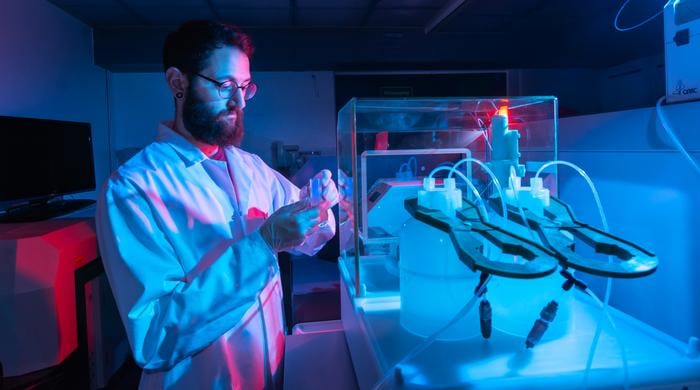
The technique in question is zinc stable isotope analysis, which exploits a quirk of how zinc moves through food webs. As you ascend the trophic ladder from plant to herbivore to omnivore to carnivore, the ratio of heavier to lighter zinc isotopes in tooth enamel shifts in a predictable direction: carnivores end up with lower values, herbivores with higher ones. Tooth enamel, crucially, preserves this signature across archaeological and even palaeontological timescales, even in tropical environments that would dissolve collagen-based evidence within decades or centuries.
Nicolas Bourgon, a postdoctoral researcher at the Max Planck Institute of Geoanthropology and lead author of the study, and his colleagues analysed 24 human specimens and 57 animal samples from Fa-Hien Lena, Batadomba-lena, and Balangoda Kuragala, spanning roughly 20,000 to 3,000 years ago. The dataset covers a remarkable chunk of prehistory: the end of the last glacial maximum, the transition into the Holocene, and the gradual approach of agriculture.
What emerged was a clear pattern. Throughout the entire period, humans occupied an intermediate isotopic position, consistent with omnivory. They were eating animals; no one is disputing that. But there was something else going on. Across those 17 millennia or so, the human zinc isotope values drifted steadily upward, toward the herbivore end of the spectrum. “Our results show that plant use was not a late development linked to farming, but part of a much longer trajectory,” says Bourgon. These rainforest populations, he adds, were already intensifying their plant resource use thousands of years before agriculture appears in the archaeological record.
Importantly, the first confirmed domesticated crops in the region, specifically millet, only show up around 3,000 years ago. The dietary shift the isotopes are recording predates that by something like 10,000 years. Agriculture didn’t create a taste for plants. It seems the taste for plants was already there, already deepening, long before anyone started cultivating them deliberately.
What the Bones Were Hiding
There’s an irony built into the archaeology of diet. The things that get preserved are often the things least likely to tell you the full story. Animal bones survive. So do stone tools and bone weapons. Plant matter, by contrast, rots away in the warm, humid conditions of tropical forests with extraordinary efficiency. The result is that archaeologists digging rainforest sites tend to find evidence that looks predominantly like a hunting economy, because that’s what the physical record retains.
Phytolith evidence from Fa-Hien Lena had already hinted at a richer botanical picture: wild bananas, breadfruit, durian, canarium, various bamboos and palms. Candlenut (also called kekuna) shows up at multiple sites, along with what may be early-processed rice and various molluscs. The zinc isotope data now give these scattered botanical clues some statistical backbone. Plant foods weren’t incidental. They were, the data suggest, a substantial and growing portion of what people were actually eating.
“The Sri Lankan archaeological record provides a rare opportunity to examine long-term human-environment interactions in a tropical setting,” says Dr Oshan Wedage, from the University of Sri Jayewardenepura. The results, he argues, highlight how these local populations adapted their resource use across time, particularly in relation to plant exploitation.
Patrick Roberts, director of the Department of Coevolution of Land Use and Urbanisation at the Max Planck Institute of Geoanthropology, draws the broader lesson. “This study contributes to a growing body of evidence that tropical rainforests were not barriers to human occupation,” he says. They were, rather, places where people developed dynamic subsistence strategies and engaged with their surroundings across very long timescales.
Sri Lanka isn’t alone in this story, though it does offer something the other sites can’t: diachronic resolution, a sequence through time rather than a single snapshot. At Taforalt in Morocco, zinc isotope analysis of Late Pleistocene hunter-gatherers revealed a heavy reliance on plant foods, overturning assumptions of animal-dominated pre-agricultural diets. A roughly 63,000-year-old human individual from Tam Pa Ling in Laos shows isotope values similar to the older end of the Sri Lankan sequence, suggesting that mixed diets with substantial plant components may have been the norm across tropical Southeast Asia for a very long time. The Niah Caves in Borneo, human deposits in the New Guinea highlands, sites across northern Australia and New Guinea: all point to early, deliberate engagement with forest plant resources, including evidence of plant processing, forest clearance, and even transport of plant taxa across elevation zones.
What Sri Lanka adds is the ability to watch this process unfold across millennia. It isn’t a single event. It’s a trajectory. People eating slightly more plants in each successive generation, reorganising how they moved through and used the forest landscape, probably managing plant communities in ways that left no durable physical trace. This makes the eventual arrival of agriculture look rather different: less like a revolution, more like a culmination. A point at which practices that had been building for thousands of years finally crossed some threshold into something recognisably formal.
The technique itself deserves some credit here. Zinc isotope analysis of tooth enamel is still fairly new as a paleodietary tool, and the Sri Lanka study is among the more ambitious applications of it yet attempted, working across multiple sites and a span of nearly 20,000 years. Collagen-based methods, which normally provide trophic information through nitrogen isotopes, almost never survive in tropical contexts. Enamel does. It’s dense, highly mineralised, and stubbornly resistant to the diagenetic processes that destroy softer material. Which means that for tropical prehistory specifically, zinc isotopes may offer a window that no other method can.
What the Sri Lankan foragers were actually doing with all those plants, whether gathering, tending, selectively harvesting, or something approaching cultivation, remains harder to see. But the isotopes establish something important: they were doing something, consistently and increasingly, for a very long time before the first millet farmer appeared. The rainforest, it turns out, was always a larder. People just took a while to figure out quite how full it was.
The study, by Nicolas Bourgon and colleagues, is published in Nature Ecology and Evolution.
Frequently Asked Questions
How can scientists tell what ancient people ate from teeth?
Zinc isotope ratios in tooth enamel shift predictably depending on where in the food web an animal feeds. Carnivores end up with lower zinc isotope values than herbivores, with omnivores falling in between. Because tooth enamel is highly mineralised, it preserves this chemical signature across thousands of years, even in tropical environments where other biological materials like bone collagen rapidly decay.
Why did archaeologists previously think these foragers were mainly hunters?
Because animal bones, stone tools, and bone weapons preserve well in cave deposits, while plant remains almost never survive in warm, humid tropical conditions. The physical record was skewed toward what persisted, not necessarily what was most important to the people who left it. The new zinc isotope evidence helps correct for this taphonomic bias by providing a direct chemical signal from human bodies themselves.
Does this mean these people were already farming?
Not necessarily. The study shows that plant reliance increased steadily long before the first domesticated crops appear in the region around 3,000 years ago. This could reflect intensified gathering, selective management of wild plant communities, or early proto-cultivation. The isotopes capture the dietary shift but cannot distinguish between those specific practices.
Why is Sri Lanka a particularly useful place to study this?
Sri Lanka has an unusually continuous archaeological record of human occupation in tropical rainforests stretching back roughly 48,000 years, across well-stratified cave sites with solid chronological control. This gives researchers what most comparable sites cannot: a long, coherent sequence through time, allowing them to track dietary change across millennia rather than just taking a single snapshot.
What does this finding change about how we understand the origins of agriculture?
It supports models in which farming emerges from longstanding, gradually intensifying foraging practices rather than appearing as a sudden break with the past. The Sri Lankan data suggest that when domesticated crops arrived in the lowland wet zone, populations were already predisposed toward plant-heavy diets built up over thousands of years. Agriculture, in this view, was less a revolution than an endpoint of a very long trajectory.